Telehealth handles psychiatric care by connecting patients with licensed psychiatrists and mental health providers through secure video and audio platforms, replicating the core clinical interactions that make in-person care effective. The American Psychiatric Association confirms that telepsychiatry services cover the full spectrum of psychiatric practice: evaluation, diagnosis, therapy, medication management, and consultation. What makes this work is that most psychiatric assessment relies on verbal communication and behavioral observation rather than physical examination, which means the video screen loses very little of what matters clinically. Regulatory requirements apply just as they do in person, including state licensing based on where the patient is located, HIPAA-compliant technology, and documented patient consent before the first session.
Telepsychiatry at a glance:
Telepsychiatry is not a single delivery method. It spans several distinct modalities, each suited to different clinical situations and patient needs.
Synchronous modalities are the most common. Live video appointments replicate the face-to-face dynamic most closely, allowing the provider to observe facial expressions, affect, and body language in real time. Audio-only calls serve patients who lack reliable video access or who find camera use uncomfortable. The American Psychiatric Association notes that multiple modalities support different clinical needs and patient preferences, and that platforms can combine them within a single care plan.
Asynchronous approaches handle situations where real-time interaction is not required. Store-and-forward methods let patients submit symptom logs, mood trackers, or recorded video updates that a provider reviews and responds to later. Secure messaging through patient portals allows ongoing communication between scheduled appointments, which is particularly useful for medication questions or minor symptom changes. Remote monitoring tools can track sleep patterns, activity levels, or self-reported mood data and feed that information directly into a patient’s chart.
Service types available via telepsychiatry:
Technology requirements for effective delivery include a stable broadband or cellular connection, a device with a working camera and microphone, and a private space where the patient can speak freely. Providers use platforms that meet HIPAA encryption standards; patients do not need to install specialized software in most cases, since browser-based access is now standard.
Pro Tip: Before your first telepsychiatry appointment, test your camera and audio in the platform’s waiting room feature. A two-minute check prevents the most common session disruptions and lets you focus on the conversation rather than the technology.
Licensing requirements follow the patient, not the provider’s home state. A psychiatrist licensed only in California cannot legally treat a patient sitting in Texas, regardless of where the video call originates. Consent documentation must specify the telehealth nature of the service and the patient’s right to request in-person care.
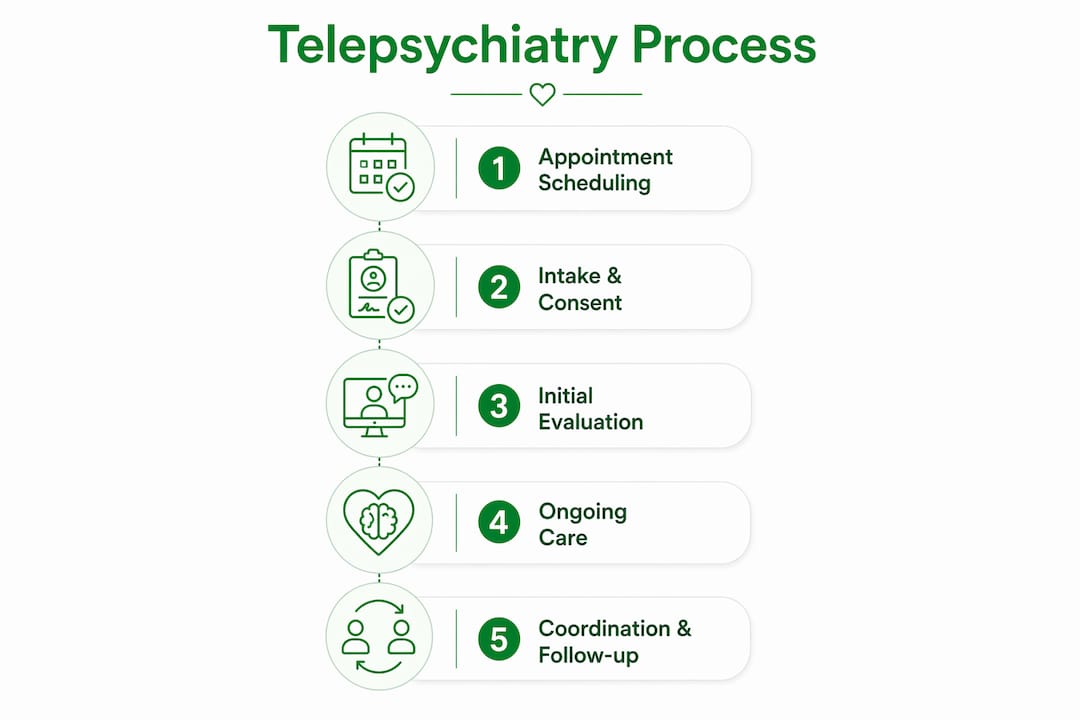
The clinical process in telepsychiatry follows a structured sequence that mirrors office-based psychiatry more closely than most patients expect.
Scheduling and preparation happen through a patient portal or app. Patients complete intake forms, release authorizations, and insurance verification before the first appointment. Many platforms send automated reminders with a direct link to the virtual waiting room, reducing no-show rates. Providers review chart history and prior notes before the session begins, the same pre-visit preparation that happens in a physical office.
Initial evaluations use standardized instruments adapted for video delivery. Validated tools like the PHQ-9 for depression or the GAD-7 for anxiety are administered digitally before the visit, with results available to the provider in real time during the session. Systematic reviews confirm that telepsychiatry is highly effective for diagnostic and symptom assessments because these tasks rely on verbal interaction rather than physical examination.

Ongoing assessment and medication management follow a similar rhythm to in-person care. Providers schedule follow-up visits at clinically appropriate intervals, review symptom changes, and adjust medications as needed. Prescriptions route electronically to the patient’s preferred pharmacy. Controlled substances carry additional federal and state restrictions in telehealth settings, so providers stay current on DEA regulations that govern remote prescribing.
Secure health messaging fills the gaps between scheduled visits. Patients can flag medication side effects, ask clarifying questions, or report worsening symptoms through encrypted portal messages, and providers can respond without scheduling a full appointment. This kind of continuous communication reduces the risk of a patient going weeks without clinical contact during a difficult period.
Crisis intervention protocols in telepsychiatry require specific preparation:
Care team coordination relies on shared electronic health records and secure messaging between providers. A telepsychiatrist consulting on a primary care patient, for example, sends structured notes directly into the referring provider’s system, closing the loop without requiring a phone tag chain.
The evidence on telepsychiatry’s effectiveness is now substantial enough to move past the “promising but unproven” framing that dominated early discussions.
A meta-analysis published in a peer-reviewed psychiatric journal found no significant difference in efficacy between telepsychiatry and in-person care across most psychiatric outcomes. For depressive disorders specifically, some studies show telepsychiatry producing better outcomes than face-to-face treatment, with effect sizes improving as treatment duration increases. Access is the other major win: the American Psychiatric Association documents extensive growth in rural areas, nursing homes, and correctional facilities where in-person psychiatric coverage has historically been scarce or nonexistent.
Key benefits:
Challenges worth knowing:
| Factor | Telepsychiatry | In-person care |
|---|---|---|
| Access in rural areas | Strong | Limited by provider shortage |
| Efficacy for most conditions | Comparable per meta-analysis | Established standard |
| Privacy and confidentiality | Equivalent when HIPAA-compliant tech is used | Established standard |
| Technology dependency | Required | Not required |
| Travel burden | None | Can be significant |
| Crisis management | Protocol-dependent | Easier direct intervention |
Privacy deserves a direct answer rather than a vague reassurance. Research shows that patient satisfaction regarding privacy and care quality in telepsychiatry is comparable to in-person care when providers use proper technology and follow established protocols. The platform matters: a consumer video app does not meet HIPAA standards, but purpose-built telehealth platforms do.
The single biggest predictor of good outcomes in telepsychiatry is not the platform or the modality. It is whether the patient sees the same provider consistently.

Studies show that patients who maintain relationships with the same mental health provider online have lower dropout rates than those rotated through a pool of clinicians. This matters because psychiatric care depends on longitudinal knowledge. A provider who has seen a patient through three medication adjustments and two depressive episodes understands that patient’s baseline in a way that no intake form can replicate. Diagnostic accuracy improves over time with the same provider, and so does the patient’s willingness to disclose difficult symptoms.
How telehealth platforms can support provider continuity:
Trust builds differently in a virtual setting. Without the physical cues of a shared space, the therapeutic relationship depends more heavily on verbal consistency, predictable scheduling, and the provider’s demonstrated memory of prior sessions. Patients who feel their provider actually knows them are more likely to stay engaged, report symptoms honestly, and follow through on treatment plans.
Pro Tip: When evaluating a telehealth mental health service, ask directly whether you will see the same provider at each visit or be assigned to whoever is available. The answer tells you more about the quality of care than any feature list.
The evidence on provider continuity also points to a practical implication for caregivers: if you are coordinating care for a family member, advocate for a named primary provider from the start. Rotating clinicians in a telehealth setting is not a neutral choice. It is a structural decision that affects how well the care actually works.
Telepsychiatry delivers psychiatric care through secure video and audio platforms, with clinical effectiveness comparable to in-person treatment for most conditions, and better outcomes for depression in some studies.
| Point | Details |
|---|---|
| Effectiveness is established | Meta-analysis finds no significant efficacy difference between telepsychiatry and in-person care for most psychiatric outcomes. |
| Depression may benefit more | Some studies show better outcomes for depressive disorders via telepsychiatry, with effect sizes improving over longer treatment. |
| Legal compliance is non-negotiable | Providers must hold a license in the patient’s state; HIPAA-compliant platforms and documented consent are required before care begins. |
| Provider continuity drives retention | Patients who see the same telehealth provider consistently show lower dropout rates than those rotated through a clinician pool. |
| Access expands meaningfully | Telepsychiatry reaches rural areas, nursing homes, and correctional facilities where in-person psychiatric coverage is historically limited. |

AM Rx connects you with experienced mental health providers through secure video visits, same-day appointments, and a care model built around seeing the same provider consistently. Whether you are managing depression, anxiety, or another psychiatric condition, the process starts with a straightforward intake and a provider matched to your needs.
Start your mental health visit with AM Rx and get care that fits your life, not your commute.