Secure health messaging is defined as the exchange of protected health information between patients and providers through encrypted, HIPAA-compliant platforms that prevent unauthorized access. The role of secure health messaging goes far beyond convenience. It forms the backbone of modern clinical communication, protecting sensitive data while keeping care teams connected and patients informed. Regulatory standards like HIPAA set the legal floor, but the real value shows up in faster diagnoses, better chronic disease management, and patients who actually stay engaged with their care.
HIPAA requires healthcare organizations to implement administrative, technical, and physical safeguards whenever protected health information moves between parties. Secure messaging platforms meet this standard through end-to-end encryption, audit logging, and role-based access controls. These are not optional features. They are the minimum technical baseline for HIPAA-compliant messaging.
Business Associate Agreements, known as BAAs, are a legal requirement when a third-party vendor handles patient data. Any platform a healthcare organization uses for clinical communication must have a signed BAA in place. Without one, the organization bears full liability for any breach that occurs through that vendor.

Consumer apps like standard SMS, WhatsApp, and personal email fail every one of these requirements. They lack encryption at rest, provide no audit trail, and offer no access controls tied to clinical roles. Healthcare experts recommend using healthcare-grade platforms specifically because consumer tools create compliance gaps that regulators treat as violations, not oversights.
Pro Tip: Before selecting any messaging platform, verify that the vendor will sign a BAA and that the platform supports audit logging. If a vendor declines to sign a BAA, that is a disqualifying factor regardless of other features.
Key technical safeguards every compliant platform must include:
Secure healthcare communication does more than protect data. It actively improves clinical outcomes. Secure messaging combined with web-based care management produces measurable improvements in glucose outcomes and patient satisfaction among patients with diabetes. That finding matters because diabetes management depends on frequent, low-friction communication between patients and their care teams.
Care coordination across specialties also improves significantly with compliant messaging. A primary care physician can send a secure referral note to a cardiologist, attach relevant lab results, and receive a response within minutes rather than days. That speed reduces the risk of patients falling through the gaps between providers.
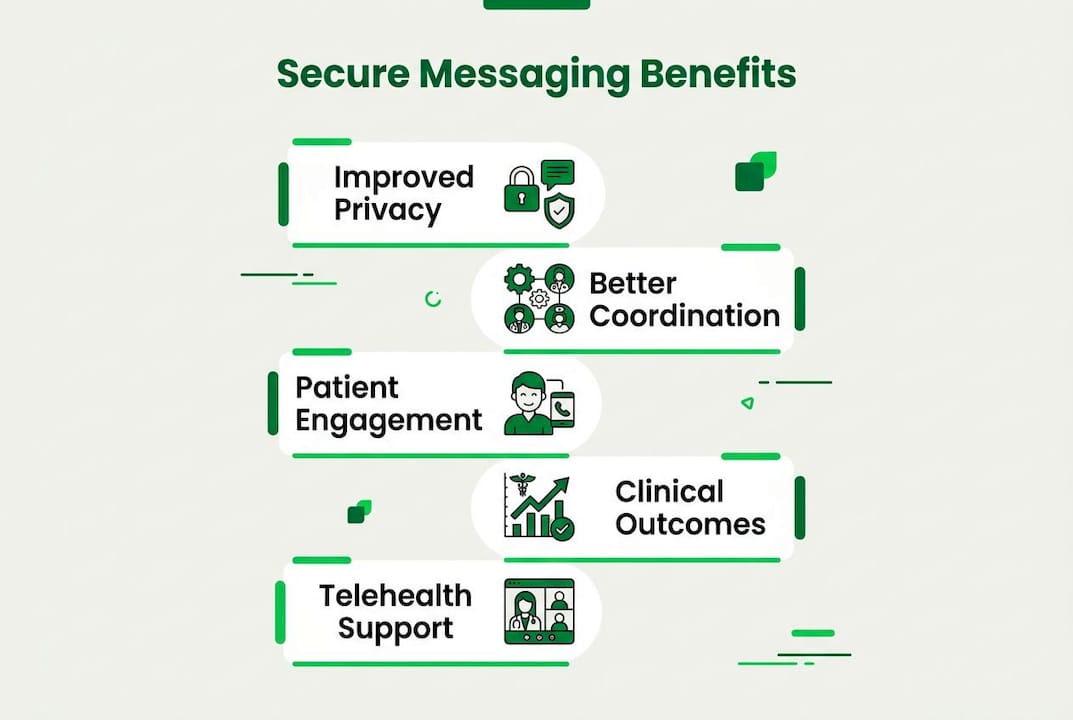
The benefits of secure messaging extend to billing as well. CMS introduced billing codes for clinician time spent on patient portal messages involving medical decision-making over five minutes within a seven-day period. This change means providers can now be compensated for the time they spend managing patient messages, which removes a long-standing financial disincentive to using secure channels.
Key benefits that secure messaging delivers across care settings:
The importance of health messaging becomes clearest in telehealth settings. When a patient consults a provider via video and then needs a follow-up question answered, a secure message thread keeps that conversation in one place, documented, and accessible to the full care team.
Selecting the right platform is the first decision, and it carries the most weight. Healthcare organizations need platforms built specifically for clinical use, not adapted from consumer products. Text-based clinical orders are permitted by CMS only when sent through HIPAA-compliant secure platforms and promptly documented in the electronic health record with proper authentication. That requirement rules out any platform that cannot integrate with an EHR.
Shadow IT is the single largest compliance risk most organizations face. Over 60% of healthcare workers use unauthorized consumer apps occasionally for clinical communication. Each instance creates a potential HIPAA violation and a data breach exposure. The solution is not punishment. It is making the compliant option easier to use than the non-compliant one.
Integration with the EHR is non-negotiable for sustainable adoption. When providers must toggle between a messaging app and the patient record, they skip documentation steps. When messaging is embedded in the EHR workflow, documentation happens naturally.
Pro Tip: Assign a compliance officer or designated team member to review messaging audit logs quarterly. Patterns of non-compliant behavior show up in logs before they become reportable incidents.
The technical side of secure messaging gets most of the attention, but how messages are written determines whether patients act on them. Dynamic framing of health information increases engagement and prevention intentions compared to static messaging, based on a study of 322 participants. Dynamic framing means tailoring the message to the patient’s current situation, values, and readiness to act rather than sending the same generic reminder to everyone.
The BE-COMMS behavioral framework identifies three factors that determine whether a health message drives behavior change: motivation, capability, and opportunity. A message that addresses all three is far more effective than one that simply states a fact. Telling a patient their A1C is elevated is a fact. Telling them what one specific change this week could do to lower it addresses motivation and capability at the same time.
Motivational factors are frequently overlooked in healthcare communication strategies, even though they are the primary driver of behavior change. A technically secure message that patients ignore produces no clinical benefit.
Practical framing strategies that improve patient response rates:
The impact of secure messaging on patient outcomes depends as much on communication quality as on technical compliance. Both matter equally.
Secure health messaging protects patient data, supports clinical compliance, and improves outcomes only when platforms meet HIPAA standards and messages are written to drive real patient action.
| Point | Details |
|---|---|
| HIPAA compliance is non-negotiable | Every platform must include encryption, audit logging, role-based access, and a signed BAA. |
| Shadow IT is the top compliance risk | Over 60% of healthcare workers use unauthorized apps; compliant tools must be easier to use than consumer alternatives. |
| Secure messaging improves outcomes | Patients with diabetes show measurable glucose improvements when care includes secure web-based messaging. |
| CMS now reimburses message time | Billing codes exist for clinician time on patient portal messages exceeding five minutes within seven days. |
| Message framing drives engagement | Dynamic, personalized framing increases patient action compared to static, generic health reminders. |
The conversation about confidential patient messaging almost always starts with technology. Which platform? Which encryption standard? Which EHR integration? Those are real questions, but they are the second conversation, not the first.
The organizations that get secure messaging right start with behavior. They ask why clinicians reach for their personal phones instead of the approved platform. The answer is almost always speed and friction. The compliant tool takes three extra steps. The personal phone is already in their hand. Until the compliant option is genuinely faster and easier, no policy will fully close the gap.
The future of this field points toward quantum-resilient encryption as the next technical frontier. Current encryption standards will eventually be vulnerable to quantum computing attacks. Healthcare organizations that wait for a breach to upgrade will face consequences that dwarf today’s HIPAA penalties.
What I find most encouraging is the shift toward patient-centered messaging design. Providers are starting to treat the message itself as a clinical tool, not just a delivery mechanism. When a well-framed message prevents an unnecessary ER visit, that is a measurable outcome. The organizations that connect message quality to clinical metrics will pull ahead of those that treat secure messaging as a compliance checkbox.
The telehealth consent process is one area where this thinking is already showing up in practice. Patients who understand what they are consenting to engage more fully with their care. That starts with how the message is written, not just where it is sent.
— Bryan
Getamrx builds its entire care model around the principle that patients deserve both convenience and privacy. Every interaction on the platform, from video consultations to prescription follow-ups, operates within a framework designed to meet telehealth compliance standards.

Patients managing weight loss, mental health, or primary care needs through Getamrx communicate with licensed providers through channels that protect their information at every step. The telehealth consent process is clear, documented, and built to meet regulatory requirements without creating friction for patients. If you are looking for a virtual care experience where secure communication is standard practice rather than an afterthought, Getamrx is worth exploring.
Secure health messaging is the exchange of protected health information through encrypted, HIPAA-compliant platforms that include audit logging, role-based access, and signed Business Associate Agreements. It differs from standard SMS or consumer apps, which lack these safeguards.
Standard SMS lacks encryption at rest, provides no audit trail, and has no access controls tied to clinical roles. CMS permits text-based clinical orders only when sent through HIPAA-compliant platforms and documented in the EHR with proper authentication.
Secure messaging combined with web-based care management produces measurable improvements in glucose control and patient satisfaction among patients with diabetes. Faster, documented communication between patients and providers reduces gaps in chronic disease management.
Shadow IT refers to clinicians using unauthorized consumer apps for clinical communication outside approved channels. Over 60% of healthcare workers use these apps occasionally, creating HIPAA violations and data breach exposure that organizations may not detect until an audit or incident occurs.
Yes. CMS introduced billing codes that apply when a clinician spends more than five minutes on patient portal messages involving medical decision-making within a seven-day period. This change allows providers to be compensated for asynchronous patient communication.