Affordable mental health care online is defined as licensed therapy, psychiatry, and counseling delivered via video, phone, or messaging at a lower cost than traditional in-person visits. Online therapy sessions typically cost between $60 and $100 per session, compared to $120 to $250 for in-person appointments. That gap matters enormously for people managing tight budgets. The Mental Health Parity and Addiction Equity Act requires most health plans to cover mental health services at the same level as physical health, which means telehealth mental health benefits are now a legal right for millions of Americans. This guide walks you through every option, cost factor, and practical step to get quality care without overpaying.
Online mental health care covers far more ground than most people realize. The main service categories include individual therapy, couples counseling, group therapy, psychiatric evaluation, medication management, and self-guided digital programs. Each one carries a different price point and serves a different need.
Individual therapy is the most common starting point. A licensed therapist meets with you one on one via video or phone, typically once a week. Couples and family counseling follows the same format but includes more than one person per session, which sometimes raises the per-session cost slightly. Group therapy is the most budget-friendly live option because the therapist’s time is split across several participants, bringing costs down considerably.

Psychiatric services through telehealth allow a licensed psychiatrist or psychiatric nurse practitioner to evaluate your symptoms and, when appropriate, request mental health prescriptions online. This is a major advantage for people who need medication management but cannot access an in-person psychiatrist due to cost or geography.
Self-guided programs and mental health apps sit at the lowest price tier. These tools use structured exercises based on cognitive behavioral therapy (CBT) techniques and are best suited for mild anxiety or stress. They are not a replacement for clinical care, but they work well as a supplement.
Pro Tip: Before paying out of pocket, call your HR department and ask specifically whether your Employee Assistance Program covers telehealth therapy. Many people never use this benefit simply because they did not know it existed.
Cost is the number one barrier people cite when avoiding mental health care. The good news is that the online model has broken that barrier for most budgets.
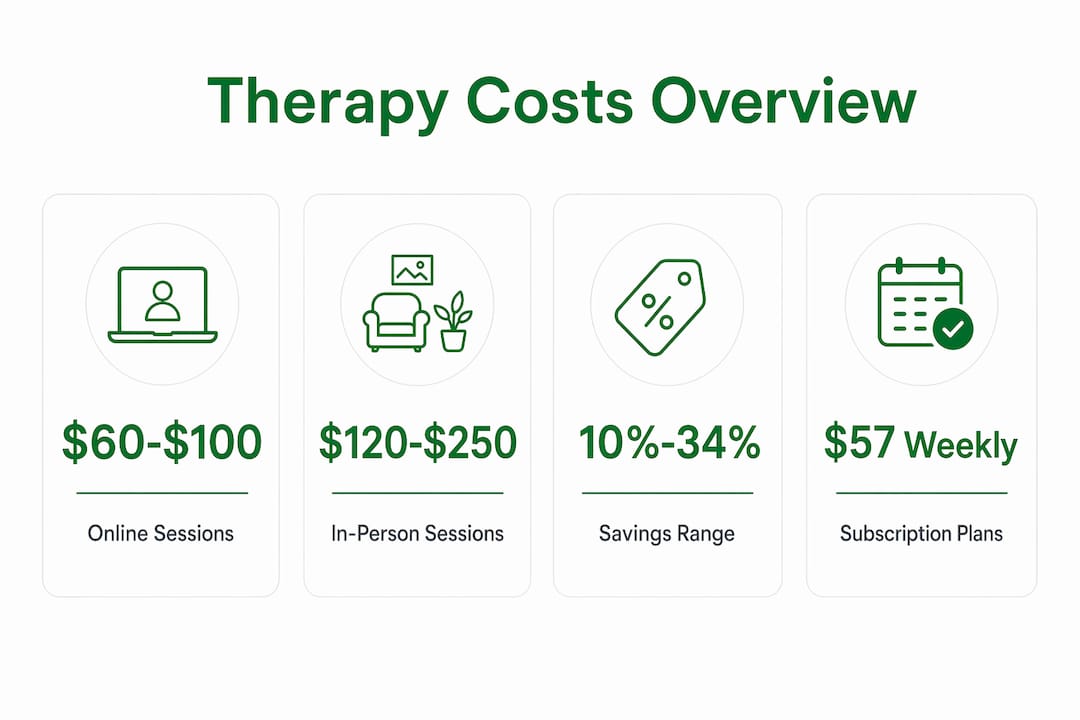
Online therapy runs roughly 10% to 34% less than in-person care on average. Self-pay telehealth rates at credible providers often land around $75 for follow-up sessions and $100 for an initial visit. That is a meaningful difference from the $120 to $250 charged by most in-person practices, especially when you factor in travel time and parking.
| Service type | Typical cost range | Key factor |
|---|---|---|
| In-person therapy | $120 to $250 per session | Location, clinician credentials |
| Online individual therapy | $60 to $100 per session | Platform, session length |
| Subscription therapy plans | From $57 per week | Frequency, platform |
| Sliding scale therapy | $15 to $90 per session | Income and household expenses |
| Self-guided app programs | $0 to $30 per month | Features, clinical backing |
Several factors push prices up or down. Clinician credentials matter: a licensed clinical social worker (LCSW) typically charges less than a licensed psychologist (PhD or PsyD). Session length also affects cost, with 45-minute sessions priced lower than 60-minute ones. Geographic location influences in-person rates significantly, but online care largely erases that gap since you can see a provider licensed in your state regardless of where they physically sit.
Insurance coverage changes the math entirely. When your plan covers telehealth mental health services under the Mental Health Parity and Addiction Equity Act, you pay only your copay, which often falls between $10 and $40 per session. Telehealth coverage varies by plan, so verifying your specific benefits before booking is the single most important cost-saving step you can take.
Subscription-based plans starting around $57 weekly offer a predictable structure for people who want ongoing care without surprise bills. That predictability helps people stick with treatment long enough to see real results.
Finding low-cost online therapy is a process, not a single search. Following a clear sequence saves both time and money.
Check your insurance benefits first. Call the member services number on your insurance card and ask three specific questions: Does my plan cover telehealth mental health services? What is my copay per session? Are there session limits per year? Write down the answers and the representative’s name.
Search for in-network providers. Your insurer’s website has a provider directory. Filter for telehealth-capable therapists or psychiatrists. In-network providers cost far less than out-of-network ones, even with a good plan.
Ask about self-pay rates. If you are uninsured or your plan has poor mental health coverage, ask providers directly for their self-pay price. Many offer a lower cash rate that is not advertised publicly.
Use your Employee Assistance Program. 73% of employers now offer virtual mental health access through EAPs. These programs typically cover three to eight free sessions per issue per year. That is enough to address many short-term concerns at zero cost to you.
Look for sliding scale clinics. Search for community mental health centers or nonprofit counseling practices in your state. Many use a sliding scale model where your fee is calculated based on your income and household size.
Verify provider credentials. Confirm that any therapist or psychiatrist you consider holds a current license in your state. Most state licensing boards have free online lookup tools. A licensed provider is non-negotiable, regardless of price.
Compare pricing transparency. Reputable telehealth platforms list their fees clearly before you sign up. If a platform requires you to enter payment information before showing you the cost, that is a red flag.
Pro Tip: If you are seeing a therapist out of pocket, ask for a “superbill” after each session. This is an itemized receipt with billing codes that you can submit to your insurance company for partial reimbursement, even if the provider is out of network.
The most common mistake is assuming your insurance covers all telehealth mental health services equally. Coverage is not uniform. Patients must verify copays, session limits, and specific provider networks before booking, or they risk unexpected bills.
Hidden fees are the second major pitfall. Some subscription platforms advertise a low weekly rate but charge separately for psychiatric services, messaging between sessions, or prescription management. Read the full pricing page, not just the headline number.
“The biggest financial mistake people make with online therapy is skipping the insurance verification step. One phone call to your insurer can save hundreds of dollars over a few months of treatment.”
Choosing an unlicensed provider to save money is a serious risk. Unlicensed coaches or wellness advisors can provide peer support, but they cannot diagnose conditions, prescribe medication, or deliver clinical therapy. The cost savings are not worth the gap in care quality.
Affordable mental health care online is most accessible when you verify insurance benefits, use employer programs, and choose licensed providers with transparent pricing.
| Point | Details |
|---|---|
| Online therapy costs less | Sessions run $60 to $100 online versus $120 to $250 in person. |
| Parity law protects you | The Mental Health Parity and Addiction Equity Act requires equal coverage for mental and physical health. |
| EAPs offer free sessions | 73% of employers provide virtual mental health access, often at no cost to you. |
| Sliding scale fees go low | Income-based fees can drop to $15 per session at qualifying providers. |
| Credential verification is required | Always confirm a provider’s state license before your first appointment. |
The conversation around mental health affordability has shifted more in the past three years than in the previous decade. Policy changes, expanded telehealth infrastructure, and genuine market competition have pushed prices down and quality up. That is not a trend. It is a structural change.
What I find most underused is the EAP benefit. People leave free therapy sessions on the table every year because they assume EAPs are only for crisis situations. They are not. You can use EAP sessions for anxiety, relationship stress, work burnout, or any concern you want to address. Starting there costs you nothing and often connects you with a licensed therapist who can refer you to longer-term care if needed.
The other thing worth saying plainly: online therapy is as effective as in-person therapy for most mental health concerns. The research on this is consistent. The idea that virtual care is somehow second-tier is outdated and, frankly, keeps people from getting help they could access today. Quality care is about the clinician and the fit, not the room you sit in.
My honest advice is to stop waiting for the “right time” to afford mental health care. Start with what is free or low cost, verify your benefits, and build from there. The options in 2026 are better than most people know.
— Bryan
Getamrx provides licensed mental health providers through a fully virtual platform, with same-day appointments and transparent pricing before you book. The service accepts major insurance plans and handles coverage verification directly, so you are not left guessing about your costs.

Getamrx’s mental health services cover therapy consultations, psychiatric evaluation, and medication management, all accessible from home. Providers are licensed, credentialed, and experienced in treating anxiety, depression, and related conditions. If you are ready to get started, explore mental health care through Getamrx and book your first appointment today. For full details on what telehealth care involves, review the telehealth consent information before your visit.
Self-pay online therapy typically costs between $60 and $100 per session, with some credible providers charging $75 for follow-up visits and $100 for an initial evaluation.
Most health plans are required to cover telehealth mental health services under the Mental Health Parity and Addiction Equity Act, but copays, session limits, and provider networks vary by plan. Always call your insurer to confirm your specific benefits before booking.
Sliding scale therapy adjusts the session fee based on your income and household expenses. Fees can drop as low as $15 per session at qualifying nonprofit or community-based providers.
Yes. Licensed psychiatrists and psychiatric nurse practitioners can evaluate your symptoms and prescribe medication through telehealth platforms, including services like Getamrx, where you can request a mental health prescription online after a clinical consultation.
Research shows online therapy is generally as effective as in-person therapy for most mental health conditions, including anxiety and depression, with many patients reporting greater comfort and consistency when attending sessions from home.