Provider continuity in mental health care is defined as a patient’s consistent engagement with the same clinician or care team over time, and research shows it directly improves clinical outcomes. The role of provider continuity in mental health extends beyond comfort. It shapes how fast patients recover, how often they end up in the emergency room, and how much trust they place in the care system. The World Health Organization and NICE both recognize continuity of care as a core quality standard in mental health services. Patients who maintain stable provider relationships show faster symptom improvement, fewer hospitalizations, and higher satisfaction with their care.
The clinical case for provider continuity is strong and growing. Patients matched to therapists based on historical continuity data improve 8.5% faster in depression symptoms compared to patients who self-select providers. That gap is not trivial. In a study of 24,303 participants, matched patients also showed higher odds of reliable clinical change across depression, anxiety, and PTSD.

The financial case is equally clear. Data-driven matching reduces total cost of care by 12.9% per clinical recovery in mental health treatment. Lower cost per recovery means health systems can serve more patients with the same resources.
Provider continuity also keeps patients out of hospitals. Higher primary care provider continuity reduces hospitalization risk by 5.5% to 6.8% and cuts emergency department visits by 4.9% to 6.3%. Those numbers come from Medicare data across 4,940 medical practices, which makes them population-level findings, not outliers.
Patient complaints tell the same story from a different angle. A 10% increase in patients unable to see their preferred provider raises formal complaints by 1.34 per 10,000 patients. That rise in complaints happens largely independent of unmet clinical needs. The loss of the relationship itself drives dissatisfaction.
Key benefits of provider continuity at a glance:
Pro Tip: If you are a clinician managing a caseload, track which patients have seen three or more different providers in the past year. Those patients carry the highest risk of disengagement and are the strongest candidates for proactive continuity planning.
Continuity of care in mental health operates across three distinct but connected dimensions. Understanding all three helps clinicians and patients identify where gaps are most likely to form.
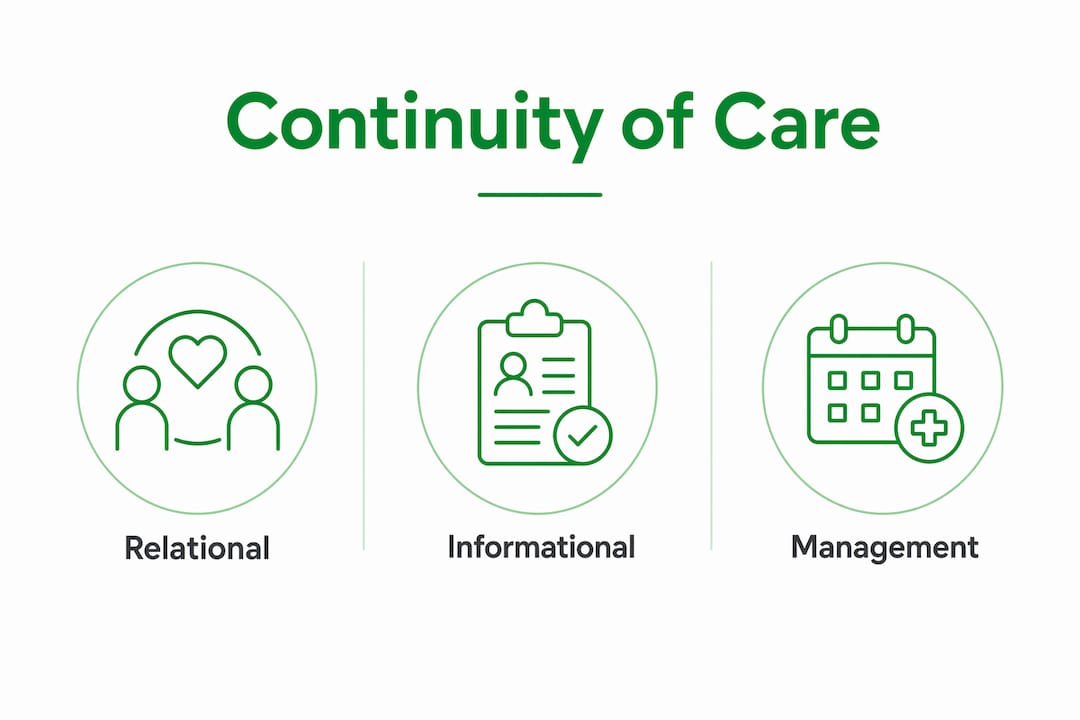
Relational continuity is the ongoing therapeutic relationship between a patient and a specific provider. This is the dimension patients feel most directly. Research confirms that team-based continuity can partially offset the loss of a personal provider relationship, but patients consistently report higher satisfaction and fewer complaints when they see the same individual clinician. The therapeutic alliance built through relational continuity is the foundation for honest disclosure, treatment adherence, and recovery.
Informational continuity means that accurate, complete patient data follows the patient across every care setting. Without it, a new provider starts from scratch, repeating assessments and missing critical history. Shared electronic health records, structured intake summaries, and standardized assessment tools all support informational continuity. When this dimension fails, clinical decisions get made with incomplete pictures.
Management continuity refers to consistent care plans that hold across providers, settings, and time. A patient moving from inpatient to outpatient care needs the same treatment goals, medication protocols, and follow-up schedules to remain in place. When management continuity breaks down, patients receive conflicting guidance, which erodes trust and increases the risk of relapse.
Pro Tip: Ask patients directly which dimension of continuity matters most to them. Some prioritize seeing the same person. Others care more about not having to repeat their history. Knowing this shapes how you structure their care.
Care transitions are the highest-risk moments for continuity loss. Moving from child to adult mental health services, from inpatient to outpatient care, or between specialty providers all create gaps where patients disengage and symptoms return.
Clinician unawareness of a patient’s self-harm history or suicidal behaviors is one of the most dangerous gaps during the child-to-adult transition. Standardized assessments that transfer this information explicitly, rather than relying on verbal handoffs, close that gap. Without them, the receiving clinician operates blind during the most vulnerable period of a patient’s care.
Structured transition planning with coordinated handoffs significantly improves post-discharge outcomes and reduces symptom recurrence. That means transition is not just an administrative step. It is a clinical intervention in its own right.
Common barriers to continuity during transitions:
Solutions that work:
Only about one-third of patients achieve high provider continuity, defined as 70% or more of visits with one provider over two years. That figure shows how far most care systems fall short of the continuity standard that research supports.
Improving continuity of care in mental health requires action from both sides of the clinical relationship. Clinicians and patients each hold levers that the other cannot pull alone.
For clinicians:
For patients:
Telehealth has changed the continuity equation significantly. Patients who previously lost their provider due to relocation or scheduling conflicts can now maintain the same therapeutic relationship through video visits. Team-based care models, where a small group of providers shares a caseload and communicates actively, also support continuity when one-to-one relationships are not possible.
Pro Tip: If you are a patient preparing for a care transition, write down the three things your current provider knows about you that a new provider would need to know immediately. Bring that list to your first appointment with the new provider.
Mental health stigma also affects continuity. Patients who feel judged are more likely to disengage after a provider change. Addressing stigma directly in the clinical relationship builds the trust that keeps patients engaged through transitions.
Provider continuity in mental health is the single most evidence-backed structural factor for faster recovery, fewer hospitalizations, and higher patient satisfaction across all major mental health conditions.
| Point | Details |
|---|---|
| Matched providers accelerate recovery | Patients matched by continuity data improve 8.5% faster and show higher odds of clinical change. |
| Continuity cuts acute care use | Higher provider continuity reduces hospitalization by up to 6.8% and emergency visits by up to 6.3%. |
| Relational loss drives complaints | A 10% drop in preferred-provider access raises formal complaints by 1.34 per 10,000 patients. |
| Transitions need active management | Structured handoffs with standardized assessments prevent disengagement and symptom recurrence. |
| Telehealth extends continuity | Video-based care allows patients to maintain the same provider relationship across distance and schedule changes. |
The mental health field talks a lot about access. We debate wait times, insurance coverage, and provider shortages. What gets far less attention is what happens after a patient finally gets in the door and then loses their provider.
Every time a patient restarts with a new clinician, they lose weeks of clinical momentum. They repeat their history. They rebuild trust from zero. For patients with trauma histories, that restart is not just inconvenient. It is actively harmful. The therapeutic alliance is not a soft metric. It is the mechanism through which most evidence-based treatments work.
The data on provider-patient matching points to something the field has been slow to act on. Continuity is not just about keeping the same provider. It is about matching patients to the right provider from the start and then protecting that relationship. Systems that treat provider assignment as an administrative task, rather than a clinical one, pay for it in worse outcomes and higher costs.
Team-based models are a real and useful adaptation to workforce shortages. But the research is clear that patients still value and benefit from consistent individual relationships. The goal should be to build teams that protect individual continuity, not teams that replace it. That requires intentional scheduling, proactive outreach, and leadership that treats continuity as a clinical priority, not a scheduling preference.
— Bryan
Consistent access to the same trusted provider is not a luxury. It is a clinical requirement for lasting recovery.

AM Rx mental health services are built around the kind of sustained provider relationships that the research supports. Patients connect with experienced clinicians through same-day video appointments and maintain those relationships over time through a platform designed for ongoing care, not one-off visits. The telehealth consent process at AM Rx is straightforward, so patients spend less time on paperwork and more time on care. For anyone managing a mental health condition who has experienced the disruption of provider switching, AM Rx offers a path to the stable, coordinated care that produces real clinical results.
Provider continuity in mental health care is defined as a patient’s consistent engagement with the same clinician or care team over time. It is recognized by the WHO and NICE as a core quality standard linked to better clinical outcomes.
Higher continuity reduces hospitalization risk by up to 6.8% and cuts emergency visits by up to 6.3%. Patients matched to consistent providers also improve 8.5% faster in depression symptoms compared to those who self-select providers.
The three types are relational continuity (same provider relationship), informational continuity (complete data transfer across settings), and management continuity (consistent care plans across providers and time).
Transitions between care settings create gaps where patient history, self-harm risk, and treatment plans can be lost. Clinician unawareness of a patient’s suicidal behaviors during the child-to-adult transition is one of the most documented risks.
Telehealth allows patients to maintain the same therapeutic relationship regardless of location or scheduling barriers. Video-based care removes one of the most common reasons patients lose access to their preferred provider.