Mental health parity is the legal requirement that insurance plans offering mental health and substance use disorder (MH/SUD) benefits must provide those benefits on equal terms with medical and surgical benefits. Under the Mental Health Parity and Addiction Equity Act (MHPAEA), your insurer cannot impose stricter financial limits or treatment barriers on mental health care than it applies to physical health care. Think of it this way: if your plan covers unlimited visits to a cardiologist, it cannot cap your therapy sessions at ten per year.
Parity does not force insurers to cover mental health services. But if they do offer that coverage, the terms must be comparable. Here is what parity specifically governs:
The MHPAEA is the backbone of federal parity protection. Passed in 2008 and updated in recent rulemaking, it sets specific mandates across benefit classifications such as inpatient and outpatient care, emergency care, and prescription drugs.
Within each classification, the law prohibits plans from applying more restrictive limits to MH/SUD benefits than to medical and surgical benefits. The 2024 federal updates specifically tightened rules around NQTLs, which had long been a loophole insurers used to create barriers that were harder to see on paper.
Key protections under MHPAEA include:
Pro Tip: If your insurer denies a mental health claim, request the specific clinical criteria used in writing. Under MHPAEA, plans must disclose this information upon request, and it is your strongest tool for an appeal.
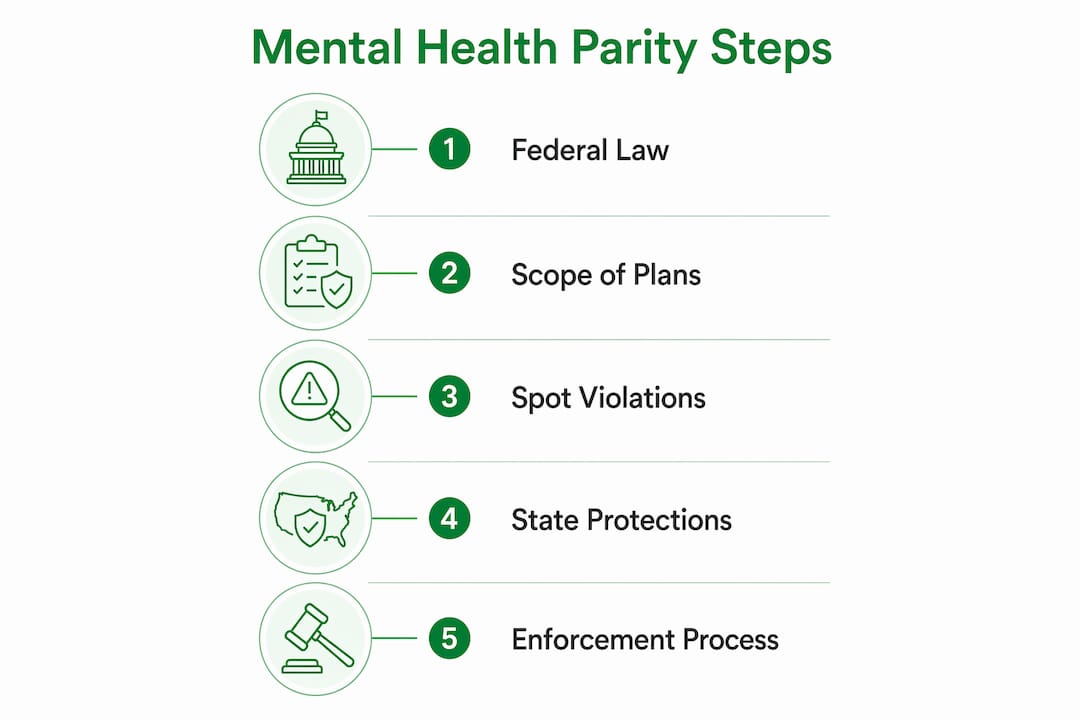
MHPAEA applies to group health plans sponsored by employers with more than 50 employees, self-insured employer plans, Medicaid managed care organizations, Taft-Hartley plans, and the Children’s Health Insurance Program (CHIP) in most cases. It does not apply to plans sold to employers with 50 or fewer employees, though the Affordable Care Act fills some of that gap for small group and individual market plans.
Coverage for MH/SUD is not mandated by MHPAEA itself. Parity kicks in only when a plan already offers both medical/surgical and MH/SUD benefits. Plans subject to parity rules include:
Services covered equally across classifications include inpatient psychiatric care, outpatient therapy, emergency mental health treatment, substance use disorder treatment, and prescription medications for mental health conditions.

Parity violations are often subtle. The most common ones do not show up in a plan’s summary of benefits; they appear when you actually try to use your coverage. Parity protections ban higher copays for mental health visits, limits on excessive prior authorization, and restrictions on medical necessity criteria that differ from those applied to physical care.
Watch for these red flags:
If you suspect a violation, contact the U.S. Department of Labor’s EBSA Benefits Advisors at 1-866-444-3272. The call is free. Advisors can help you understand your rights, review a denial, and guide you through filing a formal complaint. Insurers found in violation can face federal enforcement actions, required plan corrections, and financial penalties.
Pro Tip: Keep a written log of every denial, the date, the stated reason, and the name of the representative you spoke with. That paper trail is what makes an appeal credible.
Federal law sets the floor. Many states have built higher ceilings. Some state parity laws go further than MHPAEA by actually requiring plans to cover mental health benefits, not just requiring equal treatment if coverage exists. That is a meaningful difference for people in states with stronger protections.
State laws vary considerably. A few key patterns:
When state and federal law conflict, the rule that provides greater protection to the consumer generally applies. If you are covered by a self-insured employer plan, federal ERISA law typically preempts state rules, which means federal parity standards are your primary protection.
Virtual healthcare is a covered delivery method under parity law when the underlying benefit is covered. A plan cannot deny reimbursement for a telehealth therapy session simply because it was delivered remotely if it would cover the same session in person. AM Rx provides remote mental health care through video consultations with licensed providers, operating within the parity framework so patients can access MH/SUD treatment without the logistical barriers that often accompany in-person care.
The practical benefits of virtual care under parity include:
Pro Tip: Before your first telehealth mental health appointment, review your plan’s telehealth consent and confirm that your insurer treats virtual visits on par with in-person visits for the same service. Under parity rules, they generally must.
AM Rx’s approach aligns with the ACA nondiscrimination standards that extend parity protections to individual and small group plans, making virtual mental health care accessible to a broader population than employer-sponsored plans alone cover.
Mental health parity did not arrive fully formed. The Mental Health Parity Act of 1996 (MHPA) was the first federal step, prohibiting large group plans from setting lower annual or lifetime dollar limits on mental health benefits than on medical benefits. It was narrow: it covered only dollar limits, not visit caps or prior authorization, and it excluded substance use disorders entirely.
MHPAEA in 2008 was a generational leap. Named for Senators Paul Wellstone and Pete Domenici, both of whom had personal connections to mental illness, the law extended parity to substance use disorders, added financial requirements and treatment limitations to the scope, and introduced the NQTL framework. The Affordable Care Act in 2010 then required individual and small group marketplace plans to cover mental health and substance use disorder services as one of ten essential health benefits, effectively mandating coverage where MHPAEA only required equal terms.
The 2024 federal rule updates closed long-standing NQTL loopholes, requiring plans to conduct and document comparative analyses proving their MH/SUD restrictions are no more stringent than those applied to medical care.
Before MHPAEA, a person with depression could face a $50 copay for a psychiatrist while paying $20 to see an internist under the same plan. Annual visit limits of 20 or 30 sessions were standard. Parity laws have pushed plans to remove those explicit disparities. The goal of parity protections is to make access to mental health treatment as straightforward as access to care for conditions like heart disease or diabetes.
Access has improved in measurable ways since 2010. More plans now include mental health benefits, prior authorization requirements have been reduced for many outpatient services, and network adequacy standards have tightened. The remaining gaps tend to cluster around NQTLs, where enforcement has historically been weaker.
The law is clear. Enforcement is not. Proving an NQTL violation requires a comparative analysis of how a plan applies restrictions to MH/SUD benefits versus medical benefits, and that analysis depends on internal plan documents that insurers are not always eager to share. The 2024 rule updates require plans to proactively conduct and document these analyses, which shifts some of the burden from patients to insurers.

Three agencies share enforcement responsibility: the U.S. Department of Labor (private sector employer plans), the Department of Health and Human Services (non-federal governmental plans and marketplace plans), and state insurance commissioners (fully insured plans). Coordination between them has improved but remains imperfect. Patients who believe their plan is violating parity can file complaints with any of these agencies, and EBSA Benefits Advisors can help route a complaint to the right body.
These three concepts are related but not the same. Parity means equal terms, not equal outcomes. A plan that covers 30 outpatient therapy visits and 30 specialist visits satisfies parity even if 30 visits is inadequate for a serious mental health condition. Equal access means the practical ability to use covered benefits, which parity supports but does not guarantee, since network adequacy and geographic availability still vary. Equal benefits would mean identical coverage levels, which parity does not require.
The distinction matters when you are evaluating your plan. A plan can be technically parity-compliant and still leave significant gaps in mental health coverage, particularly if the underlying medical benefits are themselves limited.
The ACA did something MHPAEA could not: it mandated coverage. Non-grandfathered individual and small group plans sold through the Health Insurance Marketplace must cover mental health and substance use disorder services as one of ten essential health benefits. This requirement closed the coverage gap that MHPAEA left open for smaller plans.
The ACA also extended MHPAEA’s parity requirements to individual market plans, which had previously been outside the law’s scope. Combined, the two laws create a layered framework: MHPAEA sets the equal-terms standard, and the ACA ensures that standard applies to a much wider range of plans while requiring actual coverage in the individual and small group markets.
Mental health parity requires that any plan offering MH/SUD benefits must apply the same financial and treatment standards it uses for medical and surgical care, with no exceptions for copays, visit limits, or prior authorization rules.
| Point | Details |
|---|---|
| Parity requires equal terms, not coverage | MHPAEA mandates comparable limits if MH/SUD benefits are offered, but does not force plans to cover them. |
| NQTLs are the most contested area | Prior authorization and medical necessity criteria must be no more restrictive for mental health than for medical care. |
| State laws can go further | Some states require actual MH/SUD coverage and extend parity to small employer plans federal law exempts. |
| You have transparency rights | You can request the clinical criteria behind any denial and receive a written explanation under federal law. |
| Virtual care is covered under parity | Telehealth mental health visits receive the same parity protections as in-person visits when the benefit is covered. |