Mental health comorbidity means two or more mental disorders are present in the same person at the same time. The term comes from medicine’s broader concept of comorbidity, where multiple conditions coexist, but in psychiatry it carries a specific weight: the disorders interact, complicate each other, and rarely respond to treatment as neatly as a single diagnosis would.
The clinical term you will also see is “co-occurring mental health conditions,” used interchangeably in treatment settings. Understanding mental health and comorbidity together is the starting point for getting care that actually addresses what is happening.
Co-occurring mental health conditions fall into two broad categories, and knowing the difference shapes how clinicians approach them.
Psychiatric comorbidity covers two or more mental disorders occurring together, such as major depressive disorder alongside generalized anxiety disorder, or ADHD alongside oppositional defiant disorder. Mental-physical comorbidity describes the interaction between a mental disorder and a physical health condition, for example, depression developing in someone managing a chronic illness like diabetes or HIV.
Common mental illness comorbidity examples include:
The symptom overlap problem runs through all of these pairs. Sleep disturbance, for instance, appears in anxiety, depression, PTSD, and bipolar disorder. When a symptom belongs to multiple diagnostic categories, overlapping symptoms make it genuinely difficult to determine which disorder produced it and which is secondary.
The short answer: far more common than most people realize. Community surveys and national health data consistently show that comorbidity is the norm, not the outlier, among people with mental illness.
| Population group | Key statistic | Source |
|---|---|---|
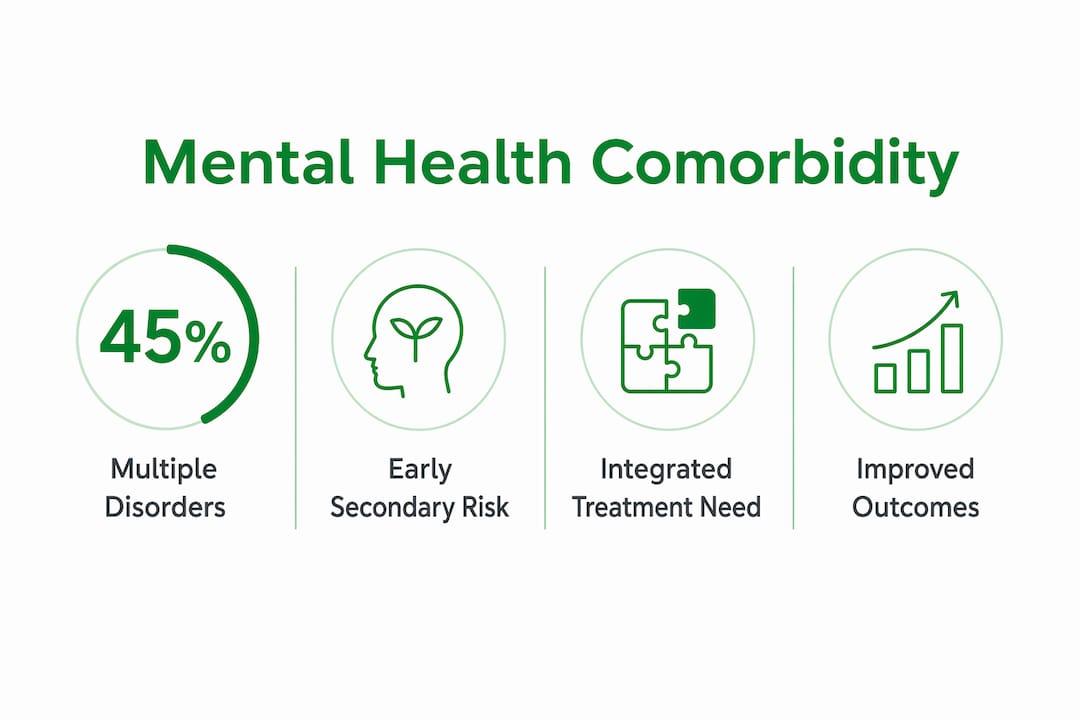
| General mental health patients | Up to 45% meet comorbid diagnosis criteria annually | National Survey on Drug Use and Health |
| Adults with any mental disorder | Up to 45% carry one or more additional lifetime diagnoses | JAMA Psychiatry / PMC population studies |
| Americans with co-occurring substance use and mental illness | 9.2 million in 2018 | National Survey on Drug Use and Health |
| OCD patients | 90% lifetime comorbidity rate | Oxford University research |
Stat to know: 9.2 million Americans had both a substance use disorder and a mental illness in 2018, according to the National Survey on Drug Use and Health. That figure represents only the cases captured in a single survey year.
The risk of developing a secondary disorder is highest early after an initial diagnosis, but remains meaningfully elevated for many years. A comprehensive analysis of 145,990 survey respondents across 27 countries found that every prior mental disorder was associated with an increased risk of subsequently developing each other disorder studied. The median hazard ratio across all disorder pairs indicated a substantially increased risk of secondary disorders.
What this tells you practically: a single mental health diagnosis is rarely the whole picture. Clinicians who treat one condition in isolation, without screening for others, are working with incomplete information.
Comorbidity does not just complicate paperwork. It changes prognosis, treatment response, and long-term health in ways that a single-disorder framework misses entirely.
Diagnostic challenges:
Prognosis and health impact:
Pro Tip: When seeking a mental health evaluation, ask your provider explicitly whether they screen for co-occurring conditions. A differential diagnosis that rules out comorbid disorders is not over-caution; it is the standard of care. Early, accurate identification prevents years of mismatched treatment.
The NIMH has highlighted that differentiating between trait and state conditions is one of the most clinically consequential steps in comorbid assessment. Getting that distinction right early determines whether treatment targets the right mechanism or chases the wrong one for years.

Treatment for co-occurring mental health conditions requires a fundamentally different approach than treating a single disorder. The presence of multiple diagnoses changes what works, what is safe, and how long recovery takes.
Core treatment considerations:
Telehealth has expanded access to integrated mental health care, particularly for people in areas where specialist availability is limited. When a provider can coordinate psychiatric, psychological, and primary care services through a single platform, the gaps where comorbid conditions fall through the cracks narrow considerably.
The mental health and physical health connection is not incidental. Ignoring one condition actively worsens outcomes for the other, which is why treatment plans that address only the presenting complaint are structurally incomplete for anyone with comorbid diagnoses.

The research picture on co-occurring mental health conditions has shifted considerably in the past decade. The older model treated each diagnosis as a separate entity with its own cause, course, and treatment. The newer evidence suggests that model is too simple.
A comprehensive analysis published in Psychological Medicine, drawing on 145,990 respondents from 27 countries, found that every prior mental disorder studied was associated with an increased risk of subsequently developing each other disorder. The median hazard ratio of 12.1 across all pairs is not a subtle statistical signal. It points toward shared underlying risk architecture, including genetic and environmental factors that cut across diagnostic categories.
Key findings from current research:
The practical takeaway from this body of work is that a mental health diagnosis should prompt active monitoring for other conditions, not just treatment of the presenting one. Clinicians who treat comorbidity as a complication rather than an expected feature of mental illness are working against the evidence.
If you are managing one or more mental health conditions and want care that accounts for the full picture, AM Rx offers mental health services through same-day virtual appointments with experienced providers. The platform coordinates care across conditions, handles prescriptions, and connects you with clinicians who understand how co-occurring disorders interact. Start with telehealth and get a comprehensive evaluation from the comfort of home.

Mental health comorbidity is the norm among people with mental illness, not an unusual complication, and treating it effectively requires integrated care that addresses all co-occurring conditions simultaneously.
| Point | Details |
|---|---|
| Comorbidity is common | Up to 45% of mental health patients meet comorbid diagnosis criteria in any given year. |
| Substance use overlap is large | 9.2 million Americans had co-occurring substance use and mental illness in 2018. |
| Risk persists long-term | Secondary disorder risk is highest in the first 1–2 years but stays elevated for at least 15 years. |
| Life expectancy is affected | Severe mental illness is linked to dying 10–20 years earlier, largely due to untreated physical comorbidities. |
| Integrated care produces better outcomes | Treating mental and physical health conditions together improves quality of life and medical outcomes, per the WHO. |