Yes, you can get a specialist to review your diagnosis without leaving home. Most programs deliver a written report from a board-certified specialist, sometimes paired with a live virtual visit, and Cleveland Clinic reports that 67% of these reviews change the original diagnosis or treatment plan. Availability depends on your state and your diagnosis, and none of this replaces urgent or emergency care.
TL;DR:
- About two-thirds of virtual second opinions result in a change to the initial diagnosis or treatment plan, highlighting their potential impact.
- Record quality plays a crucial role, with original DICOM images and detailed pathology and operative reports necessary for a reliable review.
- Turnaround times typically average around 10 business days after records are received, with costs ranging from $239 to $750 depending on scope and speed.
- Reputable programs require board-certified specialists in the relevant field, clear turnaround promises, and HIPAA-compliant, US-based data handling.
- These reviews are best suited for serious or complex diagnoses, high-risk procedures, conflicting test results, or seeking peace of mind, but not for urgent emergency cases.
The process runs on a fairly predictable track across most hospital-affiliated programs, though the pace varies by how fast your records move.
Knowing this sequence upfront helps you set a realistic timeline instead of expecting an answer in 48 hours.
Not every diagnosis needs a second look, but certain situations call for one almost every time.
If your situation is urgent—chest pain, sudden neurological symptoms, uncontrolled bleeding—a second opinion service is the wrong tool. Go to an emergency room instead. For everything else, most treating physicians expect this. A simple line works fine: “I want to feel confident before moving forward, so I’m getting an outside specialist to review my case.” Most clinicians read that as due diligence, not distrust.
Turnaround and pricing swing more than most patients expect, mostly based on how fast your old hospital releases your records.
Timeline: Mass General Brigham cites a typical turnaround of about 10 business days once records actually arrive at the reviewing specialist’s desk. That last clause matters. Waiting on a radiology department to release DICOM files can add a week or more before the clock even starts.
Cost examples:
Cleveland Clinic’s data point is worth sitting with: a significant portion of virtual second opinions led to a change in diagnosis or treatment. That’s not a rounding error. Many patients walk away with a materially different care plan than the one they started with.
Insurance: Most of these programs are not covered by Medicare or standard insurance plans, since they fall outside typical in-network review structures. HSA and FSA funds usually apply, since the service qualifies as a medical expense. It’s worth checking your specific coverage before you pay out of pocket, since a handful of insurers do reimburse partial costs on request. Expedited review or international patient requests can also push the price higher than the baseline examples above.
The quality of your second opinion depends almost entirely on the quality of what you send in. A specialist working from a blurry PDF summary is going to give you a vaguer answer than one working from the original files.
Request records through your hospital’s patient portal first. If that stalls, call the health information management department directly and ask for a release form by name.
Pro Tip: Ask your imaging center for a CD or secure download link with the actual DICOM files, not a printed film or a compressed JPEG export. Reviewing radiologists need the raw data to zoom, measure, and adjust contrast, none of which works on a flattened image.
A handful of criteria separate a serious program from a marketing page with a stock photo of a stethoscope.
Ask directly: “Who signs the final report, and what’s their board certification?” A vague answer here is the clearest red flag you’ll get.
Before paying, ask what happens if no specialist in your state can legally review your case. A legitimate telehealth provider will have a refund or referral policy ready for that exact scenario, because state licensure gaps are common enough that reputable programs plan for them.
Getting the report is not the finish line. AM Rx exists downstream of that moment, as a telehealth option for the ongoing care that follows a second opinion rather than the specialty review itself.
AM Rx is not a hospital oncology program or a neurosurgery review board, and it doesn’t claim to be. Its role is narrower and more practical: helping you act on a decision that a specialist center already made. Think of it as the bridge between “here’s what the specialist recommended” and “here’s how I actually get that prescription filled or that follow-up scheduled” without another multi-week wait for an in-person slot.
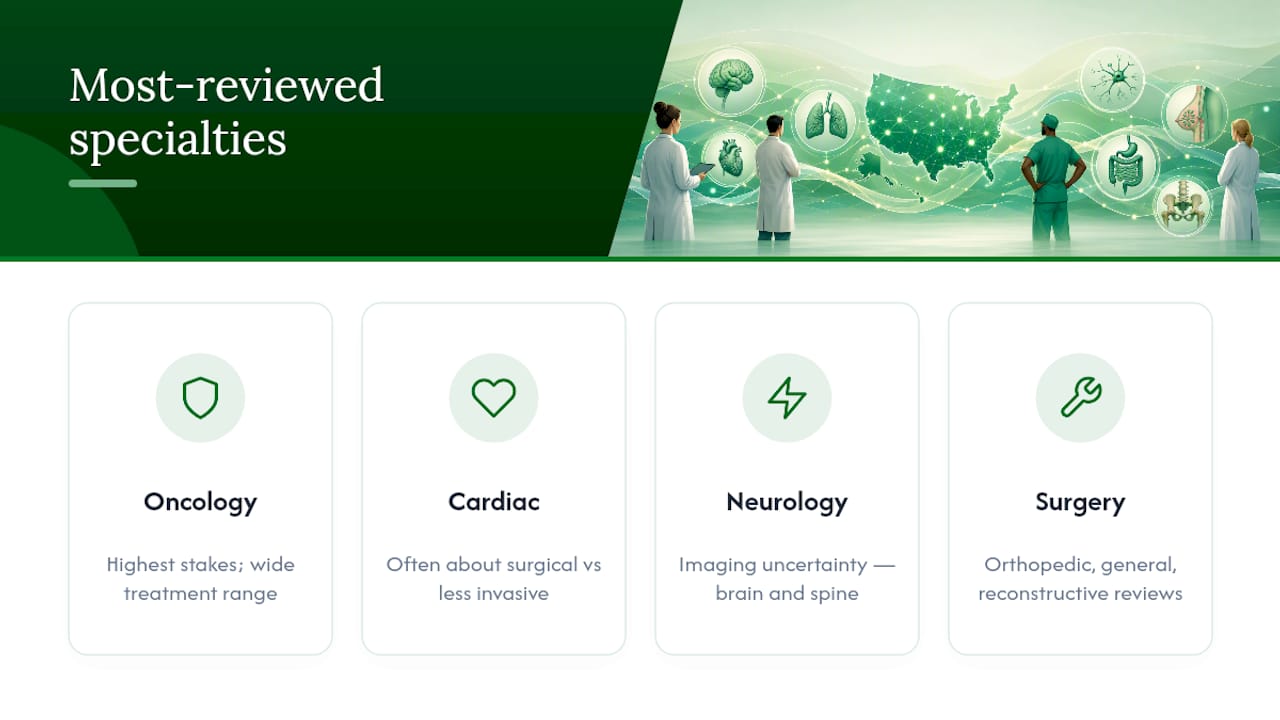
Oncology dominates second-opinion requests, and for good reason. A cancer diagnosis carries the highest stakes and the widest range of possible treatment paths, from active surveillance to aggressive multi-modal therapy. Patients want confirmation that the recommended path actually fits their specific tumor type and stage before committing months of treatment to it.
Cardiac cases come next, particularly around surgical recommendations like bypass grafts, valve replacements, or ablation procedures. A second opinion here often centers on whether a less invasive option was fully considered before surgery got proposed.
Neurology and neurosurgery cases, brain tumors, spinal surgery, complex seizure disorders, tend to involve the highest degree of diagnostic uncertainty, which is exactly why specialists get pulled in for a fresh read of the imaging.
Surgical cases broadly, orthopedic, general, and reconstructive, round out the most common categories. Programs at systems including Cedars-Sinai list oncology, cardiac, and orthopedic review among their core specialty areas, and most major academic hospital programs mirror that same lineup. If your diagnosis falls into one of these buckets, you’re not an edge case. You’re exactly who these programs were built for.
Don’t treat the written report as a verdict to act on alone. Bring it back to your treating physician and walk through it together. A remote second opinion is designed to complement your existing care relationship, not replace it, and your local doctor is the one who will actually manage your day-to-day treatment.
Start by reading the full report yourself, not just the summary paragraph, and flag anything you don’t understand. If the second opinion agrees with your original diagnosis, that confirmation has real value on its own; it’s not a wasted step just because nothing changed. If it disagrees, ask your treating physician directly how they’d respond to the specific points raised. A good clinician will engage with that conversation rather than dismiss it.
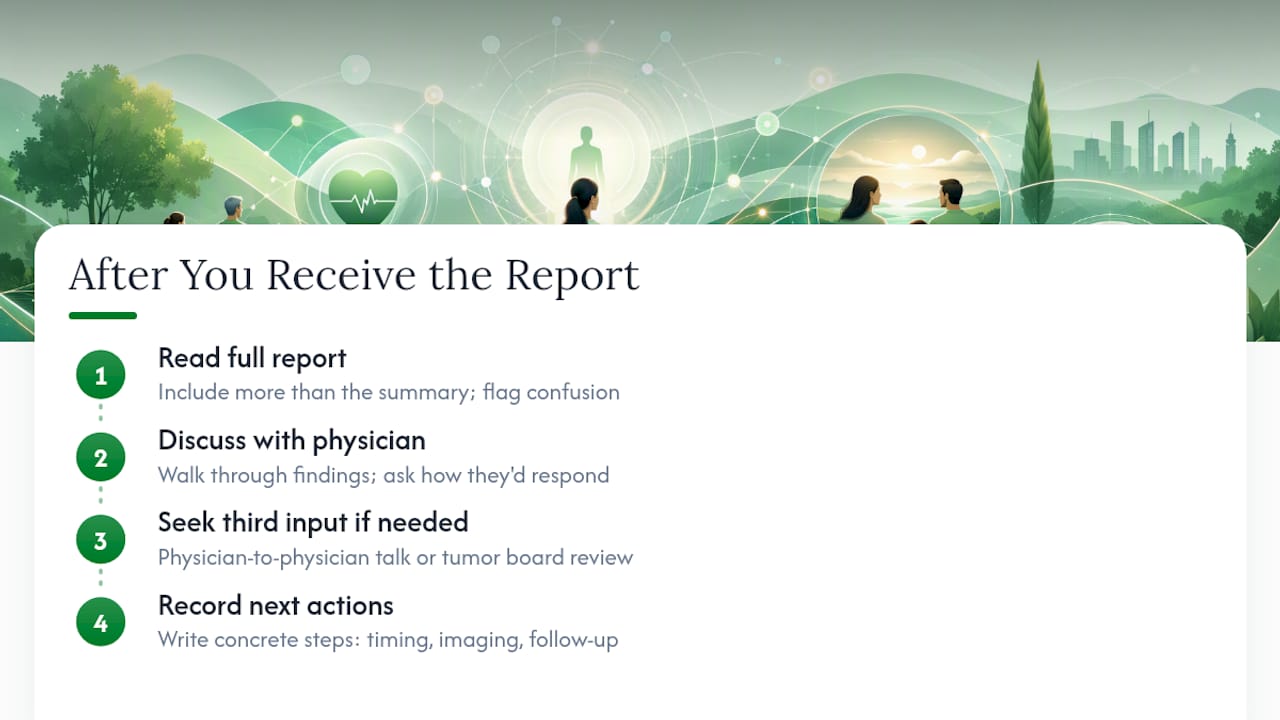
Where the two opinions genuinely conflict on something consequential, a surgery decision, a chemotherapy regimen, consider a third input, either a direct conversation between the two physicians (many programs will facilitate this) or a formal tumor board or multidisciplinary review if your case qualifies for one.
Finally, decide what changes practically. Does this affect your treatment timeline? Do you need new imaging before the next step? Write down the concrete next actions before you leave that follow-up conversation, because it’s easy for a detailed report to generate a lot of discussion and very little forward motion otherwise.
Reputable programs run on HIPAA-compliant platforms with encrypted uploads, which is a real and enforceable legal standard, not a marketing phrase. That said, “HIPAA-compliant” doesn’t mean risk-free; it means the provider has legal obligations around how your data is stored, transmitted, and accessed.
Before uploading anything, confirm the platform uses a secure patient portal rather than email attachments. Standard email is not encrypted end to end, and pathology reports or imaging files sent that way can be intercepted or exposed. Ask specifically whether your records are stored on servers within the United States and how long they’re retained after your review concludes.
Also check who has access beyond the reviewing specialist. Coordinator staff typically need visibility into your file to manage logistics, but that access should be limited and logged, not open to the entire organization. A provider that can’t clearly answer who touches your data, and why, is one to be cautious about, regardless of how polished their website looks.
The programs that work well, Cleveland Clinic, Cedars-Sinai, Mass General Brigham, all share one unglamorous trait: someone on their staff is obsessive about record quality before a specialist ever looks at the case. That’s the part conventional advice skips. Most guidance tells you to “seek a second opinion” without mentioning that a rushed, incomplete record packet is the single biggest reason a review comes back vague or unhelpful.
Here’s where I’d push back on the common framing: patients treat the written report as the finish line. It’s closer to the midpoint. The real value shows up in the conversation you have afterward with your treating physician, where a changed recommendation actually gets translated into a changed plan.
If you’re weighing this decision, prioritize three things in order: confirm your state’s licensure coverage before you pay anything, send original DICOM imaging rather than summaries, and go in knowing roughly two-thirds of these reviews shift the plan in some way. That number should shape your expectations, not just your decision to proceed.
— Bryan
Once a specialist confirms or changes your diagnosis, some telehealth services can help turn that report into actual care. Unlike a hospital oncology board or a surgical review program, these services focus on what comes next: virtual visits, prescription adjustments, and ongoing follow-up without long waits for an appointment slot.

Book a visit, bring your written second-opinion report with you, and a licensed provider can talk through medication changes or a revised treatment approach the same day. If your second opinion recommended a new prescription or a different management plan, AM Rx handles the delivery logistics so you’re not chasing down a local pharmacy mid-transition. Every visit runs through a documented consent-to-telehealth process that covers exactly what you’re agreeing to before you start. If your insurance situation changed along with your diagnosis, it’s also worth a quick look at how health insurance options outside open enrollment might apply to your case. Start your visit today and get your revised plan into motion.
This article is general information, not a substitute for advice from a qualified doctor. Consult a qualified healthcare professional about your own circumstances before acting on anything here.
Yes. Hospital systems including Cleveland Clinic, Mass General Brigham, and Cedars-Sinai all offer remote second opinions that deliver a written specialist report, often paired with an optional virtual visit.
Academic hospital programs at Cleveland Clinic, Mass General Brigham, UChicago Medicine, and Cedars-Sinai are among the most established, each offering specialist-matched review with a written report as the core deliverable.
Frame it as wanting confidence before a major decision, something like, “I’d like an outside specialist to review this before I move forward.” Most physicians see this as normal due diligence rather than a lack of trust.
Start with your treating physician’s own hospital system if it offers a formal second-opinion program, gather your original imaging and pathology reports first, and confirm the reviewing specialist is licensed in your state before paying.
No. AM Rx is a telehealth follow-up provider, not a specialty hospital review board. It’s built to help you act on a second opinion, through same-day visits and prescription support, once you already have the specialist’s report in hand.