TL;DR
- There's no single best telehealth provider in the United States. The right pick depends on what you need treated, whether you have insurance, and how fast you need the prescription in hand.
- AM Rx fits patients who want one account covering GLP-1 weight loss, ED, birth control, hair loss, skincare, mental health, and enclomiphene, with same-day visits plus both insurance and self-pay options.
- Found, Ro, and Vitastir concentrate on weight loss and men's health. Sesame Care is built around upfront cash pricing across many specialties. NativeMed and Noom put coaching first.
- Ask every provider the same three questions: what the monthly fee covers, whether medication is billed separately, and whether they submit to your insurance.
- Run the three-month math before you enroll. The worked example below shows a self-pay program at $891 versus $4,350 for the traditional specialist-plus-brand-name route.
You typed "best telehealth provider" into Google at 11 p.m. because the thought of sitting in a pharmacy drive-through line with a screaming toddler in the back seat is worse than the symptom itself. Short answer: if you need ongoing prescription management for more than one condition, AM Rx or Sesame Care will serve you best. If you're focused on GLP-1 weight loss or men's health and nothing else, Found, Ro, and Vitastir are strong. Noom and NativeMed make sense when the coaching matters as much as the script.
What does "best telehealth provider" actually mean?
It means something different depending on what's wrong with you. A platform that's excellent for a quarterly enclomiphene refill can be a bad fit for someone in a depressive episode who needs a visit today.
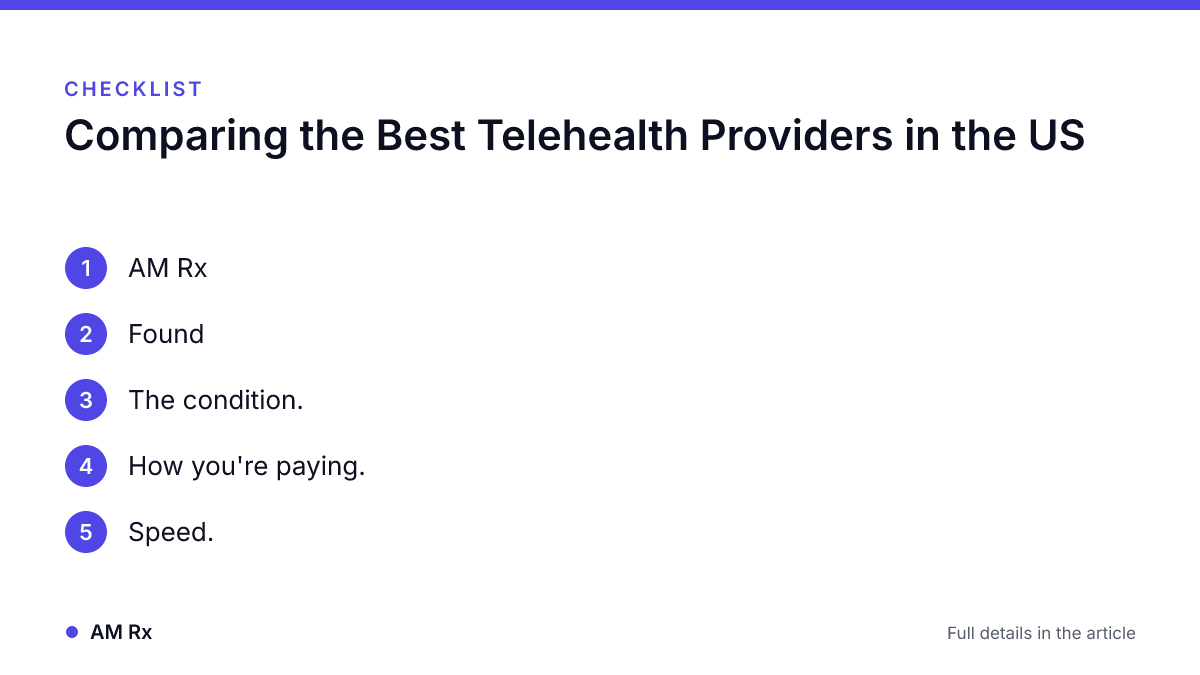
Four things decide it:
- The condition. Single-issue platforms go deep. Multi-condition platforms save you from repeating your medical history five times.
- How you're paying. Cash-pay programs quote one clean number. Insurance-billing providers can be cheaper, but only after your deductible situation is clear.
- Speed. Same-day matters for a UTI or an anxiety flare. It matters less for a hair loss plan you'll be on for years.
- Continuity. Will the same provider follow you across follow-ups, or do you get whoever's next in the queue?
Pro tip: Before you create an account anywhere, message support with one narrow question, like "Do you bill my insurance for the GLP-1 medication itself, or only the visit?" How fast they answer, and whether the answer is a real answer or a link to a pricing page, tells you more about the service than the homepage ever will.
How do the major telehealth providers actually compare?
Here's how AM Rx sits against the platforms patients ask about most. Pricing and coverage in this category change often, so confirm anything marked "ask" directly before you enroll.
| Provider | Core specialty | Speed to appointment | Service area | Insurance vs. self-pay |
|---|---|---|---|---|
| AM Rx | GLP-1 weight loss, ED, birth control, hair loss, skincare, mental health, enclomiphene, primary care | Same-day or scheduled | All 50 states | Bills insurance where possible; self-pay available |
| Found | Weight loss and GLP-1 programs | Ask about current wait times | Multi-state | Ask whether insurance is billed or self-pay only |
| Ro | Men's health, weight loss, hair loss | Ask about current wait times | Multi-state | Primarily self-pay; confirm insurance options |
| Sesame Care | Broad marketplace, cash-pay focus | Often same-day, varies by clinician | Multi-state | Upfront cash pricing; ask about insurance |
| NativeMed | Weight loss and wellness coaching | Ask about scheduling window | Multi-state | Ask directly about insurance acceptance |
| Noom | Behavior-based weight loss, some GLP-1 access | Coaching starts quickly; medical visits vary | Multi-state | Subscription-based; confirm medication billing |
| Vitastir | Weight loss and men's health | Ask about current wait times | Multi-state | Ask directly about self-pay vs. insurance |
Pro tip: Ask what happens between visits. That's where platforms separate. Some leave you alone with nausea at week three of a GLP-1 titration. Others, AM Rx included, let you message the care team without booking anything new.
Which telehealth provider is best for GLP-1 weight loss?
Found, Ro, Noom, Vitastir, and AM Rx all run dedicated weight loss programs. The differences show up in coaching depth, insurance handling, and whether anyone follows you after the prescription goes out. AM Rx pairs GLP-1 prescribing with provider check-ins and coaching, and works with both insurance and self-pay patients, which matters more than it sounds when a plan denies coverage and you're suddenly holding the full cost.
Run this math before you commit anywhere. Take a self-pay telehealth program quoted at $297 a month. Now price the traditional route: a $150 specialist copay plus a brand-name prescription at roughly $1,300 a month with no insurance approval.
- Telehealth over three months: $297 × 3 = $891
- Traditional over three months: ($150 + $1,300) × 3 = $4,350
Those are illustrative figures, not a quote. Swap in your own copay and your pharmacy's cash price and the structure holds. The number that actually moves your total is whether medication is bundled into the monthly fee or billed separately, so ask that first. AM Rx's weight loss page lays out what's included before you book.
Which one is best for erectile dysfunction treatment?
For ED, the best provider is the one that gets you a private visit fast and ships in plain packaging. Ro built its early reputation here and is worth a look if that's your only concern. AM Rx's ED program covers the same ground, a same-day visit with a licensed provider reviewing your history and delivery to your door, with the advantage that it lives on the same account as your other care instead of a third separate login.
One question saves more money than any coupon: ask which medications the provider actually prescribes, and whether generic sildenafil or tadalafil is on the list. Generics are usually the sensible starting point, and asking about brand-name Viagra versus the generic before your first refill can change your annual cost considerably. Also ask about dose flexibility. Daily low-dose tadalafil and as-needed higher doses are priced very differently, and some programs quote you one without mentioning the other exists.
What about birth control, hair loss, mental health, and testosterone support?
Each one has its own reason for going virtual.
- Birth control: If you need a refill or a new prescription and no pelvic exam is indicated, most platforms including AM Rx handle it in one visit, with refills managed by message instead of repeat office trips.
- Hair loss: Male pattern baldness rewards early, uninterrupted treatment, so consistency beats everything. Compare which platform auto-ships on a subscription so you never have a two-week gap while a refill processes. Gaps are what quietly undo a year of progress. See AM Rx's hair loss program alongside Ro's.
- Mental health: Continuity is the whole ballgame. Adjusting an SSRI dose is a conversation across months with someone who remembers your last check-in. Ask specifically whether follow-ups are booked with your original provider or the next available one.
- Enclomiphene for testosterone: A narrower niche than GLP-1s or ED, and plenty of platforms don't carry it. If raising testosterone without traditional TRT is your goal, confirm the exact medication is on the formulary before you pay for anything. AM Rx lists it in its core lineup.
- Skincare: For acne, rosacea, hyperpigmentation, or fine lines, prescription topicals generally outperform anything on a drugstore shelf. AM Rx's skincare visits get you a treatment plan without waiting out a dermatology backlog.
Pro tip: Treating two things at once, say weight loss and anxiety, is exactly when a single-platform provider pays off. One medical history, one medication list, one provider who can see that your new prescription interacts with the old one.
Does insurance actually work with online telehealth providers?
Sometimes. It depends on the provider, your plan, and the specific drug. Some platforms are cash-pay only with a flat monthly fee. Others, AM Rx among them, bill insurance where possible and offer self-pay pricing when a plan won't cover a treatment. Sesame Care built its entire model on transparent cash pricing, which is genuinely the better deal if you're uninsured or your deductible just reset in January.
Ask these before you hand over a card:
- Is the visit billed to insurance, or is it cash only? These are two separate charges from the medication, and platforms blur them constantly.
- Is the medication billed through my pharmacy benefit or bundled into the program price? Bundled pricing usually means compounded or cash-price generic, which can be cheaper or pricier depending on your plan.
- Do you handle prior authorization? GLP-1s frequently need one. A platform that submits it for you, and appeals a denial, is worth more than a $30 lower monthly fee.
- Can I pay with HSA or FSA funds? Most legitimate telehealth visits and prescriptions qualify, and it's pre-tax money.
The answers to those four determine your real monthly cost far more than the sticker price on the landing page.
How fast can you actually get a prescription this way?
Usually same-day for straightforward cases, versus a couple of hours at urgent care or a multi-week wait for a specialist. The bigger savings often come after the prescription is written, not before.
Anyone who has stood at a Walgreens or CVS counter and been told the script "isn't ready yet, give us twenty minutes" knows the fill can eat more of the afternoon than the appointment did. AM Rx's breakdown on CVS pharmacy waits versus getting your Rx online walks through where that time actually goes and how e-prescribing to a local pharmacy or shipping direct to your door skips most of it. If your pharmacy has ever closed early or been out of stock on your dose, the same logic shows up in refill your Rx online when Walgreens pharmacy is closed, whichever chain you use.
Pro tip: Screenshot the prescription confirmation and the pharmacy's pickup window as soon as you get it. Small habit, but it kills the "did that actually go through?" phone call, and it gives you a timestamp to point at if the pharmacy says they never received anything.
One practical thing people underestimate: where you take the call. A video visit from the kitchen table with dishes stacked behind you does not feel like a medical appointment, and for therapy or psychiatry it actively gets in the way. If you're carving out a quiet corner or a real home office for monthly check-ins, Italcasa Design in Metro Detroit is worth knowing about. It's an Italian furniture and design studio with showrooms in Royal Oak and Troy, and they'll do anything from a single reading chair with decent back support to a full office buildout. Prioritize a door that closes and a chair you can sit in for 50 minutes.
What should you do next?
Start with the condition, then match it to a provider whose specialty and payment model fit. Doing it the other way around is how people end up paying for a subscription that doesn't cover the one drug they came for.
If you want a single account covering weight loss, ED, birth control, hair loss, skincare, mental health, and testosterone support, with same-day visits and both insurance and self-pay options, creating an account with AM Rx is a short intake form and, in most cases, a licensed provider the same day.
Frequently asked questions
Can I switch telehealth providers if my first choice doesn't work out?
Yes. Nothing locks you in, and most of these subscriptions are month to month rather than annual contracts. Check the cancellation terms and whether any already-paid medication still ships before you cancel, since some programs bill a month ahead.
Do telehealth providers require a video visit, or can everything be done by messaging?
It depends on the condition and your state. Some prescriptions legally require at least an initial video or phone visit, while refills and follow-ups often run through secure messaging alone. Confirm the process for your specific medication instead of assuming it's text-only.
Is it safe to get prescription medication shipped to my home instead of picking it up at a pharmacy?
Yes, provided the company uses licensed providers and licensed pharmacies. Medication ships in standard, usually unmarked packaging, the same as any mail-order pharmacy. If you want to verify it yourself, ask which pharmacy network fulfills their prescriptions and look up that pharmacy's license in your state's board records.
.jpg)