TL;DR
- Most non-controlled prescriptions never require a pharmacy visit: a telehealth provider can e-prescribe to your local CVS or ship the medication to your door instead.
- Transferring a prescription to CVS is usually one app request or phone call, and in our experience it's ready the same day, but controlled substances follow stricter DEA rules and often can't be transferred at all.
- CVS hours vary by format. Standalone stores run late; a CVS counter inside a Target follows the host store's schedule and closes earlier, so check the specific location, not the chain.
- Cash prices for the same generic can differ between two CVS stores in the same city, so ask for the self-pay price before assuming your insurance card is the cheaper option.
- AM Rx visits take about as long as filling out a form. If treatment is appropriate, the prescription ships to your house or routes electronically to the pharmacy you pick.
You can get a prescription filled without setting foot in a CVS Pharmacy. Your provider can send it electronically to the CVS closest to you, or you can skip retail pharmacy entirely and have the medication mailed. Both options exist right now. Most people have no idea how easy the second one is.
If you've ever stood in line behind someone arguing about an expired coupon while your bag sits three feet away on the shelf, you already know the problem. The pharmacy trip is usually the most avoidable step in getting treated.
What are CVS Pharmacy hours, and can you get a prescription outside them?
CVS hours depend on the store format, and the difference trips people up constantly. A standalone CVS Pharmacy generally stays open into the evening with shorter weekend hours. A CVS counter inside a Target closes on the host store's clock, which is often noticeably earlier. Searching "CVS Pharmacy near me" will happily show you both without flagging which is which.
That gap has real consequences. A prescription called in at 6:45 to a counter that closes at 7 is a prescription you're picking up tomorrow. If you need medication outside store hours, your options are a 24-hour pharmacy if your area still has one, or a telehealth visit that ships the medication and ignores store hours entirely. Same-day visits through AM Rx don't run on a pharmacy's schedule. Evenings and weekends work, and if treatment is appropriate the order goes out that day.
Pro tip: Call the store directly, not the general CVS customer service line. Posted hours on Google and in the app lag behind real staffing changes, and pharmacy departments close for a lunch break at many locations even when the front of the store is wide open. The lunch closure is the one that catches people.
How do you transfer a prescription to CVS from another pharmacy or provider?
Transferring is faster than most people expect, with limits worth knowing before you plan your day around it.
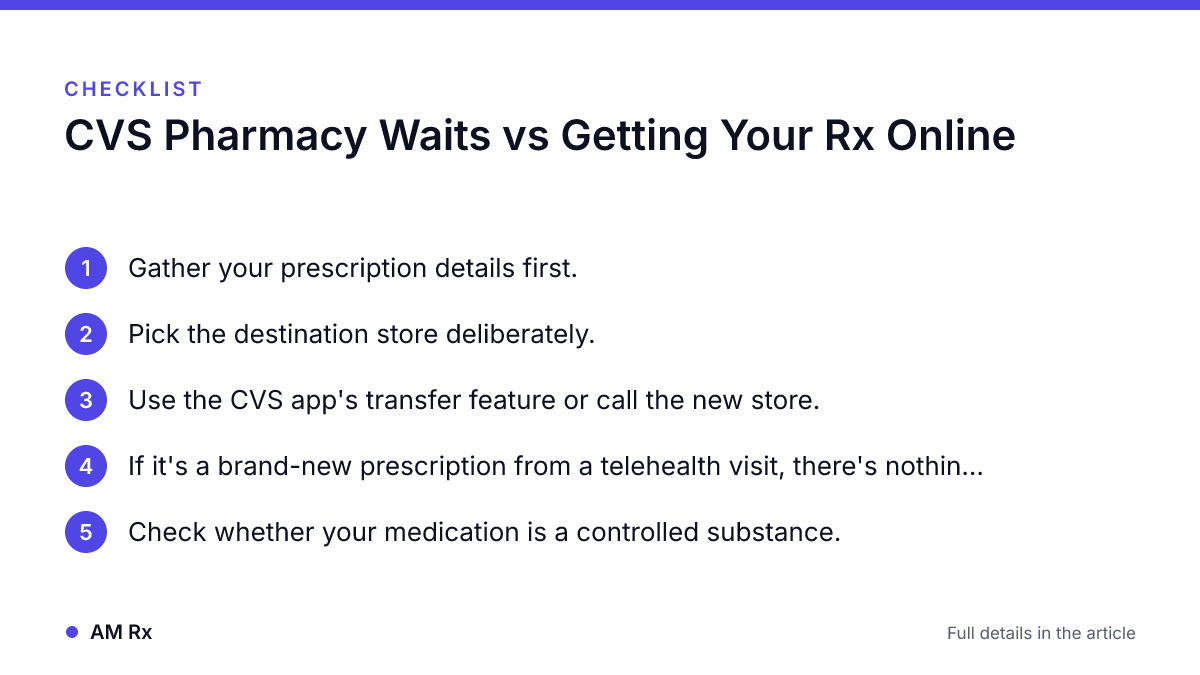
Gather your prescription details first. Medication name, dose, your current pharmacy's name and phone number, and the Rx number off the bottle. With that in hand it's a two-minute request. Without it, you're playing phone tag between two pharmacies.
Pick the destination store deliberately. Check its hours against when you'll actually be free. A store 12 minutes away that closes at 7 does nothing for you if you leave work at 6:50.
Use the CVS app's transfer feature or call the new store. You enter your old pharmacy's info and CVS handles the rest. If you'd rather talk to a person, the receiving pharmacist initiates the request with your old pharmacy directly. You never have to call the old one yourself.
If it's a brand-new prescription from a telehealth visit, there's nothing to transfer. When your AM Rx provider writes a new prescription, you name the pharmacy during the visit or through the messaging portal and it goes there electronically. Skip steps 1 through 3 entirely.
Check whether your medication is a controlled substance. This is the step almost everyone misses. Certain ADHD medications, some anxiety medications, and testosterone products fall under stricter DEA transfer rules, and depending on your state and the drug's schedule, they may transfer only once or not at all. If you're on one of these, tell your provider which pharmacy you want from the very first prescription and stay there.
Confirm your insurance is on file at the new store. Being "in-network" at both pharmacies doesn't mean your plan details travel with the prescription. Have your card ready at pickup or you may get quoted a cash price by mistake and assume something went wrong with your coverage.
Ask when it'll be ready before you drive over. In our experience most transfers land the same day, often within a few hours, but a slow-responding old pharmacy or a Monday morning rush can push it to the next day. Ask for a text notification.
Turn on auto-refill and reminders immediately. This is what keeps you from doing all of this again in 30 days.
What do people get wrong about pharmacy transfers and telehealth prescriptions?
Three things, over and over.
You are not locked to the pharmacy on file. Patients assume their prescription belongs to whatever pharmacy their old doctor's office defaulted to years ago. It doesn't. Most telehealth providers, AM Rx included, let you choose or change the destination pharmacy during the visit or later through your portal.
"Out of stock" often means "specialty." Some medications, including certain injectable GLP-1s and a number of dermatology and hormone products, route through CVS Specialty rather than the retail counter. Separate phone line, separate hours, separate delivery scheduling. When a local CVS tells you a medication isn't in stock and can't say when it will be, ask directly whether it's a specialty item. That's usually the real answer, and it's solvable with home delivery instead of three more trips to the store.
Pharmacists flag prior authorizations, they don't file them. The pharmacy tech will tell you your plan needs a prior auth and hand the problem back to you. The submission has to come from the prescribing office. Patients then spend a week as the messenger between two voicemail systems. An ongoing telehealth relationship kills this loop, since your AM Rx care team already has your chart and handles the paperwork on their end while you do nothing.
Does CVS Pharmacy take insurance, and how does the pricing compare?
CVS accepts most major plans, including employer coverage, Medicare Part D, and Medicaid in states that allow it. What you actually pay depends on your plan's formulary and where you stand on your deductible. Two coworkers with identical insurance cards can pay wildly different amounts for the same pill in the same week, purely because one has met the deductible and the other hasn't.
For self-pay patients, prices move around. It's not unusual to be quoted meaningfully different cash prices for the same generic at two CVS stores in the same metro, and the discount cards floating around change the number again. Always ask for the cash price even when you have insurance, because on cheap generics the cash price sometimes beats the copay.
Here's the math worth running before you assume retail is cheaper. Take an ongoing medication at $45 a month cash, plus a provider visit every three months at $120 to keep the prescription active. That's $45 × 12 = $540 in medication and $120 × 4 = $480 in visits, so $1,020 for the year. A bundled telehealth program at $70 to $90 a month with the visits included works out to $840 to $1,080 a year. Similar or lower, with the follow-ups already in the price rather than billed separately. (Illustrative numbers. Run yours with your real copay and visit cost.)
The rule of thumb: if your annual visit costs are more than about a third of your annual medication costs, bundled telehealth pricing usually wins.
Pro tip: Ask any telehealth provider for self-pay pricing on your exact medication and dose before comparing anything. For our weight loss programs or birth control, bundled pricing that includes provider follow-ups often beats stitching together a pharmacy price and a separate office visit bill.
CVS Pharmacy vs Walgreens vs mail-order: which works best with telehealth prescriptions?
It comes down to how fast you need it and whether it's a controlled substance.
| Factor | CVS Pharmacy (retail pickup) | Walgreens pharmacy (retail pickup) | Telehealth home delivery (AM Rx) |
|---|---|---|---|
| Speed for a new Rx | Often same day if e-prescribed, subject to store hours | Similar to CVS, subject to store hours | Same-day dispatch possible, arrives in a few days by mail |
| Controlled substances | Handles them under DEA rules | Handles them under DEA rules | Not shipped by mail, use a local pharmacy |
| Insurance handling | Runs your plan at checkout | Runs your plan at checkout | Insurance or self-pay, coordinated by your care team |
| Ongoing refills | Refill request each cycle via app or phone | Same as CVS | Managed through provider messaging, no store visit |
| Specialty/injectables | Routed through CVS Specialty, separate process | Routed through Walgreens Specialty | Often shipped as part of the program |
| Dependence on store hours | High, a closed store means no pickup | High, same limitation | None |
For a same-day antibiotic or anything controlled, retail pickup at CVS or Walgreens is the right call, and for many controlled medications the law leaves you no other option. For ongoing non-controlled treatment like hair loss, birth control, ED medication, or a GLP-1 program, mail delivery removes the store hours problem for good.
What's the process for starting care without a pharmacy visit at all?
You create an account, answer health questions specific to the condition you're treating, and take a same-day or scheduled visit with a licensed provider. If treatment is appropriate, the medication ships to your door or routes electronically to the pharmacy you name, CVS included. Most people finish the intake in about the time it takes to wait at a counter.
Two details that save people trouble later. First, be precise about which CVS you want, since chains often have three stores within a few miles and prescriptions land at the wrong one when patients just say "the CVS on Main." Give the cross street or the store number. Second, if you're switching from a prescription you're already taking, tell your provider the exact dose and how long you've been on it during intake rather than after. It changes what they can prescribe on the first visit.
This covers the full range of AM Rx services: ED treatment, hair loss, skincare for acne and rosacea, enclomiphene for testosterone support, and mental health care for anxiety and depression. Between visits you message your care team instead of booking a new appointment every time a dose needs adjusting.
Pro tip: If your refills are currently split across two pharmacies because a past provider sent things wherever was open that night, use your first visit to consolidate. One location or home delivery. Small change, and it ends the monthly guessing game about which store has what.
Tired of planning your week around a pharmacy line? Check our FAQs or start a visit through AM Rx.
Frequently asked questions
Can CVS Pharmacy deliver prescriptions to my house?
Many CVS locations offer delivery through the app or website, though the windows, fees, and availability vary by store and same-day isn't guaranteed. If you want shipping tied directly to your provider visit, a telehealth program that sends the medication as part of the treatment plan is more predictable.
What happens if CVS doesn't have my medication in stock?
CVS will typically offer to move your prescription to a nearby location that has it, or special-order it, which usually adds a few days. Newer and high-demand medications, including some GLP-1s, run into this often. It's a big reason patients switch to direct shipping through a telehealth provider rather than chasing retail stock around town.
Do I need a referral to switch from CVS to a telehealth provider like AM Rx?
No. No referral, no permission from your current provider. You create an account, complete a health questionnaire, and see a licensed provider directly. From there they send prescriptions to whichever pharmacy you choose, or arrange delivery instead.
.jpg)