Call the member-services number on your insurance card right now, before you book. Ask three things: whether your specific telehealth service is covered, which modality (live video or audio-only) is approved, and what your out-of-pocket cost will be. That single call, or five minutes on your insurer’s member portal, is the fastest way to verify telehealth insurance coverage and avoid a surprise bill. Medicare Part B, state Medicaid programs, and private commercial plans all cover some telehealth, but the rules differ enough that a general “yes, we cover telehealth” from a friend or a web search is not enough.
Quick pre-call checklist:
This guide covers all three scenarios:
The short version: Medicare is the most predictable, Medicaid is the most variable, and private plans fall somewhere in between.
Medicare Part B covers specific telehealth services when delivered via two-way interactive audio/video technology, and in some cases audio-only. The cost-sharing structure is consistent: you pay 20% of the Medicare-approved amount after the Part B deductible for covered services. That predictability makes Medicare the easiest program to estimate costs for, as long as you confirm the service is on Medicare’s covered list.
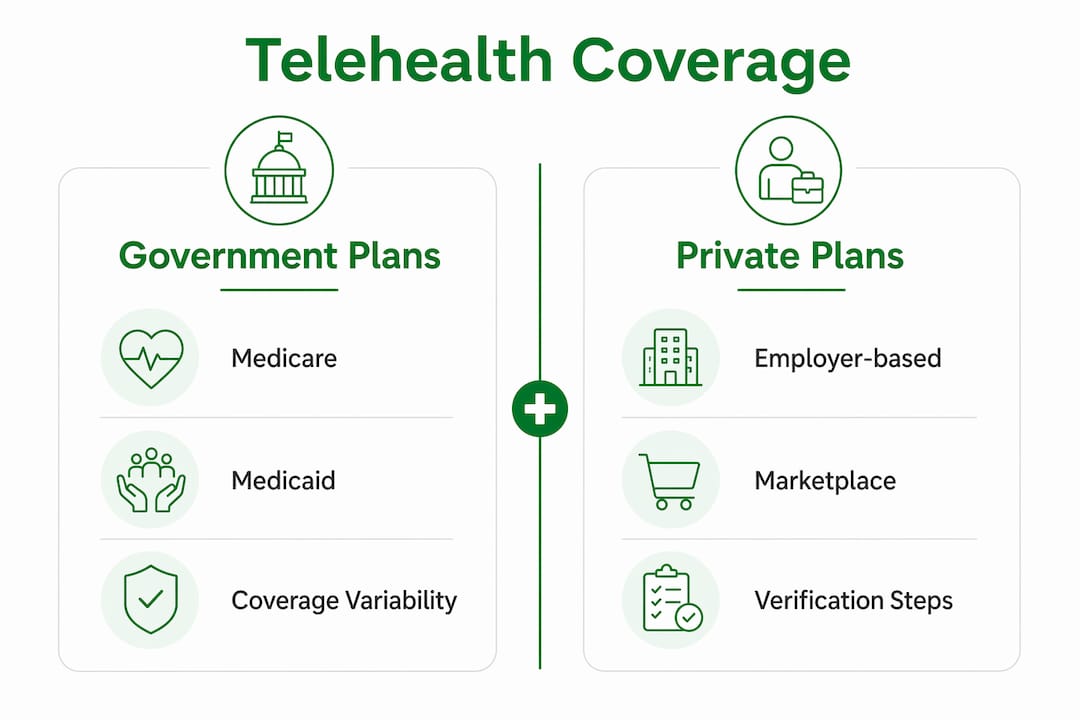
Medicaid is a different story. Each state sets its own rules on which providers can bill for telehealth, which modalities qualify, and how reimbursement is calculated. A service covered in California may not be covered in Texas. That means you cannot rely on a national summary.
Private commercial plans usually cover some telehealth, but terms vary by employer contract, plan type, and state. HHS guidance recommends treating benefit verification as contract verification: confirm copay, coinsurance, prior authorization, and network recognition for your specific clinician and platform.
Common telehealth modalities and typical coverage:
Because telehealth is a delivery method rather than a standalone benefit, coverage can differ for live video versus audio-only even within the same plan. Always verify the modality, not just the service.
Medicare Part B covers certain telehealth services when a physician or qualified practitioner delivers care via two-way interactive technology. The cost-sharing is consistent: 20% of the Medicare-approved amount after the Part B deductible for covered services. That structure makes cost estimation straightforward once you confirm the service is on Medicare’s covered list.
Covered services include office visits, psychotherapy, certain mental health assessments, and a range of other clinical encounters. Medicare publishes a complete List of Telehealth Services updated annually; checking it before your visit is worth the two minutes it takes.
Medicare Advantage adds a layer of complexity. Medicare Advantage plans and ACO participants may offer telehealth benefits that go beyond Original Medicare, including lower cost-sharing or expanded service lists. Your Medicare Advantage plan documents are the authoritative source, not Medicare.gov alone.
Step-by-step verification for Medicare:
One timing note worth knowing: CMS guidance confirms that certain telehealth flexibilities for Rural Health Clinics and Federally Qualified Health Centers extend through December 31, 2026 for non-behavioral services. Behavioral and mental health telehealth services at RHCs and FQHCs are covered under separate rate structures. Confirm the current status of any flexibility before booking, since these dates can shift with legislation.
Key cost fact: For covered Medicare telehealth services, you pay 20% of the Medicare-approved amount after the Part B deductible. That percentage applies whether the visit is in-person or via video.
The short answer: Medicaid telehealth coverage is set by each state, not by a federal standard. Do not assume that because a service is covered in one state, it is covered in yours.

States decide which providers can bill for telehealth, which modalities qualify for reimbursement, whether originating-site requirements apply, and how they reimburse compared to face-to-face visits. The Center for Connected Health Policy notes that live video is the most widely reimbursed modality across Medicaid programs, while store-and-forward and remote monitoring remain inconsistent across states.
Post-pandemic flexibility is another variable. ASPE briefing documents show that states adopted, extended, or rescinded COVID-era telehealth flexibilities at different rates, and some remain tied to state-level emergency declarations. A policy that was active last year may not be active today.
How to check your state Medicaid rules:
Questions to ask state Medicaid:
Most commercial plans cover some telehealth, but the terms differ by plan type, employer contract, and state. A virtual visit might be billed like a standard office visit under one plan and carry a separate, lower virtual-visit copay under another. Insurer guidance confirms that benefit details vary by plan type, including employer plans, Medicare Advantage, Medicaid managed care, and ACA marketplace plans.

State parity laws add another dimension. Some states require insurers to cover telehealth services on the same terms as in-person care. Understanding mental health parity rules can also affect whether behavioral health telehealth is covered at the same rate as other services. Check your state’s insurance commissioner website for parity requirements.
Fastest verification workflow:
| Verification step | Employer plan | Individual/marketplace plan |
|---|---|---|
| Check SBC for telehealth row | Ask HR for current SBC | Download from healthcare.gov or insurer portal |
| Confirm in-network clinician | Call insurer member services | Call insurer member services |
| Ask about approved platforms | Ask HR or insurer | Ask insurer directly |
| Confirm copay vs. coinsurance | HR or member services | Member services |
| Prior authorization required? | HR or member services | Member services |
For private plans, HHS recommends treating this as contract verification: confirm copay, coinsurance, prior authorization, and network recognition for the specific clinician and platform before the visit.
Call the number on your insurance card and say: “I need to verify telehealth coverage for a specific service before I book an appointment,” following best practices like those recommended in the HEMA Zorgverzekering klantenservice en contactinformatie. That framing gets you to the right department faster than a general benefits question.
Phone/portal script (read verbatim if helpful):
Checklist of what the insurer must confirm:
Pro Tip: Ask the customer service representative for their reference number or employee ID, and request an email confirmation of what was stated. Write down the representative’s name and the time of the call. That documentation can be critical if you need to appeal a denial later.
If the appointment will be billed by a telehealth platform rather than the clinician’s usual practice, confirm whether the platform will bill under the clinician’s NPI or under a separate vendor account. That distinction directly affects in-network status and your payment outcome.
Re-check your coverage immediately before the visit if more than a few weeks have passed since your initial call. Plan terms and network status can change.
Most surprise denials are not about telehealth itself. HHS billing guidance points to in-network or eligibility problems, incorrect coding, and unrecognized platforms as the most common causes. Knowing that shifts your focus: the pre-visit verification call is your best defense.
Common billing pitfalls:
Steps after a denial:
Yes, there are near-term deadlines that could affect your coverage. CMS guidance confirms that certain telehealth payment flexibilities for RHCs and FQHCs for non-behavioral services run through December 31, 2026. Behavioral and mental health telehealth services at those facilities follow a separate rate structure. Congress has extended Medicare telehealth flexibilities multiple times; the current extension runs through December 31, 2027 for many home-based services, but specific provisions vary.
On the Medicaid side, state-level flexibility tied to COVID-era emergency declarations has been uneven. Some states made pandemic-era expansions permanent; others let them expire. Checking your state Medicaid page at least once a year is not excessive.
Official pages to bookmark:
Subscribe to your insurer’s email alerts and bookmark your state Medicaid page. Policy changes rarely come with advance notice to patients.
Verifying telehealth coverage before your visit requires confirming the specific service, modality, clinician, and cost-sharing with your insurer or program, because telehealth is a delivery method, not a standalone benefit, and rules differ across Medicare, Medicaid, and private plans.
| Point | Details |
|---|---|
| Call before you book | Confirm service, modality, in-network clinician, and cost-sharing with member services or your insurer portal. |
| Medicare cost-sharing is predictable | You pay 20% after the Part B deductible for covered services; confirm the service is on Medicare’s covered list. |
| Medicaid rules are state-specific | Check your state Medicaid agency site or the HHS Policy Finder; live video is most widely covered, other modalities vary. |
| Private plans require contract-level checks | Confirm copay, prior authorization, and platform recognition; billing can differ between employer and marketplace plans. |
| AM Rx handles verification and billing | AM Rx assists with insurance verification and billing logistics for telehealth visits, reducing the risk of surprise denials. |
There is a gap between what people think “covered” means and what insurers actually process. Most patients hear “yes, we cover telehealth” from a customer service rep and book the appointment. Then the claim comes back denied because the platform billed under a vendor account instead of the clinician’s NPI, or because the place-of-service code was wrong, or because the audio-only visit was not covered under that specific plan.
The verification steps in this guide are not bureaucratic box-checking. They are the difference between a $30 copay and a $200 surprise bill. The pre-call script exists because insurers process claims based on codes and network status, not on what a rep said over the phone. Getting a reference number and written confirmation is the only way to hold an insurer accountable to what they told you.
One thing that often gets overlooked: the clinician’s NPI matters more than the platform name. A telehealth visit billed under a third-party platform’s vendor account can fall outside your in-network benefit even when the clinician is in-network. That is not a technicality. It is a billing reality that catches patients off guard regularly. Confirming how the claim will be submitted takes thirty seconds and can save a significant amount of money.
For mental health and psychiatric telehealth visits specifically, parity laws may require your insurer to cover them on the same terms as in-person care. If your plan denies a behavioral health telehealth claim at a higher cost-sharing rate than an equivalent in-person visit, that may be a parity violation worth escalating.
Navigating insurer portals and Medicaid state pages takes time most people do not have before an appointment. AM Rx offers telehealth visits across primary care, mental health, weight loss, and more, with transparent insurance handling built into the process. The team assists with insurance verification and billing logistics so you are not left piecing together coverage details on your own.

Same-day appointments are available, and the platform is designed to handle the billing side clearly, including confirming in-network status and helping patients understand their cost-sharing before the visit. If you want a provider that manages the verification process alongside you, check your eligibility with AM Rx before your next visit.
Keeping these pages bookmarked means you can re-verify coverage whenever a policy changes, a new plan year starts, or you switch providers.
Subscribe to insurer email alerts and check these pages at the start of each plan year. For Medicare, the annual Notice of Change arrives each fall and may include telehealth benefit updates worth reviewing before January 1.