On-demand telehealth visits typically run a few minutes, primary care video visits are often scheduled within a day or two, and mental health appointments usually land within hours to a few days. A 2025 systematic review found telemedicine cuts total wait time by a weighted average of 25.4 days across specialties compared with in-person scheduling. The rest of this article breaks down what drives the difference and what you can do about it.
TL;DR:
- Telehealth wait times vary significantly by visit type, with on-demand urgent care typically under 20 minutes and scheduled primary care often within two days.
- Factors like platform routing, staffing hours, pre-visit preparation, and technical readiness strongly influence actual delays, with poorly optimized systems extending wait times.
- Overall, telehealth reduces total wait time by an average of 25.4 days across specialties compared to in-person care, but patience may still be shorter once logged in.
- Completing intake forms early, verifying insurance beforehand, and staying flexible on visit format can significantly shorten personal waiting periods.
- Disparities exist for vulnerable populations, such as older adults or those with limited internet, who face longer effective waits due to technology and process barriers.
Wait times swing hard depending on what kind of care you’re booking, and lumping them together is where most patient confusion starts. An on-demand urgent care video visit and a scheduled psychiatric evaluation are not the same animal, even though both fall under “telehealth.”
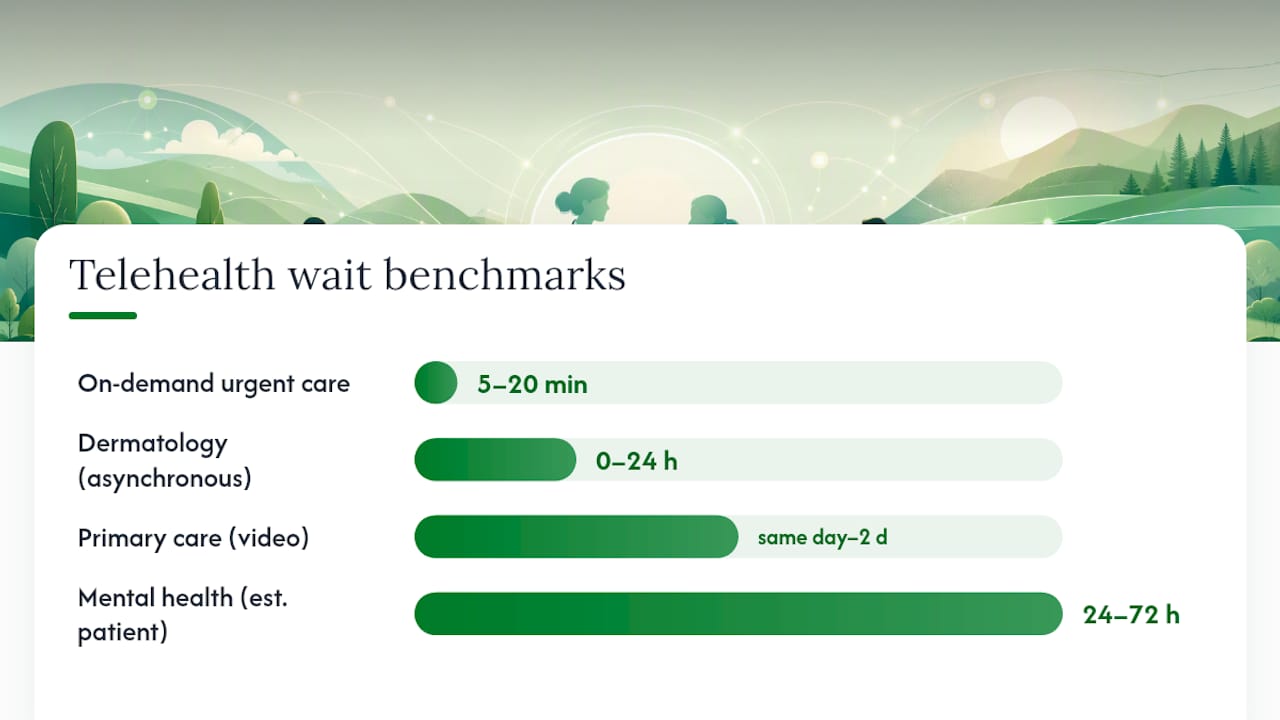
On-demand urgent care sits at the fast end of the spectrum. Industry data on telemedicine wait times puts the common range at 5 to 20 minutes, with the strongest platforms clearing patients in under 10. One study of an integrated virtual urgent care system recorded an average daily wait of 47.7 minutes for virtual visits versus 68.89 minutes for in-person urgent care, and that gap widens once you factor in drive time and parking.
Primary care usually falls into a same-day-to-a-few-days window. A study covering more than 2 million primary care visits found 56.58% of video visits were booked within a single day, compared with 46.49% for in-person appointments. Meantime to appointment came out to 2.29 days for video versus 3.52 days for in-person care. If you need a specific doctor for ongoing management, expect that number to stretch.
Mental health telehealth generally books faster than most people assume. Many providers schedule within 24 to 72 hours for established patients. New-patient psychiatric evaluations are the exception. Those can take days to weeks depending on specialist availability, similar to what you’d see trying to get an in-person slot.
Dermatology splits into two tracks. Live video visits behave like primary care, often same-day to a few days out. Asynchronous “store-and-forward” visits, where you upload photos and a provider reviews them later, typically return an answer same-day to within 24 hours.
Pro Tip: If a photo-based dermatology review fits your situation, it almost always beats waiting for a live video slot. You skip the scheduling step entirely.
Here’s a rough benchmark for what “reasonable” looks like by category:
The numbers that matter: Video primary care visits get scheduled in 2.29 days on average, versus 3.52 days for in-person care, a gap of more than a full day, according to research on appointment timeliness.
Anything well outside these ranges, say, a 45-minute wait for an on-demand urgent care visit, or a two-week wait for an established mental health follow-up, is a signal something operational is off, not a normal part of virtual care.
Wait time isn’t random. It’s the output of a handful of variables, some the platform controls, and some you control.
Platform routing matters more than most patients realize. Systems that auto-assign patients to the next available provider clear queues faster than ones relying on manual triage. Research on operational drivers of telehealth performance found that infrastructure and process design often account for more wait-time variance than the raw number of providers on staff. A platform with 200 providers and clunky routing can still leave you stuck longer than one with 50 providers and smart automated assignment.
Provider availability and staffing models set the ceiling. A platform that staffs light evening hours or weekends will show longer waits during those windows regardless of how good its routing software is.
Visit type and urgency change the calculus entirely. On-demand visits compete for the next open slot; scheduled continuity visits get calendared in advance, so “wait time” means something different for each.
Pre-visit readiness is the biggest lever patients hold. Incomplete intake forms, missing consent, or unverified insurance are frequent causes of delay. Research on telehealth check-in processes found that fragmented pre-visit preparation is a recurring bottleneck, and that automated reminders and integrated portals meaningfully cut those delays.
Technical barriers stall visits before they even start: a weak broadband connection, an outdated app, a forgotten login. These add minutes, sometimes visits, to the process, especially for patients less comfortable with digital tools.
Time, day, and seasonal demand spike wait times predictably. Monday mornings, cold and flu season, and the days after a holiday weekend all push queues longer across nearly every telehealth category.
Here’s the breakdown of what’s within a platform’s control versus your own:
Pro Tip: Fill out intake forms the night before a scheduled visit, not five minutes beforehand. Platforms that require ID verification or insurance card uploads often bump incomplete profiles to the back of the queue.
The evidence leans decisively toward telehealth being faster, and the gap is bigger than most patients expect.
The clearest data point comes from a 2025 systematic review and quantitative analysis, which found telemedicine implementation reduced total wait time by a weighted mean of 25.4 days across specialties. Break that down further and the effect is uneven: clinical specialties saw a larger reduction, while surgical patients saw a smaller reduction in wait times. That’s not a marginal improvement. For someone waiting on a specialist referral, a month less waiting changes how a condition gets managed.
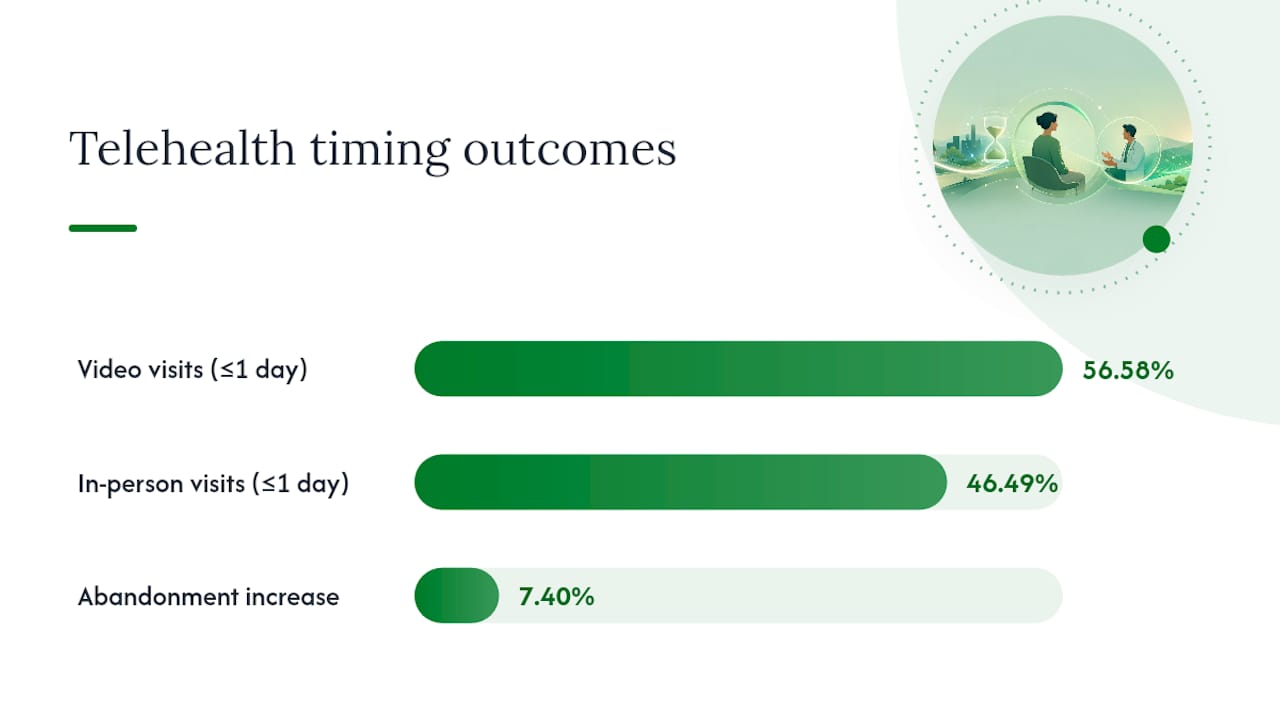
The primary care data tells a similar story at a different scale. In the large-scale analysis of over 2 million visits, video visits beat in-person scheduling on every timeliness measure tracked. More than half of video visits (56.58%) were booked within a day, compared with under half (46.49%) for in-person visits.
There’s a catch, though, and it’s one operations researchers have flagged clearly. Telehealth patients are more sensitive to delays once they’re already in the queue. A study on outpatient visit incompletion found that intraday delay, meaning a provider running behind on earlier appointments, increases telehealth incompletion (patients leaving without being seen) by a measurable percentage. In-person patients, stuck in a waiting room with nowhere else to be, tolerate delay differently. Telehealth patients close the laptop.
Key evidence at a glance:
The number that changes planning: A 7.40% jump in incompletion tied to in-session delay means the biggest risk to your telehealth visit isn’t the initial booking wait. It’s what happens after you’ve already logged in, according to operations research on visit incompletion.
What this means practically: telehealth will very likely get you scheduled faster than an in-person equivalent. But once you’re in the virtual waiting room, patience has a shorter shelf life, and platforms know it.
Most of what determines how long you wait happens before the visit even starts. Here’s the order of operations that actually moves the needle.
Complete intake and consent paperwork in advance. Platforms flag incomplete profiles and often push them behind fully-prepped patients in the queue. Filling out your telehealth consent and medical history the day before, not the minute of, removes the single most common bottleneck research points to.
Verify insurance and authorization requirements before you book. If your visit needs prior authorization or a specific coverage confirmation, sorting that out ahead of time prevents a mid-visit stall or a rescheduled appointment.
Join the virtual waiting room a few minutes early and turn on notifications. Platforms with callback or “we’ll text you” features let you step away instead of babysitting a browser tab. Use that feature if it’s offered.
Stay flexible on visit format. If your situation is clinically appropriate for an audio-only call or an asynchronous review instead of live video, take it. Asynchronous dermatology reviews, for example, often return same-day answers without any scheduling wait at all.
State your urgency clearly at booking. “I need a refill” and “I have a spreading rash with fever” should never funnel into the same queue. Most platforms triage based on what you tell them, so vague descriptions get average treatment.
Know your exit ramp if the wait runs long. If you’ve been sitting in a virtual waiting room well past the platform’s stated estimate, ask for a callback slot instead of staying logged in indefinitely. If your symptoms escalate while you wait, that’s not a telehealth situation anymore. Head to urgent care or an emergency room.
Pro Tip: If a platform gives you an estimated wait time and you blow past it by more than double, don’t keep refreshing the page. Reschedule or request a callback. Sitting in a stalled queue is exactly the scenario tied to higher visit abandonment.
None of this guarantees a five-minute visit every time. But readiness on your end removes the delays that are actually preventable, and that’s most of them.
The operational side of a telehealth platform matters as much as the medical side. Two platforms with identical provider rosters can produce very different wait experiences based purely on how they’re built.
Automated routing is the clearest lever. Systems that assign patients to the next available provider in real time, rather than relying on staff to manually triage a queue, consistently clear volume faster. Research on operational drivers of telehealth wait times found infrastructure and process design frequently outweigh raw provider headcount in explaining wait-time variance.
Integrated intake removes a step that otherwise happens live, during the visit. When a platform pulls insurance verification, medical history, and consent into a single pre-visit flow, providers start the actual consultation faster. Data-driven analysis of telehealth check-in processes points to automated reminders and integrated portals as concrete fixes for the fragmented intake that causes delays in the first place.
Same-day appointment workflows matter for anyone who needs care now, not next week. AM Rx structures its same-day telehealth visits around this exact gap, aiming to get patients in front of a provider the day they reach out rather than routing them into a multi-day queue.
Lab-order integration cuts a different kind of wait, the one between your visit and your next step. When a provider can order labs directly through the platform, as with AM Rx’s telehealth lab orders, you skip a separate scheduling loop with an outside lab.
Real-time status updates, accurate wait estimates, and callback options do more than shorten the clock. They change whether patients stick around for the visit at all, according to research on telehealth check-in optimization.
A few features that reliably move the needle on wait time:
None of this erases clinical reality. A same-day workflow can only move as fast as provider availability allows, and complex cases still need the time they need. Technology shortens the parts of the process that are administrative, not the parts that require actual medical judgment.
Wait-time averages hide a real split in who experiences delay. Patients without reliable broadband, older adults less comfortable navigating a portal, and non-English speakers face longer effective waits, even when the platform’s stated average looks fine.
Research on telehealth access across specialty clinics found that fragmented pre-visit workflows disproportionately affect older adults and people with limited digital literacy. A confusing portal or a multi-step login isn’t just an inconvenience for these patients. It’s a wait-time multiplier, since a failed login attempt or an abandoned intake form often means starting over, or missing the visit entirely.
This connects directly to no-show rates. A patient who can’t complete intake on a shaky connection is more likely to drop off before the visit starts, which shows up in the data as incompletion, not as a “long wait.” Simplified portals, audio-only options for patients without stable video bandwidth, and multilingual intake materials all reduce this gap.
The practical fix isn’t complicated: platforms that offer a phone-based fallback and plain-language instructions see fewer patients falling through the cracks. If you’re helping an older relative or a family member less comfortable online, building in extra time for the login and intake steps before the appointment window opens is worth it.
Specialty care behaves differently from general telehealth, largely because specialist supply is tighter everywhere, virtual or in-person.
Endocrinology and behavioral health show some of the clearest telehealth advantages. Research on specialty clinic telehealth access found shorter time-to-appointment and lower no-show rates for both new and established patients in integrated systems offering virtual specialty visits, compared with in-person-only scheduling.
Pediatrics tends to track closer to primary care timelines for straightforward concerns, often same-day to a few days, since much pediatric telehealth covers common illnesses rather than complex referrals. Specialist pediatric subspecialties (developmental, endocrine) follow slower, more limited-availability timelines similar to adult specialty care.
Cardiology telehealth splits by visit purpose. A follow-up on stable, previously diagnosed condition can often be scheduled within days. A new cardiac concern requiring diagnostic workup usually still needs in-person testing folded into the process, which stretches the overall timeline regardless of how fast the video portion gets booked.
The pattern across specialties: telehealth shortens the scheduling wait consistently, but doesn’t erase the underlying scarcity of specialists in narrow fields. If a subspecialist has a three-week backlog in-person, virtual visits shrink that backlog somewhat, they don’t eliminate it.
Yes, and the variation tracks closely with broadband access and provider density rather than telehealth adoption itself.
Rural areas often see the largest relative benefit from telehealth, precisely because in-person specialist wait times are longest there to begin with. A patient three hours from the nearest endocrinologist gains more from a video visit than someone in a city with five in-network options nearby. But that same rural patient is also more likely to face broadband limitations that slow down the visit itself, an uneven trade-off.
Urban and suburban markets tend to have denser provider networks feeding into telehealth platforms, which shortens on-demand queue times during peak hours. Metro areas also generally see faster 4G and 5G speeds, reducing the technical-barrier delays common in more remote regions.
State-level insurance and licensure rules add another layer. Providers must be licensed in the patient’s state, so a platform with strong coverage in one state can show noticeably faster availability there than in a state where it has fewer licensed clinicians on staff. This is worth checking before assuming a platform’s average wait time applies evenly everywhere it operates.
Coverage type affects wait time indirectly, mostly through authorization requirements rather than the visit itself.
Self-pay and cash-pay telehealth visits generally move fastest, since there’s no prior-authorization step or insurance verification holding up scheduling. Platforms offering transparent self-pay pricing can often get a patient from booking to visit in the shortest possible window.
Insured visits, particularly through Medicaid or plans requiring prior authorization for specialty referrals, can add days to the front end of the process. This isn’t a telehealth-specific problem. It’s a byproduct of the authorization step existing at all, whether the visit happens on video or in person.
High-deductible plans sometimes push patients toward self-pay telehealth for minor, common issues simply because the out-of-pocket cost is comparable and the wait is shorter. Platforms handling insurance coordination directly, rather than leaving verification to the patient, tend to shave meaningful time off this part of the process.
Patient satisfaction with telehealth tends to track closely with whether the actual wait matched the expected wait, more than the raw number of minutes involved.
A five-minute wait that was promised upfront generates less frustration than a fifteen-minute wait with no estimate given at all. This lines up with the operations research on incompletion: patients tolerate delay better when they have visibility into it, through a queue position, a callback offer, or a real-time estimate. Platforms lacking that transparency see higher abandonment even at comparable average wait times.
Satisfaction scores also tend to favor telehealth over in-person care specifically because the “dead time” feels less wasted. Waiting on a couch at home with a laptop open reads differently to most patients than sitting in a clinic waiting room, even when the clock says the same number.
Where satisfaction drops sharply is technical failure mid-visit: a dropped connection, a frozen screen, a forced restart. These incidents generate outsized frustration relative to their time cost, because they compound an already-imperfect experience.
Telehealth wait times have generally improved since the early pandemic years, when demand vastly outpaced platform capacity and provider licensure flexibility.
During the initial COVID-19 emergency period, many platforms saw wait times balloon as patient volume surged faster than staffing could scale. Emergency licensure waivers helped providers see patients across state lines temporarily, easing some of that pressure, but the sheer volume still stretched queues well beyond what’s typical today.
Since then, platforms have matured their routing systems, expanded staffing models, and built the integrated intake processes described earlier in this article. The 2025 systematic review reflects this maturity, showing telemedicine now delivering a consistent 25.4-day average reduction in total wait time across specialties, evidence of a more stable, operationally refined system than what existed in 2020 and 2021.
The bigger shift is structural: telehealth has moved from an emergency substitute to a standing part of how primary care, mental health, and several specialties get delivered. That permanence is what’s let platforms invest in the routing and intake infrastructure that keeps wait times down.
Faster isn’t always better, and treating every telehealth visit like a race misses the point. Speed makes sense for acute, low-complexity problems: a UTI, a medication refill, a rash that needs a quick look. Waiting extra days for your regular doctor when a same-day provider can handle it in ten minutes is not continuity, it’s inertia.
Continuity earns the wait when the case has history behind it. A new psychiatric evaluation, a complex chronic condition, a diagnosis that needs a clinician who already knows your chart, these benefit more from a slightly longer wait for the right provider than from the fastest available slot.
The rule of thumb: if a stranger with your chart in front of them could handle it competently, take the fast option. If the value is in someone who already knows your history, wait for them.
— Bryan
AM Rx is built around cutting the parts of a telehealth visit that don’t need to be slow. Its same-day telehealth scheduling gets you in front of a provider the day you reach out, backed by integrated intake so your history, insurance, and consent are handled before the visit starts, not during it.

Exact wait still depends on visit type and provider availability, a psychiatric evaluation and a same-day sore throat visit are not going to move at the same speed. But for common, time-sensitive needs, AM Rx’s integrated model, same-day booking, telehealth lab orders, and direct prescription delivery, removes several of the scheduling steps that typically add days to virtual care. If you’re managing a condition like erectile dysfunction or need a primary care visit without the multi-day wait, start by checking same-day availability for your state and visit type.
This article is general information, not a substitute for advice from a qualified doctor. Consult a qualified healthcare professional about your own circumstances before acting on anything here.
On-demand telehealth visits typically take 5 to 20 minutes to connect with a provider, while scheduled visits like primary care or mental health are often booked within 1 to 3 days, according to industry wait-time data and primary care scheduling research.
Yes. A systematic review found telemedicine reduces total wait time by a weighted average of 25.4 days across specialties compared with in-person scheduling.
If an on-demand visit runs well past 20 minutes with no callback option offered, or a scheduled visit’s stated wait time doubles without an update, that’s outside the normal range and worth escalating or rescheduling.
Prior-authorization requirements on some insured visits can add days to the scheduling process, while self-pay visits typically avoid that step and move faster to booking.
Many platforms, including AM Rx’s same-day telehealth service, structure scheduling specifically to get patients seen the day they request care, though availability still depends on visit type and provider capacity.