Yes, sildenafil commonly causes mild, temporary side effects. Headache, facial flushing, a stuffy nose, and mild indigestion are the ones most people notice, and they usually fade within a few hours. A much smaller group of people experience something serious: sudden vision loss, sudden hearing loss, an erection lasting more than four hours, or chest pain. Those need emergency care, not a wait-and-see approach.
Rare complications like stroke, heart attack, and irregular heartbeat affect up to 1 in 1,000 people taking sildenafil, according to MedlinePlus. Your dose and whatever else is in your medicine cabinet, especially nitrates, largely determine where you land on that risk spectrum.
Sildenafil’s side-effect risk is driven mainly by dose and drug interactions, especially nitrates, and almost all serious complications are rare but require emergency care, not a wait-and-see approach.
| Point | Details |
|---|---|
| Mild effects are common | Headache, flushing, congestion, and indigestion affect many users but usually fade within hours. |
| Emergency symptoms exist | Sudden vision or hearing loss, priapism over 4 hours, and chest pain need 911 or an ER visit. |
| Nitrates are an absolute no | Combining sildenafil with nitrate medications can cause dangerous, sometimes fatal, drops in blood pressure. |
| Dose drives risk | Higher doses raise the likelihood of side effects, so clinicians typically start low and adjust. |
| Telehealth screens before prescribing | AM Rx reviews cardiovascular history and medication lists before approving a sildenafil prescription. |
Most people who take sildenafil for erectile dysfunction or pulmonary hypertension deal with something mild, not something dangerous. The standard list includes headache, flushing, a congested or runny nose, indigestion, back pain, muscle aches, and mild changes in vision, sometimes described as a blue tint to eyesight or increased light sensitivity.
Onset tends to happen within 30 to 60 minutes of taking the tablet, which lines up with when the drug reaches peak concentration in the bloodstream. The good news: clinical summaries indicate that side effects fall sharply within hours after dosing for most people, and long-term discontinuation because of side effects is uncommon.
That doesn’t mean every symptom is created equal. A headache that responds to water and an over-the-counter pain reliever is a nuisance. A headache paired with visual disturbance or chest tightness is a different animal entirely, and it deserves a phone call to your provider rather than a shrug.
Frequency and severity of these effects are dose dependent. Providers commonly start patients at lower dosages and adjust upward only as needed, which is one reason a telehealth intake process asks so many questions before writing a prescription. The lowest effective dose isn’t a cautious afterthought. It’s the actual clinical strategy for keeping side effects manageable while still treating erectile dysfunction or pulmonary arterial hypertension.
Muscle aches and back pain show up less often than headache or flushing, but they’re recognized enough to appear in most prescribing summaries. They typically resolve on their own within a day, without any specific treatment beyond rest and time.
A short list of sildenafil reactions cross the line from “annoying” to “get help now.” Knowing the exact symptoms, not just vague categories, is what lets you act fast instead of hesitating.
Vision loss. Sudden vision loss or decrease, including a condition called nonarteritic anterior ischemic optic neuropathy (NAION), has been reported with sildenafil and related medications. Warning signs include a sudden drop in vision, new blind spots, or a rapid change in color perception. Doctors cannot always prove sildenafil caused a given case of NAION, but the standard advice holds regardless: stop the medication and get evaluated immediately if your vision changes suddenly.

Hearing loss. Sudden hearing loss or decrease, sometimes with ringing in the ears (tinnitus) or dizziness, is another rare but recognized reaction. Treat it the same way as sudden vision loss: stop taking the drug and seek care right away.
Priapism. An erection that is painful or lasts longer than four hours is a urological emergency, not something to wait out. Blood trapped in the penis for too long can damage tissue permanently. People with sickle cell disease, blood disorders, or certain cancers face higher risk and should discuss this specifically before starting sildenafil.
Cardiovascular events. Chest pain, irregular heartbeat, heart attack, and stroke are rare but serious possibilities, especially in people with existing heart disease or those combining sildenafil with nitrates.
Pro Tip: Keep the pharmacy insert or a photo of the sildenafil label on your phone. If you ever need to describe symptoms to an ER doctor or a telehealth provider, having the exact dose and formulation on hand speeds up triage considerably.
The single most important interaction rule with sildenafil involves nitrates, and it isn’t a soft suggestion. Nitroglycerin, isosorbide, and other nitrate medications combined with sildenafil can cause a severe, sometimes fatal drop in blood pressure. Both drug classes relax blood vessels through overlapping pathways, and stacking them can crash blood pressure to dangerous levels within minutes. If you take nitrates in any form, including short-acting sprays for angina, sildenafil is off the table entirely.
Alpha-blockers and other blood-pressure medications require more nuance than an outright ban. Cardiovascular status is central to sildenafil safety, so clinicians often stagger the timing of alpha-blockers and sildenafil, or start at a lower sildenafil dose, to avoid additive drops in blood pressure. This is exactly the kind of adjustment a thorough medical history catches before it becomes a problem.
Some antidepressants and other common prescriptions carry their own interaction profiles worth reviewing with a provider, particularly if you’re on a multi-drug regimen. Anyone managing a stack of prescriptions, including antidepressants, benefits from a full medication review before adding sildenafil to the mix. The goal isn’t to scare you off treatment. It’s to make sure whoever prescribes it actually sees your full medication list first.
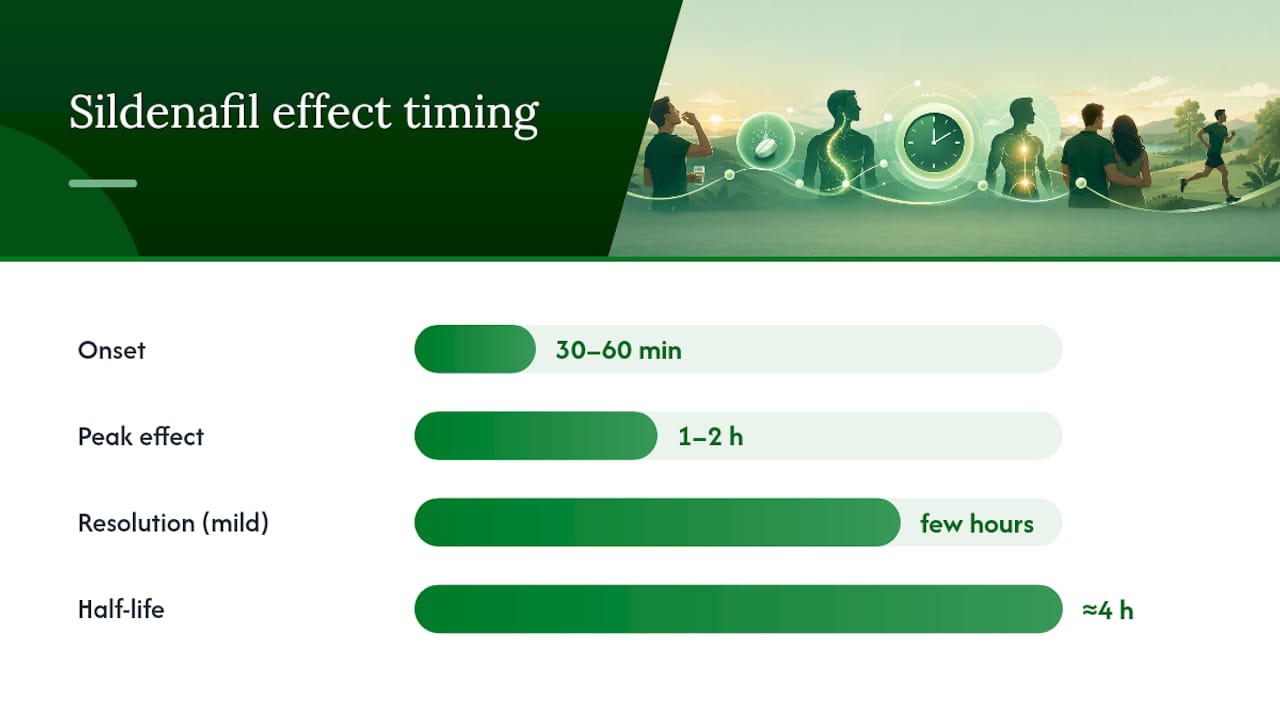
Most people notice something within 30 to 60 minutes of taking sildenafil, which tracks with how quickly the drug reaches peak levels in the blood. Mild effects like headache and flushing generally start fading within a few hours as the drug clears your system. Sildenafil has a half-life of roughly four hours, so its effects, wanted and unwanted, taper off well before the next day in most healthy adults.
Dose matters more than most people expect. Higher doses correlate with higher rates of certain effects, particularly visual disturbances and stomach upset, which is exactly why starting low and adjusting only if needed is standard clinical practice rather than an overly cautious default. A patient who jumps straight to the maximum dose without trying a lower one first is taking on side-effect risk with no proven benefit to match it.
Taking sildenafil with a high-fat meal can slow absorption, which sometimes delays onset and may ease some digestive side effects, though it can also blunt how quickly the medication works. Timing sildenafil around meals is one of the small, practical adjustments a provider can walk you through based on your own response.
Persistent or late-onset symptoms, ones that show up well outside the typical window or that don’t fade the way earlier doses did, are a signal to check back in with your provider rather than assume they’ll resolve on their own. A pattern that changes between doses is worth a conversation, not a shrug.
Most mild side effects respond to basic self-care. Here’s the practical playbook:
Write down what happened, when it started, the dose you took, and how long it lasted. That record helps your provider spot patterns and matters if you ever need to file a report with FDA MedWatch, the government’s system for tracking medication side effects.
Pro Tip: Log side effects the same day they happen, not a week later. Memory blurs details like exact timing and dose, and those details are precisely what a clinician needs to tell a coincidence apart from a real drug reaction.
A responsible telehealth visit for sildenafil starts with a real medication and cardiovascular history review, not a rubber stamp. Providers check for nitrate use, uncontrolled blood pressure, recent heart events, and other contraindications before ever recommending a starting dose. That screening step is what separates a safe prescription from a risky one.
Follow-up matters just as much as intake. A good process asks how the medication is working, tracks any side effects you report, and adjusts dose or switches approaches if something isn’t sitting right. Certain situations, like complicated cardiac history or symptoms that don’t fit a clean pattern, call for an in-person exam rather than a video visit. AM Rx builds its ED evaluation process around exactly that judgment call, pairing virtual access with the same clinical rigor a good in-person visit would apply.
AM Rx gets you a licensed provider’s eligibility screening, a sildenafil prescription when appropriate, and home delivery, without a waiting room or a rushed in-person visit squeezed into a lunch break.

A virtual visit works well for most adults seeking treatment for erectile dysfunction, but it isn’t the right path for everyone. If you have a complicated cardiac history, take nitrates, or you’re not sure what’s causing your symptoms, an in-person exam should come first, and AM Rx providers will tell you that directly rather than push a prescription through anyway. For everyone else, the process is built to be fast: complete a health history, talk with a provider through video, and get your prescription sent to your door if you’re approved.
Before you book, have your current medication list ready, including anything over-the-counter, and note any heart or blood pressure history. Start your ED evaluation today, or review the consent to telehealth details to see exactly how the virtual visit works before you commit.
This article is general information, not a substitute for advice from a qualified doctor. Consult a qualified healthcare professional about your own circumstances before acting on anything here.
Most people experience mild, temporary effects like headache, flushing, congestion, or indigestion. A small number face rare but serious risks, including vision or hearing loss, priapism, or cardiovascular events, particularly if combined with nitrates.
Sildenafil is the active ingredient in Viagra, so a standard sildenafil tablet at the same dose works identically. Brand and generic versions differ in price and formulation, not in how the drug performs at an equivalent dose.
Avoid nitrate medications entirely, since the combination can cause a dangerous drop in blood pressure. Skip grapefruit juice and heavy alcohol use as well, since both can intensify or prolong side effects.
Daily low-dose sildenafil is sometimes prescribed for pulmonary arterial hypertension under close medical supervision. For erectile dysfunction, it’s typically taken as needed rather than daily, and any daily regimen should be guided by a provider who monitors your cardiovascular health over time.