TL;DR:
- Most men tolerate finasteride well, with sexual side effects being mild, often improving over time. Serious adverse reactions are rare but require prompt medical attention, especially breast changes or allergic responses. Ongoing monitoring and informed consent are essential for safe use, particularly regarding dose differences and long-term effects.
Most men who take finasteride tolerate it without major problems. Sexual side effects do occur, they are usually mild and often improve over time, and rare but serious reactions exist that require prompt attention. If you develop severe psychiatric symptoms, a breast lump, or a serious allergic reaction, stop the medication and contact a clinician immediately. You can report adverse events directly to the FDA MedWatch program.
Clinical trial data from the PROPECIA label shows that drug-related sexual adverse events occurred in roughly 1–2% of men on the 1 mg dose, compared to under 1.5% on placebo. Those numbers are small in absolute terms, but they are real, and the picture changes at higher doses and over longer treatment periods.
Pro Tip: Before starting finasteride, document your baseline sexual function and mood in a few sentences. If something shifts later, you will have a clear reference point to share with your clinician.
Finasteride is a 5α-reductase inhibitor. It works by blocking the enzyme that converts testosterone into dihydrotestosterone (DHT), a hormone responsible for both prostate growth and male pattern hair loss. Lower DHT means a smaller prostate or slower hair loss, depending on why you are taking it.
The dose determines a lot:
When you read a study or a product label, always check which dose was used. A finding from a Proscar trial does not automatically apply to someone taking Propecia for hair loss, and vice versa. The PROSCAR prescribing information documents higher sexual adverse-event rates at 5 mg than the 1 mg Propecia label reports, which is a direct reflection of dose-dependent DHT suppression.
Sexual adverse effects are the most commonly reported finasteride side effects, and the clinical trial data gives a clearer picture than most online summaries do.
Three controlled 12-month trials of 1 mg finasteride reported the following drug-related sexual adverse events at incidence ≥1%:
| Side Effect | Finasteride 1 mg | Placebo |
|---|---|---|
| Decreased libido | ~1.8% | ~1.3% |
| Erectile dysfunction | ~1.3% | ~0.7% |
| Ejaculation disorders | ~1.2% | ~0.7% |
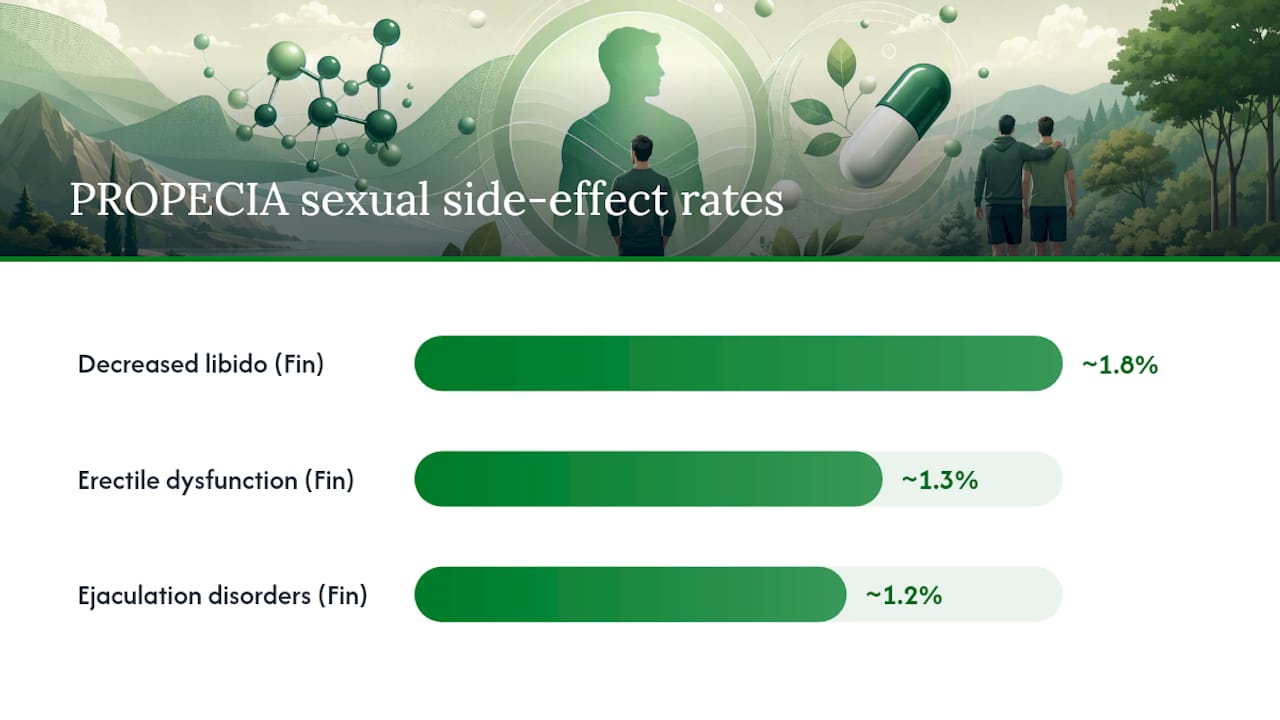
The absolute differences are modest. By year five of continuous treatment, incidence for each category fell to ≤0.3%, suggesting the body adapts for most men.
The 5 mg dose tells a different story. Long-term data from the PLESS study (PROSCAR Long-Term Efficacy and Safety Study) show higher rates of impotence and decreased libido in year one compared to placebo, reinforcing that dose matters when weighing risk.
StatPearls clinical summaries place erectile dysfunction rates for finasteride broadly in the 2–4% range across studies, which reflects the wider real-world population beyond tightly controlled trials.
Decreased ejaculatory volume is a separate effect worth knowing about. It does not always appear in the headline numbers but is documented in product labeling and MedlinePlus drug information. For men actively trying to conceive, even a modest reduction in semen parameters matters. The 1 mg dose has minimal evidence for permanent infertility, but the 5 mg dose more consistently affects semen quality, and that effect is generally reversible after stopping.
Pro Tip: If you are trying to conceive, tell your prescribing clinician before starting finasteride. A shared decision about timing and dose can prevent an avoidable complication.
The link between finasteride and mood changes is real but more complicated than headlines suggest.
The Prostate Cancer Prevention Trial (PCPT), a large randomized study with long-term follow-up linked to Medicare claims, found that men who took finasteride had a modestly higher rate of new depression claims compared to placebo, with a hazard ratio of approximately 1.10 (95% CI 1.01–1.19). A hazard ratio of 1.10 means roughly a 10% relative increase in risk. Over a median follow-up of about 16 years, that signal was statistically significant but small in absolute terms.
The MHRA safety review and Public Assessment Report identified psychiatric signals including depression and anxiety in pharmacovigilance data and recommended better patient awareness and active monitoring, highlighting the importance of understanding medication choices as discussed in Concerta vs Vyvanse: Which Should You Discuss With Your Prescriber?. The MHRA review also noted that causality is difficult to establish cleanly because sexual dysfunction itself can cause depression, and some men who develop mood symptoms may have had preexisting psychiatric vulnerability.
The Propecia SmPC documents mood alterations including depression as adverse reactions and recommends stopping the medication and seeking medical advice if severe psychiatric symptoms occur.
Pro Tip: Tell your prescribing clinician about any personal or family history of depression or anxiety before starting finasteride. That context shapes how closely you should be monitored and whether a lower-risk alternative for hair loss, such as oral minoxidil, might be a better fit.
Most men never experience these, but they appear in postmarketing surveillance and product labeling, and they require prompt action.
Serious adverse events reported with finasteride include:
The NHS patient guidance on finasteride classifies these as serious but rare, occurring in fewer than 1 in 1,000 people. The same guidance advises patients to speak to a doctor immediately if they notice breast changes.
The Propecia SmPC also specifically instructs male patients to report breast changes promptly, given the small but documented signal for male breast cancer in postmarketing reports.
Some men report that sexual side effects continue after they stop taking finasteride. This is called persistent sexual dysfunction, and a subset of cases involving sexual, neurological, and psychiatric symptoms together is sometimes labeled post-finasteride syndrome (PFS).
The MHRA Public Assessment Report recognized persistence as a real pharmacovigilance signal and noted it in product information updates. However, the evidence base has significant limitations: studies use inconsistent definitions, sample sizes are often small, and recall bias is a genuine concern in retrospective reports.
A rigorous definition of persistence typically requires symptoms to last at least 90 days after stopping the medication. Many older case reports do not meet that standard, which makes prevalence estimates unreliable.
Pro Tip: Keep a simple symptom log with dates. A clinician reviewing your case will find a dated record far more useful than a general description of “months of problems.”
Timing matters for setting realistic expectations.
Onset patterns:
Reversibility after stopping:
The picture for psychiatric effects after stopping is less clear. Some men report mood improvement within weeks; others describe a longer recovery. Current data cannot reliably predict individual outcomes.
This is the most absolute contraindication associated with finasteride. Women who are pregnant or may become pregnant must not handle crushed or broken finasteride tablets and should avoid contact with semen from a partner taking finasteride. DHT is required for normal male fetal genital development, and finasteride exposure during pregnancy carries a risk of birth defects in a male fetus. The PROSCAR prescribing information lists pregnancy as a contraindication. Partners who are pregnant or planning pregnancy should discuss barrier contraception with their clinician.
Finasteride does not have many clinically significant drug-drug interactions, but one deserves attention: combining it with alpha-blocker medications (such as doxazosin or tamsulosin, commonly used for BPH) can produce additive orthostatic hypotension. This means a greater drop in blood pressure when standing up, which can cause dizziness or fainting. Patients on both medications should rise slowly from sitting and report dizziness to their clinician.
Finasteride also reduces serum PSA values by approximately 50%. Any clinician ordering a PSA test for prostate cancer screening must know the patient is taking finasteride, or the result will be misinterpreted.
Pro Tip: Always tell your urologist, primary care clinician, and any lab ordering a PSA test that you are taking finasteride. A PSA that looks normal on finasteride may actually be elevated relative to your true baseline.
Safe prescribing of finasteride is not just about handing over a prescription. At AM Rx, the workflow is built around informed consent and ongoing monitoring, not a one-time visit.
When sexual side effects arise, AM Rx clinicians can evaluate whether ED treatment options are appropriate alongside or instead of finasteride. When mood symptoms emerge, the care pathway connects to mental health support within the same platform, so patients are not left to navigate a referral on their own.
Pro Tip: At your first AM Rx follow-up, bring your symptom log. A clinician who can see a dated record of changes can make a much faster and more accurate decision about whether to continue, adjust, or stop your medication.
Finasteride’s sexual side effects are real but small in absolute terms at the 1 mg dose, and most resolve after stopping; the psychiatric signal is modest but documented, and any serious symptom warrants immediate clinician contact.
| Point | Details |
|---|---|
| Sexual side effects at 1 mg | Decreased libido (~1.8%), erectile dysfunction (~1.3%), and ejaculation disorders (~1.2%) in trials, all declining to ≤0.3% by year five. |
| Dose matters | The 5 mg dose (Proscar) carries higher sexual adverse-event rates than the 1 mg hair-loss dose (Propecia). |
| Psychiatric signal | PCPT long-term data found a hazard ratio of ~1.10 for new depression claims on finasteride vs. placebo. |
| Serious reactions are rare | Breast changes, allergic reactions, and persistent sexual dysfunction occur in fewer than 1 in 1,000 people but require prompt medical attention. |
| AM Rx clinical pathway | AM Rx clinicians conduct baseline assessments, provide informed consent, and schedule follow-ups at 3 and 6 months to catch and manage side effects early. |
The conversation around finasteride side effects tends to split into two camps: dismissive (“the rates are tiny, stop worrying”) and alarmist (“it ruins lives”). Neither framing serves the man actually sitting with a prescription in his hand.
What gets lost is the informed-consent gap. Clinical trial numbers like 1.8% versus 1.3% look reassuring on paper, but they come from tightly controlled populations with regular follow-up and active monitoring. Real-world prescribing often lacks that structure. A man who develops low mood three months into treatment may not connect it to finasteride at all, especially if no one told him to watch for it.
The psychiatric signal from the PCPT is worth taking seriously precisely because it is modest. A hazard ratio of 1.10 is not a crisis, but it is a signal that deserves a conversation before prescribing, not after a patient calls in distress. The same applies to the persistent sexual dysfunction reports. The evidence base is imperfect, the definitions are inconsistent, and prevalence is genuinely unclear. But “we don’t know exactly how common it is” is not the same as “it doesn’t happen.” Regulators at the MHRA have recognized it in product information. That matters.
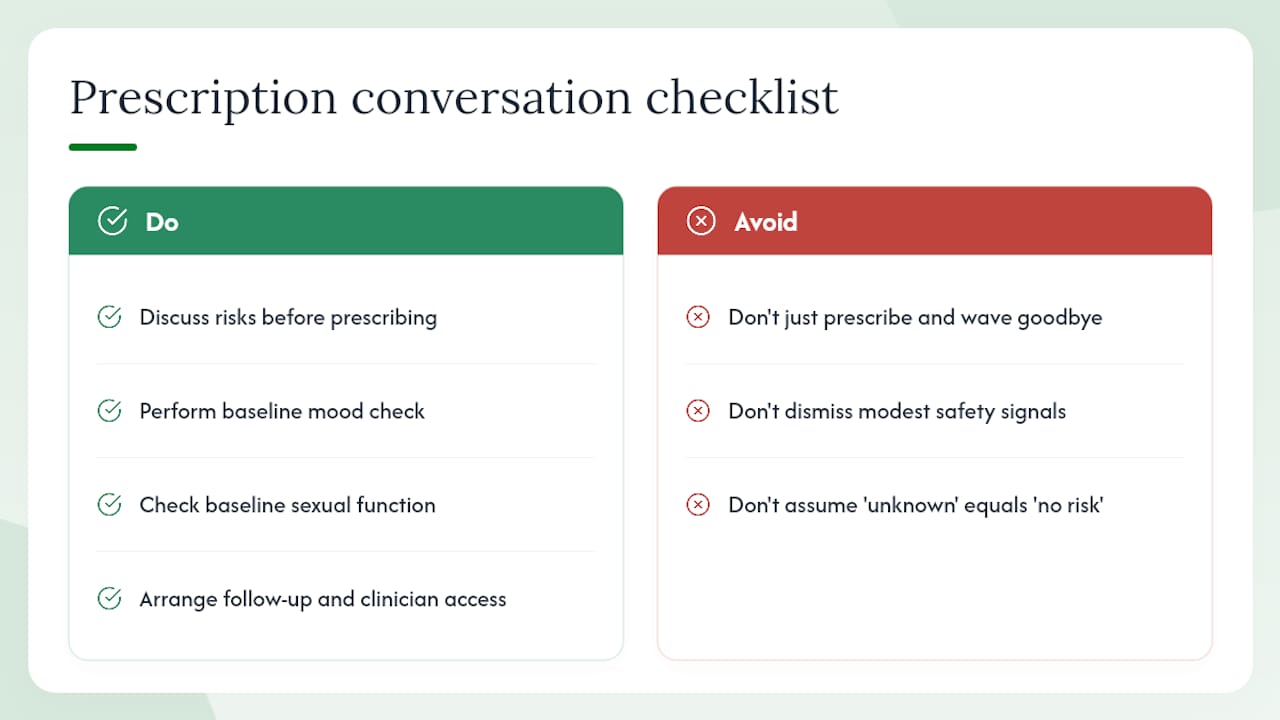
The practical takeaway: finasteride is a reasonable option for many men with hair loss, but it should come with a real informed-consent discussion, a baseline mood and sexual-function check, and a follow-up plan. Not a prescription and a wave goodbye. The men who do best on this medication are the ones who know what to watch for and have a clinician they can actually reach when something changes.
Worrying about finasteride side effects is easier when you have a clinician you can actually reach. AM Rx gives you a same-day telehealth visit with a licensed provider who reviews your full health history before prescribing, not a questionnaire that auto-generates a prescription.

For hair loss, that means a real conversation about whether finasteride is the right fit, what dose makes sense, and what alternatives exist. If sexual side effects emerge, AM Rx clinicians can evaluate and manage ED concerns within the same platform. If mood changes arise, the pathway to mental health support is built in, not a separate referral you have to chase. Prescriptions ship to your door, follow-ups are scheduled from the start, and your clinician is reachable when something changes.
Start your telehealth evaluation at AM Rx and get a clinician review of your finasteride risks and benefits today.
The following sources were used throughout this article. Each one is worth bookmarking if you want to go deeper or verify specific claims.
Persistent sexual dysfunction, including decreased libido and erectile dysfunction lasting more than 90 days after stopping the medication, is the most documented serious long-term concern. Male breast cancer has been reported rarely in postmarketing data, and any breast lump warrants immediate evaluation.
For most men, the 1 mg dose carries a small absolute risk of sexual side effects (roughly 1–2% above placebo in trials), and those effects often resolve after stopping. Whether that tradeoff is acceptable depends on individual priorities, baseline health, and how closely you can be monitored. A clinician-led evaluation, like the one AM Rx provides, helps you make that call with accurate information.
The main reasons are concern about sexual side effects, reports of persistent dysfunction after stopping, and the psychiatric signal for depression. Many men are also not told about these risks upfront, which creates distrust. Better informed consent and active follow-up address most of those concerns.
At the 1 mg dose, finasteride is generally well tolerated for long-term use. The NHS notes that most people take it for months or years without problems. The main systemic considerations are the PSA effect (which requires clinician awareness during prostate cancer screening) and the rare risk of serious allergic reactions or breast changes.