Yes — you can get an oral minoxidil prescription through telehealth in the U.S. when a licensed clinician determines it is medically appropriate. The process is faster than most people expect. You fill out an online questionnaire, submit scalp photos, and a board-certified clinician reviews your case. If everything checks out, the prescription goes straight to your pharmacy.
Three things matter most before you start:
What to have ready before your visit:
Pro Tip: Sit quietly for five minutes before taking your blood pressure, use a validated automatic cuff on your upper arm, and take three readings two minutes apart. Average the last two. This gives the clinician a reliable baseline and can speed up the approval process considerably.
Minoxidil was originally developed as an oral antihypertensive. Researchers noticed a consistent side effect: significant hair growth. That observation eventually led to the topical formulation approved by the FDA for androgenetic alopecia. The oral version, however, was never formally approved for hair loss in the U.S. — it remains off-label for that use, meaning clinicians prescribe it based on clinical evidence and judgment rather than an FDA hair-loss indication.
Off-label prescribing is legal and common in American medicine. What it means practically is that your clinician must document informed consent, walk you through the known risks and benefits, and confirm you understand the treatment is being used outside its approved indication. Reputable telehealth services build this disclosure into the intake process.
Oral vs. topical minoxidil at a glance:
HIPAA compliance, board-certified clinician review, and a clear off-label disclosure are the minimum trust signals worth looking for in any telehealth service you consider.
The mechanism comes down to two effects on the hair follicle. First, minoxidil prolongs the anagen (growth) phase of the hair cycle, keeping follicles active longer than they would be otherwise. Second, it increases blood flow to the scalp through vasodilation, which appears to increase hair shaft diameter over time. The result is thicker, denser hair in areas where follicles are still viable.

Low-dose oral minoxidil for hair loss typically falls within a low-dose range, with many providers using moderate starting doses for men and lower doses for women. The exact dose depends on your blood pressure, weight, tolerance, and the clinician’s judgment.
Typical dosing principles:
Pro Tip: If you miss a dose, take it as soon as you remember — unless it is almost time for the next one. Never double up. Consistent daily use is what drives results; occasional missed doses matter far less than stopping and restarting.
Oral minoxidil works well for a specific patient profile: adults with androgenetic alopecia (male or female pattern hair loss) who have normal or well-controlled blood pressure, no significant cardiovascular disease, and no major drug interactions. That profile covers a lot of people, but not everyone.
Common contraindications a clinician will screen for:
Medication classes that require careful review:
Clinicians review blood pressure and medical history and may refuse prescriptions when safety concerns exist. Providing an accurate medication list is not optional — it directly determines whether you get a prescription or a referral.
For women specifically, female hair loss evaluations at AM Rx include a thorough review of hormonal factors and reproductive status before any prescription is considered.
Low-dose oral minoxidil has a well-documented side effect profile. Most effects are dose-dependent and manageable, but some require immediate attention.
Common side effects:
Side effects reported with low-dose oral minoxidil include hypertrichosis, edema, dizziness, and blood pressure changes. Telehealth clinicians provide monitoring plans to catch problems early.
Monitoring schedule most clinicians follow:
| Timepoint | What gets checked |
|---|---|
| Baseline (before starting) | Blood pressure, current medications, medical history |
| 2–4 weeks | Blood pressure check, early side effect review |
| 2–3 months | BP, symptom review, dose adjustment if needed |
| Every 6 months ongoing | BP, labs if clinically indicated, prescription renewal |
Red flags that require immediate in-person evaluation: chest pain or tightness, fainting or near-fainting, sudden significant swelling with shortness of breath, or rapid weight gain (more than 5 lbs in a day). These are not “wait and message your telehealth provider” symptoms — go to an urgent care or emergency room.
Telehealth platforms document BP readings submitted by patients and flag values outside safe ranges. If your readings are consistently elevated, a synchronous video visit or referral to in-person care is typically triggered before any prescription is continued.
The asynchronous model is the standard for hair loss consultations: you submit your information, a clinician reviews it on their schedule, and you get a response within 12–24 hours in most cases. No video required for routine cases.
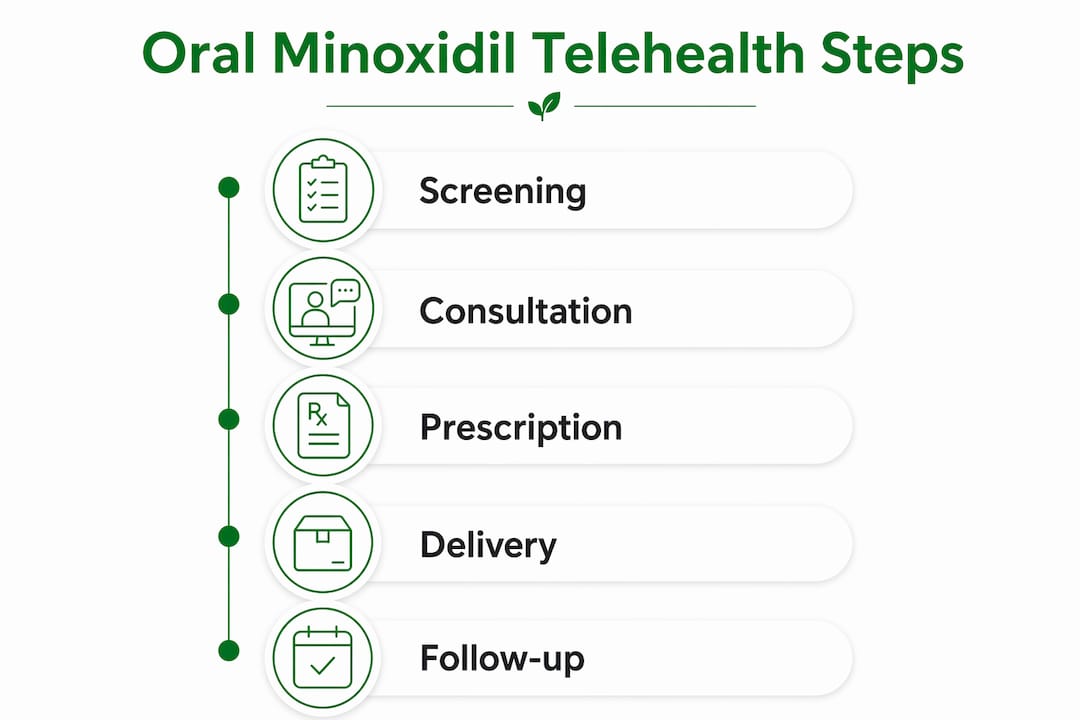
The typical workflow:
Video calls are reserved for cases where the written history raises safety questions that cannot be resolved asynchronously. If your BP readings are borderline, your medication list is complex, or your history includes a cardiac condition, expect a synchronous visit before any prescription is issued.
Documents to have ready:
Telehealth visit fees for hair loss consultations vary by provider and review speed. Some telehealth providers charge around $59 for a standard dermatology visit, with priority review options at $129 for faster turnaround. These are visit fees only — the cost of the medication itself is separate.
Cost breakdown to budget for:
Most telehealth hair loss visits are self-pay. Insurance rarely covers the visit fee, though the prescription itself may be covered depending on your pharmacy plan. Always check your plan’s formulary for minoxidil oral tablets.
Comparing what you actually pay monthly:
| Cost component | Typical range | Notes |
|---|---|---|
| Initial visit fee | $59 – $129 | Standard ($59) vs. priority ($129) review options |
| Oral minoxidil (generic) | Low cost at most pharmacies | GoodRx discounts often available |
| Follow-up visit | Required periodically | Often every 6 months |
| Shipping | Varies | Free with some mail-order options |

AM Rx offers transparent pricing with no hidden fees, and prescriptions are sent to your preferred pharmacy or fulfilled through home delivery. The hair loss services page outlines what is included in each visit.
Patience is the hardest part of oral minoxidil therapy. The hair cycle is slow, and the drug works by extending it, not accelerating it.
Realistic timeline:
Stopping treatment reverses the gains. Oral minoxidil does not cure androgenetic alopecia — it manages it. Clinicians track progress through photographic comparisons taken at consistent angles and lighting, and through patient-reported outcomes at follow-up visits. If you are not seeing any change by month six, a dose adjustment or combination approach may be worth discussing.
The most important thing to understand about getting oral minoxidil online is that a licensed clinician is making a medical decision, not an algorithm approving a checkout. Telehealth visits for oral minoxidil are performed by U.S.-licensed providers, board-certified where applicable, who use blood pressure and medication review as their primary safety checks.
Blood pressure is the central gateway. Reliable home BP measurement using a validated automatic cuff, taken after five minutes of seated rest, with multiple readings averaged, gives clinicians the data they need to prescribe safely. A single rushed reading on a cheap wrist cuff is not the same thing.
What happens when a prescription is declined:
AM Rx’s telehealth consent process outlines exactly what patients agree to and what protections are in place, including HIPAA compliance and the right to a clinical explanation if treatment is not prescribed.
Prescribing oral minoxidil via telehealth in the U.S. sits at the intersection of federal prescribing law, state medical licensing, and the specific rules each state applies to telemedicine practice.
The foundational rule is straightforward: a clinician must be licensed in the state where the patient is located at the time of the visit. A provider licensed only in California cannot legally prescribe to a patient sitting in Texas. Reputable telehealth platforms maintain networks of providers licensed across multiple states, or use interstate compact arrangements, to cover their patient base.
The Ryan Haight Online Pharmacy Consumer Protection Act governs controlled substances via telehealth, but oral minoxidil is not a controlled substance, so that specific law does not restrict its prescribing. What does apply is each state’s telemedicine practice standard, which typically requires that a valid patient-provider relationship be established before prescribing. Most states accept an asynchronous questionnaire-based encounter as sufficient for non-controlled medications like minoxidil, but a handful require a synchronous (live video or phone) interaction first.
Some states also have specific rules about prescribing without a prior in-person visit. These rules vary and change. A legitimate telehealth platform operating in your state will have already built compliance into its workflow, but it is worth confirming that the service you choose has licensed providers in your state before you pay for a visit.
Getting the initial prescription is step one. Staying on oral minoxidil safely over months and years requires ongoing monitoring, and telehealth handles that through a structured follow-up cadence.
Most platforms schedule a follow-up visit within a few months to review early side effects, check BP readings, and assess whether the starting dose is appropriate. After that, follow-ups typically occur periodically for prescription renewal. Some services require a paid follow-up visit to continue issuing prescriptions — this is standard practice and worth factoring into your total cost.
Dose adjustments happen at these follow-up visits. If you are tolerating the starting dose well and not seeing adequate response, the clinician may increase from 1.25 mg to 2.5 mg, or from 2.5 mg to 5 mg, depending on your BP and side effect profile. If you are experiencing significant edema or hypertrichosis, a dose reduction or switch to a different treatment may be recommended.
Between scheduled visits, most telehealth platforms offer asynchronous messaging so you can flag new symptoms without waiting for the next appointment. If a message describes a red-flag symptom (chest pain, significant swelling, fainting), the platform should escalate to a synchronous call or direct you to in-person care immediately. AM Rx provides continuous clinician support between visits, so questions about side effects or missed doses do not have to wait.
The telehealth market for hair loss prescriptions has grown considerably, and not all services are built the same way. The differences that actually matter to patients come down to four areas: clinical rigor, pricing transparency, pharmacy options, and ongoing support.
Clinical rigor is the hardest to assess from the outside. Look for board-certified dermatologists or licensed physicians in the review chain, not just nurse practitioners working without physician oversight. Check whether the platform requires BP readings before prescribing, not just asks about them. A service that skips the BP gateway to reduce friction is cutting a corner that matters.
Pricing transparency separates good services from frustrating ones. Some platforms advertise a low visit fee and bury the follow-up cost, the medication markup, or the shipping fee. The total monthly cost (visit amortized over months, plus medication, plus any delivery fee) is the number that matters. Entry-level asynchronous services tend to run lower on visit fees; platforms with faster turnaround or synchronous options charge more.
Pharmacy options affect both cost and convenience. Services that send prescriptions to any licensed U.S. pharmacy give you the flexibility to use GoodRx or your insurance formulary. Platforms that route exclusively to their own compounding pharmacy may offer convenience but remove your ability to price-shop the medication itself.
Patient support between visits ranges from automated messaging bots to actual clinician access. For a medication with cardiovascular implications, real clinician access between appointments is not a luxury.
AM Rx covers all four of these dimensions: licensed clinicians, transparent pricing, pharmacy flexibility, and ongoing support. The hair loss services page details what each visit includes. For women specifically, the female hair loss consultation addresses the additional screening considerations that apply.
Hair loss is personal. The fact that you are seeking treatment for it, the medications you take, and your medical history are all protected health information under HIPAA. Any telehealth platform operating in the U.S. is legally required to comply with HIPAA’s privacy and security rules, which means your data must be stored securely, transmitted over encrypted channels, and never sold to third parties without your explicit consent.
In practice, what this means for you: look for platforms that use encrypted messaging and secure patient portals rather than standard email for clinical communications. Check the privacy policy for language about data sharing with marketing partners — some platforms share de-identified data for research or analytics, which is permitted under HIPAA, but sharing identifiable information for marketing purposes is not.
Telehealth platforms also collect sensitive data during intake: your medication list, blood pressure history, and in some cases photos of your scalp. This data should be stored in HIPAA-compliant infrastructure (typically AWS GovCloud, Microsoft Azure Government, or equivalent). LegitScript certification is an additional trust signal that a telehealth pharmacy or prescribing platform meets verified compliance standards.
AM Rx’s telehealth consent page explains exactly what data is collected, how it is stored, and what your rights are as a patient. Reading it before you book is worth the two minutes.
Getting oral minoxidil through telehealth is medically legitimate, practically accessible, and safe when blood pressure screening, medication review, and informed consent are built into the process.
| Point | Details |
|---|---|
| Off-label but clinician-approved | Oral minoxidil is off-label for hair loss in the U.S.; clinicians prescribe it legally with documented informed consent. |
| Blood pressure is the key gate | Uncontrolled hypertension is a hard contraindication; have a recent, reliable BP reading before your visit. |
| Dosing starts low | Common starting doses vary; clinicians titrate based on response and tolerance. |
| Results take months | Meaningful hair regrowth typically appears at 9–12 months; stopping treatment reverses the gains. |
| AM Rx covers the full workflow | AM Rx offers licensed clinician review, transparent pricing, pharmacy delivery, and ongoing support for hair loss patients. |
There is a version of the oral minoxidil telehealth conversation that treats the intake form as a formality to get through quickly. That is the wrong approach, and not just for liability reasons.
Oral minoxidil is genuinely effective for a lot of people. The clinical evidence supports it. But it is a systemic drug with real cardiovascular effects, and the blood pressure screening is not bureaucratic theater. The patients who get into trouble with it are usually the ones who minimized a BP reading, forgot to mention a diuretic, or assumed their “mild” heart condition was irrelevant.
The telehealth model works precisely because it puts a real clinician between you and the prescription. That clinician is not there to slow you down. They are there to make sure the drug is actually safe for your specific physiology. A service that skips that step to reduce friction is not doing you a favor.
What I find genuinely encouraging about where oral minoxidil telehealth has landed in 2026 is that the better platforms have figured out how to be both fast and rigorous. Asynchronous review with a 12–24 hour turnaround, combined with a real BP requirement and a clear escalation path to video when needed, is a model that respects both your time and your safety. The hair loss treatment options conversation has shifted from “topical vs. nothing” to a much more nuanced clinical discussion, and telehealth is a big part of why that access exists for people who would never have seen a dermatologist otherwise.
Hair loss treatment should not require a three-month wait for a dermatology appointment. AM Rx gives you access to licensed clinicians who can evaluate you for oral minoxidil from home, with same-day appointments available and prescriptions sent directly to your pharmacy.

Here is what the AM Rx process looks like:
AM Rx also handles ongoing follow-up, so your monitoring and dose adjustments happen through the same platform without starting over. Detailed terms, informed consent language, and what to expect after booking are all on the AM Rx telehealth consent page. Start your evaluation there.
This article is general health information, not medical advice. Confirm current prescribing guidelines and your personal eligibility with a licensed clinician before starting any treatment.
Primary clinical references:
Telehealth workflow and pricing examples:
AM Rx resources: