See your primary care provider (PCP) whenever your schedule allows it, since continuity of records and long term treatment beats any one time visit. If your PCP can’t see you today and it’s not life-threatening, urgent care is the right call for immediate, episode-based treatment. If you notice any red-flag symptom, skip both and get to the emergency room or call 911. The trade-offs come down to three things: continuity, timing, and cost.
TL;DR:
- Urgent care is best for immediate, non-life-threatening issues when your primary care provider cannot see you quickly, especially during evenings and weekends.
- Primary care offers long-term management and continuity through scheduled appointments, making it preferable for ongoing or complex health conditions.
- Cost comparisons show primary care and telehealth are generally cheaper than urgent care, with emergency room visits being the most expensive for non-emergency problems.
- For high-risk symptoms like chest pain or severe shortness of breath, going directly to the emergency room remains crucial regardless of other guidelines.
- Telehealth can provide same-day, record-integrated care that balances quick access with ongoing relationship benefits, especially outside office hours.
A primary care physician (PCP) is the doctor, nurse practitioner, or physician assistant who manages your health over years, not just for one symptom. Primary care is relationship-based medicine. Your PCP sees your history, your labs from three years ago, the medication that gave you a rash in 2022, and the pattern in your blood pressure readings that a stranger in a walk-in clinic would never catch.
Typical primary care services include:
Most primary care runs on scheduled appointments, though many practices now offer telehealth visits that keep continuity intact even when you can’t come in.
Urgent care exists for one job: treating a problem today, without an appointment, when it isn’t a medical emergency. There’s no ongoing relationship. You walk in, get treated for that specific issue, and walk out, usually with a paper summary rather than a doctor who remembers your last five visits.
Urgent care clinics commonly handle:
Most locations run extended evening and weekend hours, which is their real advantage over a typical doctor’s office. Quality and ownership vary a lot, too. Some urgent care services explained on hospital system websites describe chains tied to a hospital network, while others are independently owned, so the equipment and staffing you get can differ clinic to clinic.
The choice usually comes down to four practical factors, and they pull in different directions depending on what you need.
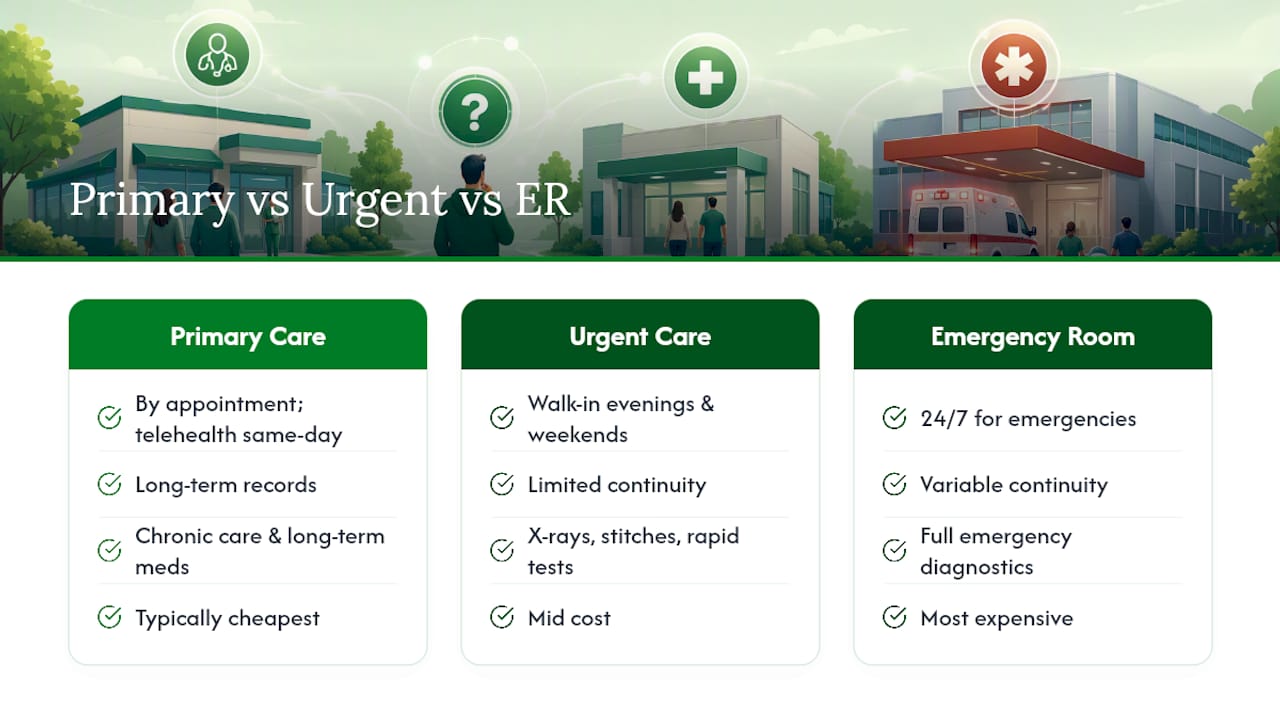
Timing and access. Urgent care wins on speed: walk in any evening or Saturday, no appointment required. Primary care wins on planning: you book ahead, though telehealth has closed much of that gap for same-day, non-urgent problems.
Continuity. A PCP builds a record over years and can catch a pattern, like recurring infections, that a one time urgent care visit would simply treat and forget. Lean on urgent care too often, and your health history gets fragmented across clinics that never talk to each other.
Scope and diagnostics. Urgent care handles X-rays, stitches, and rapid tests well, but it isn’t set up for complex chronic care, deep diagnostic workups, or long-term medication management.
Cost. Here’s the ranking that matters most: primary care and telehealth are typically cheapest, urgent care sits in the middle, and the emergency room costs the most by a wide margin for problems that didn’t need to be there. Roughly one in five U.S. adults visits an ER each year, and a large share of those visits turn out to be non-urgent, which drives up costs and wait times for everyone.
Run through these three questions in order. Don’t skip ahead.
Pro Tip: Call your PCP’s office first, even outside business hours. Harvard Health notes many practices offer after-hours triage lines, and a five-minute call can save you a trip and tell you exactly where to go.
Age and health status change the math entirely. A symptom that’s routine in a healthy 30-year-old can be dangerous in someone else. Cedars-Sinai clinicians point out that the same illness carries very different risk depending on who has it.
Lower your threshold for the ER if you’re dealing with:
Regardless of age, treat these as automatic ER symptoms: chest pain, severe shortness of breath, sudden slurred speech or facial drooping (a stroke sign), uncontrolled bleeding, or loss of consciousness. When in doubt for a high-risk person, don’t wait and see. Go straight to the ER or call 911.
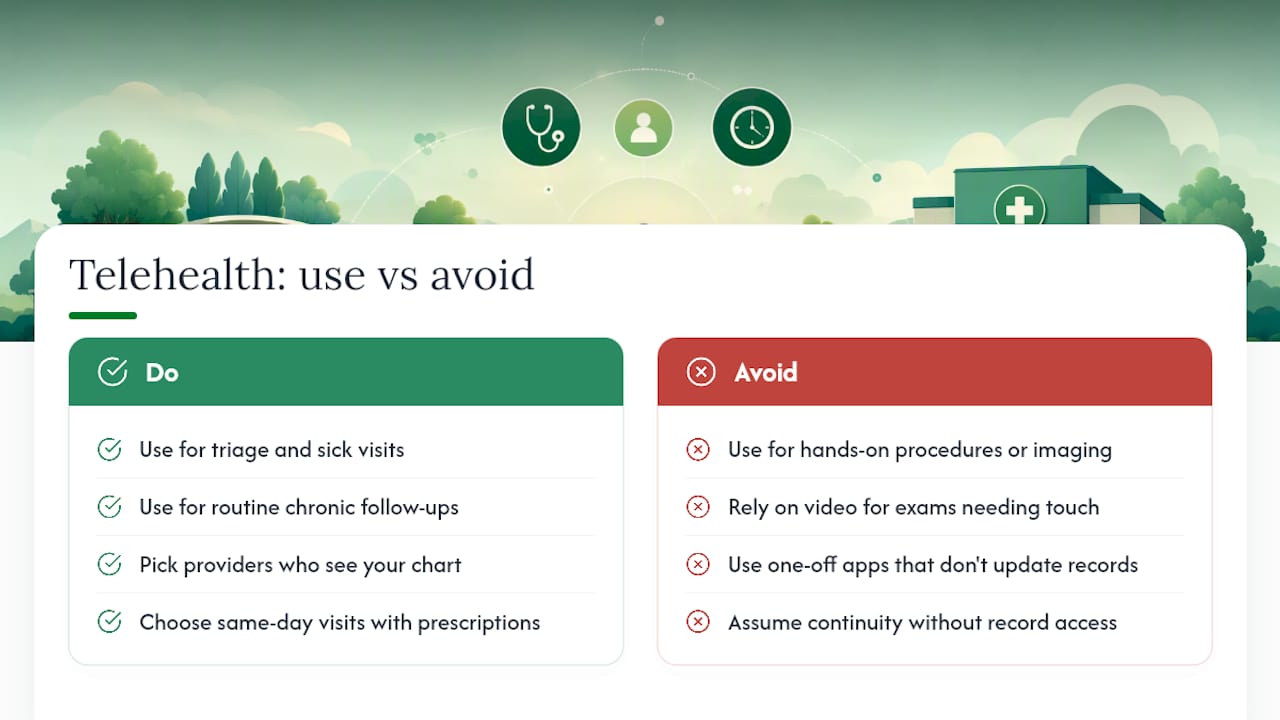
Virtual visits work well for triage calls, most acute sick visits like sinus infections or UTIs, and routine chronic disease follow-ups. They don’t work for anything requiring hands-on procedures, imaging, or a physical exam a screen can’t replicate. Research on which primary care visits actually require in-person care backs this up: some conditions simply need a physical exam, and no video call substitutes for that.
The detail most people miss: telehealth only preserves continuity when it’s tied back to your actual medical record. A random telehealth app you use once for a rash doesn’t build the pattern-recognition a real PCP relationship does.
Same-day virtual appointments with a provider who can see your history, deliver a prescription to your door, and handle your insurance paperwork can solve the access problem without sacrificing the record-keeping that makes primary care valuable.
That’s the model AM Rx builds around: remote video consultations, same-day scheduling, and continuous provider support instead of a one-off visit that vanishes from your chart the moment you walk out.
Cost ordering rarely surprises anyone once they see it laid out: primary care and telehealth visits tend to run cheapest, urgent care sits in the middle, and the ER carries the highest price tag for problems that didn’t need emergency-level resources.
Before you pick a setting, especially if cost is a real concern, take these steps:
A five-minute phone call before you walk in can be the difference between a $30 copay and a $300 surprise bill.
Continuity wins whenever you have the choice. My honest advice: save your PCP’s number, enable telehealth access today, and note your nearest urgent care address now, before you need any of them at 9 p.m. on a Friday.
— Bryan
Some virtual healthcare platforms offer a middle path between these options: the continuity of a primary care relationship combined with the speed people usually seek at urgent care. Instead of choosing between “see a stranger today” or “wait two weeks for my doctor,” you may be able to get remote video consultations, same-day appointments, and prescription delivery, all tied to one ongoing patient record.

Insurance handling is built in and transparent, so you’re not calling three numbers to figure out your copay before you book. Every visit updates the same chart your next provider will see, which means fewer fragmented records and fewer repeat explanations of your history. If a non-emergency issue comes up and your regular doctor can’t fit you in, that’s exactly when a same-day virtual visit through AM Rx’s primary care platform can replace an unnecessary trip to urgent care. Ready to set up your account? Complete your telehealth consent form and book your first visit today.
This article is general information, not a substitute for advice from a qualified doctor. Consult a qualified healthcare professional about your own circumstances before acting on anything here.
Yes. Primary care is ongoing, relationship-based medicine tied to your medical history, while urgent care treats a single episodic problem with no continuity between visits.
Call your PCP first if the issue isn’t urgent. If your doctor can’t see you same-day and it’s not life threatening, urgent care fills that gap.
Yes, urgent care clinics don’t require an existing relationship or referral, though you’ll still want to establish primary care afterward for ongoing needs, which a service like AM Rx makes easy to set up quickly.
Primary care visits and telehealth are usually the least expensive option, urgent care costs more on average, and the emergency room is the most expensive choice for problems that aren’t true emergencies.