Mental health primary care integration is defined as the practice of embedding mental health screening, assessment, and treatment directly into routine primary care visits. Understanding how mental health primary care connects means recognizing that your family doctor’s office is now one of the most important access points for mental health support in the country. Tools like the PHQ-2 and PHQ-9, models like the Collaborative Care Model, and team-based approaches that include behavioral health managers and social workers all work together inside a single visit. This guide explains each component clearly so you know exactly what to expect and how to use this system to your advantage.
Primary care providers identify mental health conditions using structured screening tools built into routine visits. The most widely used approach starts with the PHQ-2, a two-question screen that asks about low mood and loss of interest over the past two weeks. If a patient scores at risk on the PHQ-2, the provider follows up with the PHQ-9, which measures symptom severity across nine areas including sleep, concentration, and thoughts of self-harm. That two-step process catches depression early, before it becomes a crisis.
The reason this matters is that mental health symptoms often appear as physical complaints like fatigue, headaches, or chronic pain during a routine visit. A patient who comes in for back pain may leave with a depression diagnosis and a treatment plan. That is not a detour. That is the system working correctly.
Many patients struggle to bring up mental health concerns on their own. Screening tools provide a structured, stigma-reducing conversation that removes the burden of self-disclosure. The questionnaire asks the questions so the patient does not have to figure out how to start.
Pro Tip: If your provider does not offer a depression screen at your annual visit, ask for one by name. The PHQ-2 takes less than 60 seconds and can open a conversation that changes your care.
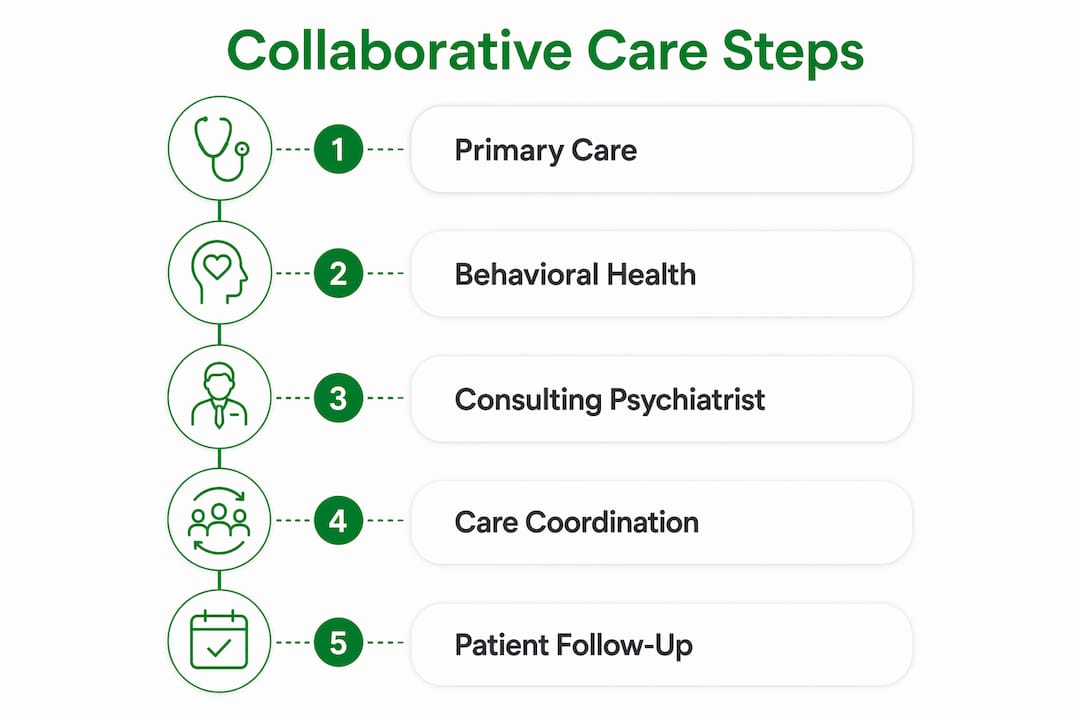
The Collaborative Care Model is the evidence-based framework that defines how mental health professionals integrate within primary care teams. It involves three core roles working in coordination: the primary care provider (PCP), a behavioral health manager, and a consulting psychiatrist. The Collaborative Care Model produces better long-term outcomes and reduces emergency room visits compared to treating mental and physical health separately. That reduction in ER visits reflects real cost savings and real suffering prevented.
Here is how the model works in practice:
Integrated Behavioral Health professionals focus on brief interventions rather than long-term therapy. They are not replacing a therapist. They are providing targeted support and education while connecting patients to specialty care when the situation calls for it.
Pro Tip: Ask your primary care office whether they have a behavioral health manager on staff. If they do, you can request a same-day warm handoff, meaning a brief introduction to that professional during your existing appointment.

Primary care has become the de facto mental health system in the United States because access barriers in specialty care leave millions of people without options. Wait times for psychiatrists can stretch months. A collaborative primary care team fills that gap immediately.
Social determinants of health are the non-medical factors that shape a person’s mental and physical well-being. Housing instability, food insecurity, unemployment, and social isolation all drive depression, anxiety, and chronic stress. Social workers embedded in primary care address these root causes directly, connecting patients to housing programs, food banks, and employment resources during the same visit where they receive medical care.
This matters because treating depression with medication while a patient returns to an unsafe home produces limited results. The social worker closes that gap. They conduct needs assessments, navigate community resources, and follow up to confirm that referrals actually land.
The benefits of embedding social workers into primary care teams extend beyond individual patients:
| Social determinant | Impact on mental health | Primary care response |
|---|---|---|
| Housing instability | Increases anxiety and depression risk | Social worker referral to housing programs |
| Food insecurity | Worsens mood, cognition, and energy | Connection to food assistance programs |
| Unemployment | Drives hopelessness and isolation | Resource navigation and community referrals |
| Social isolation | Amplifies depression and anxiety symptoms | Community program linkage and follow-up |
An integrated primary care visit looks different from a standard appointment in a few specific ways. Patients complete a brief mental health screen, often on a tablet or paper form, before seeing the provider. If the screen raises concerns, the provider discusses results openly and without judgment. Routine screening helps start important conversations that patients often cannot initiate on their own.
From there, the visit may include several types of support depending on what the screen reveals:
This model is especially valuable for patients in rural or underserved areas where specialty mental health providers are scarce. The primary care office becomes the entry point and, in many cases, the primary treatment setting. Patients who might never see a psychiatrist get real, evidence-based mental health care through their regular doctor.
Integration does not happen automatically. Clinics face real obstacles when trying to connect mental health services within primary care, and understanding those barriers helps patients advocate for better care.
Successful implementation requires training, clear roles, leadership support, and ongoing communication. Without those four elements, behavioral health professionals get siloed, screening rates drop, and patients fall through the cracks. The organizational commitment has to come from the top.
| Barrier | Solution |
|---|---|
| Lack of provider training | Structured education on screening tools and brief interventions |
| Unclear team roles | Written role definitions and regular team huddles |
| Resource constraints | Grant funding, value-based payment models, and phased implementation |
| Billing limitations | 2024 Medicare policy expansions now cover peer support specialists and community health workers |
| Patient stigma | Normalizing screening as a routine part of every visit |
The 2024 Medicare policy changes are significant. They expanded billing coverage to include peer support specialists and community health workers in behavioral health services. That policy shift makes it financially viable for more clinics to build out integrated teams. More billing options mean more practices can afford to hire the people who make integration work.
Integrated mental health primary care works because it places screening, brief intervention, and coordinated follow-up inside the same visit where patients already seek care.
| Point | Details |
|---|---|
| Screening tools drive early detection | PHQ-2 and PHQ-9 identify depression risk before patients find words for their symptoms. |
| Collaborative Care Model improves outcomes | A team of PCP, behavioral health manager, and psychiatrist reduces ER visits and improves long-term results. |
| Social determinants require direct action | Embedded social workers address housing, food, and employment issues that drive mental health decline. |
| Integrated visits include multiple supports | Patients may receive medication, brief counseling, safety planning, and referrals in a single appointment. |
| Policy changes expand access | 2024 Medicare billing expansions make it financially viable for more clinics to build integrated teams. |
The separation of mental and physical health in American medicine was always artificial. The body and mind are not two departments. They share the same nervous system, the same stress hormones, and the same patient. Treating them in separate buildings with separate billing codes and separate waiting lists was a structural failure dressed up as specialization.
What I find genuinely encouraging about the Collaborative Care Model is that it does not ask patients to do the hard work of navigating between systems. It asks the systems to coordinate around the patient. That is a meaningful reversal. The behavioral health manager follows up. The psychiatrist consults without requiring a separate appointment. The social worker calls to confirm the housing referral actually connected.
The patients who benefit most are the ones who would never have sought specialty mental health care on their own. Not because they did not need it, but because the barriers were too high. A 90-day wait for a psychiatrist is not a healthcare system. It is a waiting list with a billing code. Integrated primary care is the honest alternative.
The next step for this model is broader adoption, especially in rural and underserved communities where mental health support in primary care is often the only realistic option. Policy has to follow practice. The 2024 Medicare expansions are a start. The work is to make integrated care the default, not the exception.
— Bryan
Getting mental health support and primary care in the same place used to require finding the right clinic in the right zip code. AM Rx removes that geographic barrier entirely. Through video consultations with experienced providers, AM Rx connects patients to integrated primary care that includes mental health support, medication management, and coordinated follow-up, all from home.

Same-day appointments mean you do not wait weeks to start a conversation about how you are feeling. AM Rx handles insurance coordination transparently so cost does not become another barrier. Whether you need a depression screen, a medication review, or a referral to a behavioral health specialist, AM Rx mental health services give you a real clinical team working together on your behalf. Getting started takes minutes at getamrx.com.
The PHQ-2 is a two-question depression screen that primary care providers use to quickly identify patients who may need further evaluation. It asks about low mood and loss of interest over the past two weeks, and takes under one minute to complete.
The Collaborative Care Model places a primary care provider, a behavioral health manager, and a consulting psychiatrist on the same care team. Evidence shows this approach reduces emergency room visits and produces better long-term mental health outcomes than treating conditions separately.
Yes. Primary care providers can prescribe antidepressants, provide brief counseling through a behavioral health manager, and coordinate specialist referrals. Integrated primary care is designed to treat depression and anxiety without requiring a separate specialty appointment in most cases.
Social workers in primary care address social determinants like housing instability and food insecurity that directly affect mental health. Embedding them in the care team means patients get resource navigation and clinical treatment in the same visit.
Telehealth platforms like AM Rx deliver integrated mental health and primary care through video consultations, making coordinated care accessible to patients in rural or underserved areas who lack local specialty resources.