If erections work fine when you wake up or during masturbation but fail with a partner, performance anxiety is the likely driver, and it usually responds well to treatment. Start by ruling out warning signs like chest pain or new numbness (get urgent care for those), then move on treatment: sensate focus exercises, a conversation with your partner, and possibly a short course of a PDE5 inhibitor while you build longer-term skills through therapy.
TL;DR:
- Sudden erectile failure during sex with a partner, while morning and nocturnal erections remain, suggests performance anxiety rather than a physical issue.
- Addressing negative thought patterns through cognitive behavioral therapy and practicing sensate focus exercises can significantly interrupt the anxiety feedback loop.
- Short-term use of PDE5 inhibitors can help build confidence but should be combined with therapy for long-term improvement.
- Persistent symptoms beyond three months or in the presence of risk factors like hypertension or diabetes warrant a medical evaluation to rule out organic causes.
- Partners can support recovery by removing pressure, emphasizing non-penetrative intimacy, and engaging in open, reassuring communication.
Performance-anxiety ED happens when fear about sexual performance, not a physical blockage, interrupts the erection process. The mechanism is fairly direct: worry pulls your attention away from arousal and onto self-monitoring, while stress hormones like adrenaline constrict blood vessels and work against the parasympathetic nervous system response an erection depends on. Your body is, in a sense, arguing with itself.
This is common. Performance anxiety affects an estimated 9% to 25% of men and shows up frequently as a driver of psychogenic ED. Separate clinical guidance puts psychological causes at 10% to 20% of ED cases overall, often overlapping with physical factors rather than existing in isolation.
Two things matter for what happens next:
Three patterns tend to separate anxiety-driven ED from organic causes.
Medical risk factors change this calculation. Diabetes, high blood pressure, smoking, low testosterone, and certain medications (particularly blood pressure drugs and antidepressants) raise the odds of an organic or mixed cause. If ED symptoms persist past roughly three months, that’s the general threshold clinicians use to recommend a formal evaluation rather than waiting it out.
The physical and emotional symptoms usually show up together, and they’re distinct from a simple lack of arousal.
Partners often notice the emotional withdrawal before they understand the cause. Left unaddressed, the pattern tends to erode confidence on both sides and can quietly reshape a relationship’s intimacy, even when both partners still want closeness.
The loop follows a predictable sequence. A stressful event, whether a first-time failure, a new relationship, or unrelated life stress, triggers anticipatory worry the next time sex comes up. That worry pulls attention inward: you start monitoring your own erection instead of experiencing touch, arousal, or connection with your partner. The attentional shift itself interferes with the physiological process, the erection weakens or fails, and the failure becomes evidence for the next round of worry. Each cycle reinforces the next.
Breaking that loop is exactly why sensate focus exercises work as well as they do. By deliberately shifting attention to touch and sensation rather than performance outcomes, you interrupt the self-monitoring that’s sabotaging arousal in the first place. Clinical guidance from the International Society for Sexual Medicine recommends this present-moment refocusing as a core behavioral step, alongside open communication with a partner.
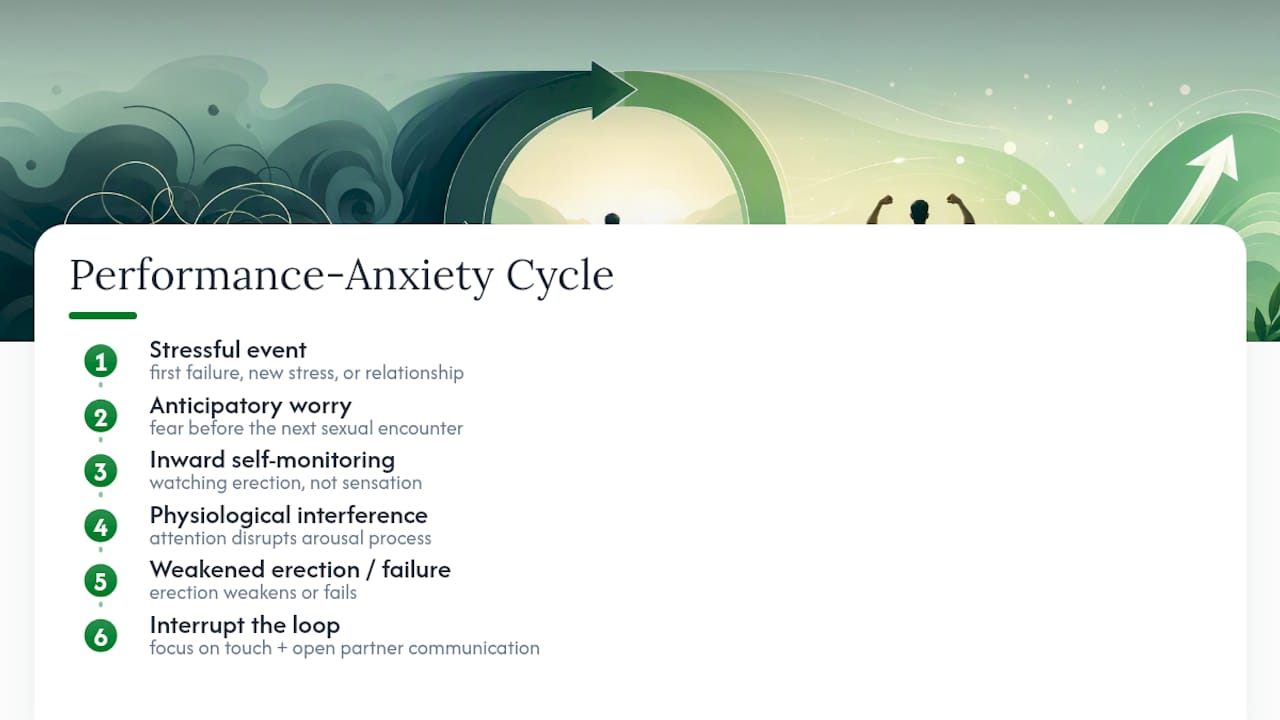
Reattribution matters too. Interpreting a failed erection as “my anxiety spiked tonight” rather than “I’m broken” keeps the setback contained instead of feeding the next anticipatory spiral.
Treatment works best as a layered approach, not a single fix.
Cognitive behavioral therapy (CBT) targets the thought patterns driving the anxiety, usually over 8 to 16 sessions, with a therapist who challenges catastrophic thinking (“this always happens,” “I’ll never fix this”) and builds coping skills for the moment worry spikes.
Sensate focus exercises are structured, low-pressure touch exercises, often starting with 5 to 10 minutes of non-genital touch with no goal of arousal or intercourse. The point is to rebuild comfort with physical closeness without a performance outcome attached, and the ISSM notes this progressive approach directly reduces the self-monitoring that fuels the cycle.
PDE5 inhibitors (sildenafil and similar medications) can act as a short-term bridge. Reliable pharmacological help can interrupt the failure-reinforcement loop while you build longer-term skills. A review of combined approaches found these medications work best paired with psychotherapy rather than used alone indefinitely.
Lifestyle factors deserve real attention: poor sleep, heavy alcohol use, and low physical activity all worsen both anxiety and erectile function independently.
A reasonable sequence looks like this:
Pro Tip: Don’t wait for therapy to “finish” before trying sensate focus. The exercises and the talk therapy reinforce each other, and starting both at once usually gets you results faster than sequencing them end to end.
For more structure on the psychological side, Prism Counseling’s guide on managing anxiety covers grounding techniques that transfer directly to performance situations.
See a clinician urgently if ED comes with chest pain, unusual fatigue, or new numbness in your limbs. Those symptoms can point to cardiovascular issues that need immediate attention, since ED itself can be an early marker of vascular disease.
For non-urgent cases, the general rule is to seek evaluation if symptoms persist beyond about three months, or sooner if you have risk factors like diabetes, high blood pressure, or a family history of heart disease. A typical workup includes a medical history review, current medication check, blood pressure and blood sugar screening, and sometimes hormone testing. This isn’t about assuming something is physically wrong. It’s about ruling it out efficiently so treatment can target the actual cause instead of guessing.
You don’t need to wait for a full treatment plan to start making progress.
Performance anxiety ED rarely stays contained to sex. Men dealing with recurring episodes often report a drop in general self-esteem that bleeds into confidence at work, in social settings, and in how they see themselves as partners. The shame attached to ED, even when it’s clearly situational and psychological, tends to get internalized as a broader statement about masculinity or adequacy, which it isn’t.
That internalized shame creates its own secondary anxiety, worrying about worrying, essentially, and this compounding effect is part of why some men develop mild depressive symptoms alongside ongoing ED. Sleep disruption, irritability, and withdrawal from social or romantic situations often follow. Some men avoid dating or new relationships entirely rather than risk another failed episode, which narrows their life in ways that have nothing to do with sexual function specifically.
Relationships absorb this too. Partners sometimes misread the anxiety cycle as disinterest or attraction loss, which adds hurt feelings on top of an already stressful situation. That’s a communication gap, not a truth about the relationship, but it needs to be named directly rather than left to fester.
The good news: because the anxiety and the ED are linked in the same loop, treating one tends to improve the other. Men who work through CBT or sex therapy commonly report improvements in general mood and confidence that extend well past the bedroom, since they’re addressing the same catastrophic thinking patterns and self-monitoring habits that show up elsewhere in life.
A few persistent myths delay men from addressing something that’s usually very treatable.
Myth: “Real men don’t get anxious about sex.” This framing treats a physiological stress response as a character flaw. Performance anxiety is a nervous system reaction, not a measure of masculinity, and it affects a meaningful share of men at some point.
Myth: “If it’s psychological, it’s not a real medical issue.” Psychological ED is just as legitimate a clinical presentation as vascular ED, and it responds to evidence-based treatment. Research reviews treat psychological interventions as a frontline option for this exact reason.
Myth: “One failed attempt means it’s broken permanently.” This is often the myth doing the most damage, because it’s precisely the catastrophic thinking that feeds the anxiety loop. One episode is data, not a diagnosis.
Myth: “Medication is cheating or a sign of failure.” PDE5 inhibitors used as a short-term bridge while you build other skills are a legitimate clinical tool, not an admission of defeat.
Myth: “Therapy takes too long to bother with.” CBT and sex therapy for performance anxiety typically run measured in weeks and months, not years, and many men notice meaningful shifts well before treatment concludes.
Each of these myths shares a common thread: they turn a fixable, common problem into a source of silent shame that keeps men from asking for help at all.
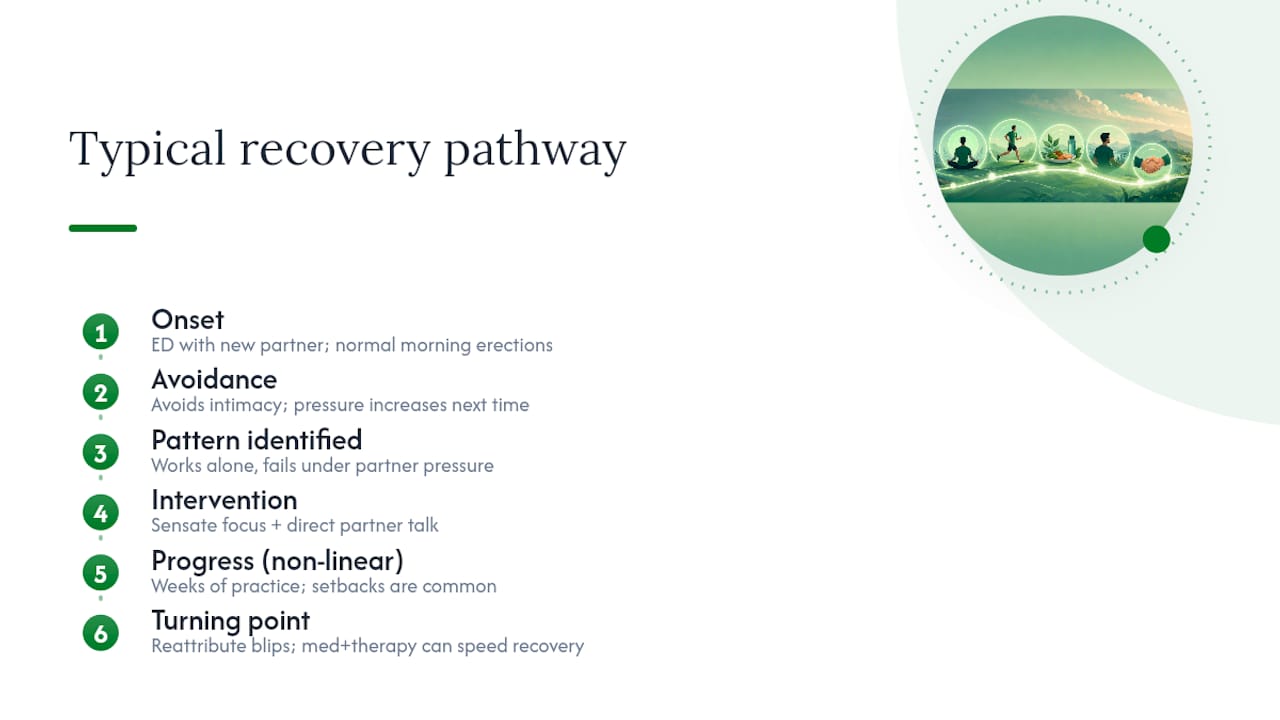
Recovery from performance-anxiety ED rarely follows a straight line, and setbacks are part of the normal pattern rather than a sign of failure.
A common early pattern looks like this: a man in his late twenties or early thirties starts noticing ED specifically with a new partner, despite normal morning erections. He assumes something is physically wrong, avoids intimacy for a few weeks, and the avoidance itself increases pressure the next time. Once he identifies the situational pattern (working fine alone, failing only under partner pressure), the fix usually starts with sensate focus and a direct conversation with the partner. Progress in these cases often shows up within a few weeks of consistent practice, though not always in a clean upward line.
Setbacks are common and don’t mean the approach has failed. A stressful week at work, a fight with a partner, or simply overthinking a “good” streak can trigger a return of symptoms. The men who recover fastest tend to treat these blips as expected noise rather than proof the problem is back for good. That reattribution skill, treating a bad night as circumstantial rather than diagnostic, is often the actual turning point in therapy, more than any single exercise or medication.
Men who combine short-term medication with ongoing therapy sometimes recover confidence faster than those who rely on medication alone, since the medication removes pressure in the moment while therapy addresses the underlying pattern. Either path can work. The men who stall out longest are usually the ones who treat a single setback as confirmation that nothing is working, rather than as one data point in a longer trend.
PDE5 inhibitors like sildenafil are generally well tolerated, but they come with a real side effect profile worth knowing before you start.
Common side effects include headache, facial flushing, nasal congestion, and mild indigestion. Some men report temporary visual changes, like a blue tinge to vision or increased light sensitivity, particularly at higher doses. Muscle aches and back pain show up less often but are documented, especially with longer-acting formulations. Full details on the side effect profile are worth reviewing before your first dose.
The more serious safety caveat applies to interactions rather than the medication alone. PDE5 inhibitors should never be combined with nitrate medications (commonly prescribed for chest pain), since the combination can cause a dangerous drop in blood pressure. Men with certain heart conditions need clearance from a clinician before starting, which is why a proper medical history review matters even for a medication as widely used as sildenafil.
For performance-anxiety ED specifically, the side effect consideration that gets overlooked is psychological: relying on medication without addressing the underlying anxiety can create a new dependency loop, where confidence becomes tied to having the pill rather than trusting your own body’s response. That’s exactly why combined approaches pairing short-term medication with therapy tend to outperform medication used in isolation over the long run.
Partners often want to help but aren’t sure what actually helps versus what adds pressure.
The most useful thing a partner can do is remove the performance framing from the conversation entirely. Saying something like “this isn’t about whether I find you attractive, I just want us to feel close” directly counters the shame narrative that’s usually driving the anxiety. Reassurance without pity works better than reassurance that sounds like damage control.
Practical communication techniques that tend to help:
Cleveland Clinic’s guidance on sexual dysfunction points out that simple reassurance and a shift toward nonpenetrative intimacy often produce fast reductions in pressure, sometimes faster than either partner expects.
For partners feeling frustrated or hurt themselves, that’s a valid response, and it’s worth naming rather than suppressing. Couples therapy can help when performance anxiety has already created tension or distance, giving both people language for what’s happening instead of guessing at each other’s intentions.
Mindfulness works on performance anxiety because it directly counters the mechanism causing the problem: attentional hijacking. Anxiety pulls focus toward self-monitoring and worst-case scenarios; mindfulness training pulls it back toward physical sensation and the present moment, which is exactly where arousal needs your attention to be.
A simple exercise: before and during intimacy, use slow diaphragmatic breathing (in for four counts, out for six) whenever you notice your mind drifting toward “is this working?” The extended exhale activates the parasympathetic nervous system, the same system responsible for erections, working directly against the fight-or-flight response anxiety triggers.
Body scan practices, spending a few minutes noticing physical sensations without judgment, help outside the bedroom too, building the general skill of observing thoughts without immediately reacting to them. That skill transfers directly to moments when performance worry spikes.
Sensate focus exercises are, in a sense, mindfulness applied specifically to touch. The instruction to notice sensation rather than monitor outcome is a mindfulness principle wearing a clinical name. Practicing it outside high-pressure moments, five minutes a day, unrelated to sex, tends to make it easier to access when you actually need it.
None of this requires meditation experience or special equipment. It requires repetition, since the skill of redirecting attention gets easier with practice, the same way any other habit does.
Most men treat ED and anxiety as two separate problems requiring two separate doctors, and that split often slows recovery. The physiology and the psychology are tangled together tightly enough that treating them in isolation misses the interaction between them. Telehealth platforms that combine mental health and ED evaluation in one visit tend to shorten the time between noticing a problem and getting real help, particularly for men who put off in-person appointments out of embarrassment. That coordination, medication screening alongside an honest conversation about what’s actually driving the anxiety, tends to get better results than either piece alone.
— Bryan
Some telehealth services offer discreet, same-day visits where a provider can evaluate whether medication, therapy referral, or both make sense for your specific pattern, without you having to explain yourself twice to two different offices.

A visit typically includes a review of your medical history, current medications, and the situational pattern behind your symptoms, the same onset and nocturnal-erection questions covered earlier in this article. If a short-term PDE5 prescription is appropriate, the telehealth provider handles the safety screening (including checks for nitrate interactions and cardiovascular risk) before anything ships, and prescriptions are delivered directly to you. If your case points more toward anxiety and relationship stress than a physical cause, providers may also connect you toward mental health support, so you’re not managing two separate care tracks on your own.
You can start by reviewing ED treatment options to see what a visit covers, or go straight to the ED evaluation page to book an appointment and get a same-day answer instead of sitting with the uncertainty any longer.
This article is general information, not a substitute for advice from a qualified doctor. Consult a qualified healthcare professional about your own circumstances before acting on anything here.
Check whether erections happen normally during sleep, masturbation, or with a different partner. If they do, but fail specifically in a performance context, anxiety is the likely driver rather than a physical cause.
Yes, PDE5 inhibitors can interrupt the anxiety-failure loop as a short-term bridge, but they work best alongside therapy or behavioral exercises rather than as a standalone long-term fix.
Combine sensate focus exercises, open communication with your partner, and CBT if anxiety runs deep, with short-term medication as an optional confidence bridge. Providers through services like AM Rx can help sequence these appropriately.
It shifts attention away from arousal and toward self-monitoring, while stress hormones work against the blood flow response an erection requires. The result is a physiological interference pattern, not a sign of low attraction or desire.
No. It’s typically one of the more reversible forms of ED, since it responds to behavioral treatment, therapy, and, when needed, short-term medication rather than requiring ongoing medical management.