Yes, you can generally get enclomiphene through a licensed telehealth visit in the United States, once baseline labs confirm it’s clinically appropriate. The process starts with an online intake, moves to lab work, and ends with a clinician reviewing your results before writing a prescription. The immediate next step is simple: book a telehealth visit with a licensed clinician and get your baseline labs ordered. One option built around that exact workflow exists for men in the U.S.
TL;DR:
- Most men can obtain enclomiphene through licensed telehealth providers in the U.S. after completing intake, labs, and clinician review, typically within a week.
- Baseline labs must include total and free testosterone, LH, FSH, estradiol, CBC, and CMP to determine if enclomiphene is appropriate, especially in cases of secondary hypogonadism.
- Cost generally ranges from moderate monthly subscriptions, with insurance rarely covering compounded enclomiphene, though HSA and FSA funds are usually applicable.
- Enclomiphene’s side effects are mild but include mood changes, headaches, vision disturbances, and hormonal shifts, requiring careful monitoring and prompt medical attention if severe symptoms occur.
- Telehealth offers a streamlined process for straightforward cases, but complex conditions or physical exam needs still benefit from in-person care.
The path from “curious about low testosterone” to “prescription in hand” runs through a handful of predictable steps. Most enclomiphene telehealth platforms follow roughly the same sequence, and knowing it ahead of time saves you from a lot of guessing.
The entire front-end process, from filling out intake to getting a prescription, can often be completed within about a week if labs come back quickly. What takes longer is the follow-up rhythm, which is where telehealth for hormone therapy actually proves its value. You’re not driving to a clinic every six weeks. You’re getting a lab order, a video call, and a plan adjustment, all without leaving your house.
Enclomiphene isn’t a fit for every man with low energy or a flagging libido. Clinicians generally reserve it for men showing signs of secondary hypogonadism, meaning the testes themselves are functioning but the signal from the brain telling them to produce testosterone is weak. It’s also a common choice for men who want to raise testosterone without shutting down natural sperm production, which makes it popular among men actively trying to conceive.
Before writing anything, a clinician wants a specific data set:
The LH/FSH pattern is the detail most men overlook. High LH and FSH alongside low testosterone usually points to primary testicular failure, a scenario where enclomiphene won’t help much, because the problem isn’t a weak signal, it’s testes that can’t respond to it. Low or normal LH and FSH alongside low testosterone is the pattern that makes enclomiphene make sense.
If you’ve had labs drawn recently for another reason, share them. Many telehealth clinicians will accept results from the past few months rather than making you repeat a full panel, which can shave real time off the process.
Pro Tip: Pause biotin supplements for about 48 hours before a hormone panel. Biotin can skew certain lab immunoassays and produce a falsely abnormal thyroid or hormone reading.
Compounded enclomiphene through telehealth typically runs in the range of moderate monthly subscription pricing that bundles the medication with clinician access, though exact numbers vary by provider and dose. Most platforms wrap the clinician visit, prescription, and sometimes lab coordination into one recurring plan rather than billing each piece separately.
Prices swing for a few concrete reasons:
Here’s the reality most men don’t expect: many insurance plans do not cover compounded enclomiphene, since it’s prescribed off-label and dispensed outside standard pharmacy benefit channels. That doesn’t mean you’re stuck paying full freight blind, though. HSA and FSA funds generally can be used for the medication and the associated clinician visit, since both qualify as legitimate medical expenses under IRS guidelines.
Before paying anything, ask for an itemized breakdown covering the visit fee, lab costs, medication price, and shipping. If cost is a concern, consider starting with a single-month trial instead of a multi-month subscription, and ask your telehealth provider for documentation you can submit for HSA/FSA reimbursement if the visit isn’t billed as a qualifying expense automatically.
Enclomiphene’s side effect profile is generally mild compared with exogenous testosterone, but it’s not without risks worth understanding before you start.
Common side effects include:
Rare but serious concerns include significant vision changes, signs of blood clots (leg swelling, chest pain, shortness of breath), or severe mood shifts. Any of these warrant immediate medical attention rather than a routine follow-up message.
The mechanism behind enclomiphene’s fertility advantage is straightforward once you see it. It works upstream, blocking estrogen’s feedback signal to the pituitary gland, which increases LH and FSH output and pushes the testes to produce more testosterone naturally. That’s fundamentally different from exogenous testosterone, which floods the body with hormone from outside and tells the pituitary to shut down its own signaling, often suppressing sperm production along the way. Clinical literature on SERMs supports this fertility-preserving effect compared with standard TRT, and reviews of male reproductive health back the same pattern: testosterone rises without the testicular suppression exogenous hormone therapy tends to cause.
Enclomiphene remains an off-label, compounded therapy in the United States. It isn’t FDA-approved as a standalone branded drug, which is exactly why clinician oversight and lab monitoring matter more here than with a conventional prescription.
Clinicians generally won’t prescribe enclomiphene for men with a history of certain hormone-sensitive conditions, active liver disease, or unexplained visual disturbances. A thorough intake and drug-interaction check up front is what keeps this treatment appropriately targeted rather than handed out broadly.
Testosterone levels typically start shifting within a few weeks, but most men don’t notice meaningful symptom change, more energy, better libido, sharper mood, until somewhere between six and twelve weeks in. That gap between lab movement and how you actually feel trips up a lot of men who expect overnight results.
If side effects don’t resolve, if labs plateau despite dose changes, or if something outside the clinician’s scope comes up (a vision issue, a cardiovascular symptom), a good telehealth provider will refer you to in-person or specialist care rather than trying to manage everything remotely.
Pro Tip: Keep a simple log of energy, mood, and libido on a 1 to 10 scale each week. It gives your clinician something more useful than “I feel a little better” when you’re deciding whether a dose adjustment is warranted.
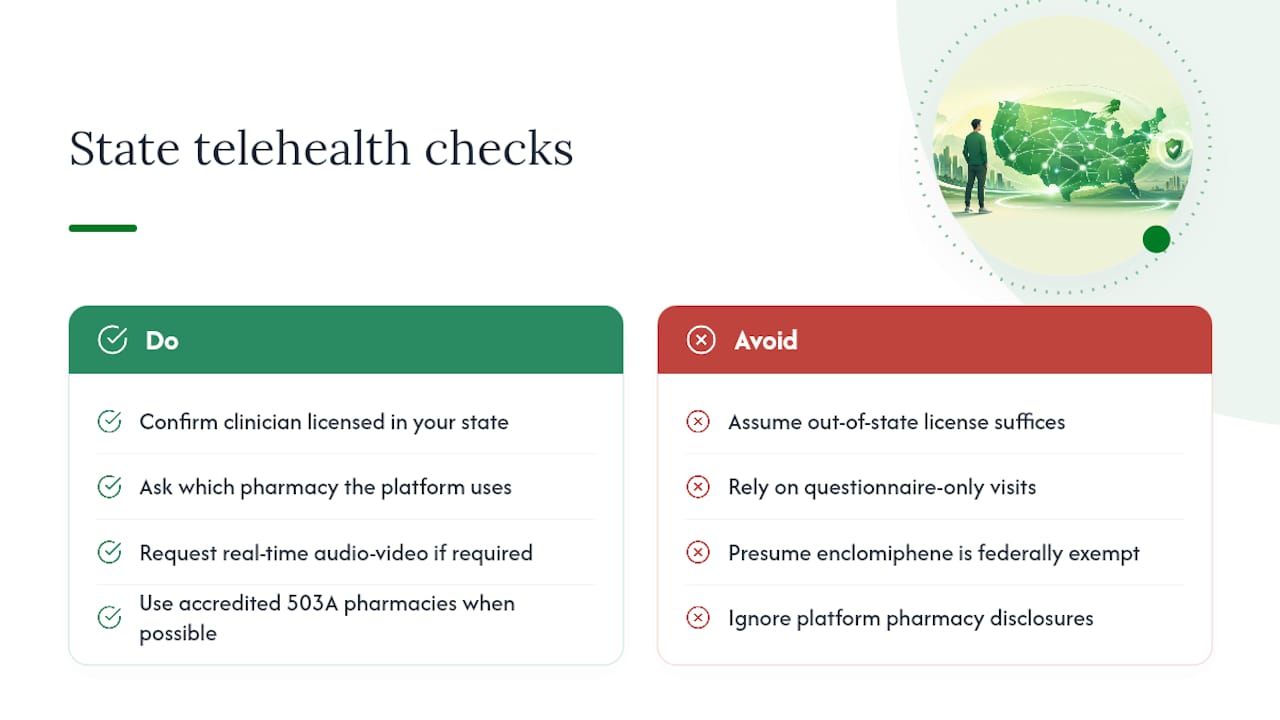
Telehealth prescribing rules for enclomiphene aren’t uniform across the country, and that matters more than most guides let on. States set their own requirements for what counts as a valid telehealth relationship, including whether a clinician needs to be licensed in the patient’s state (not just their own) before prescribing.
Nearly every state now requires the prescribing clinician to hold an active license in the state where the patient is physically located at the time of the visit, not just the clinician’s home state. That’s why reputable telehealth platforms ask for your current address and verify state licensing before matching you with a provider.
Because enclomiphene is compounded rather than commercially manufactured, it also falls under separate rules governing compounding pharmacies. The U.S. draws a distinction between 503A pharmacies, which compound patient-specific prescriptions, and 503B outsourcing facilities, which produce in larger batches under different federal oversight. Clinicians generally route enclomiphene prescriptions to accredited 503A pharmacies, and pharmacy accreditation standards exist specifically to make sure compounded medications meet consistent quality and safety benchmarks.
A few states have added extra layers, like requiring an initial visit to include real-time audio-video rather than a written questionnaire alone, or restricting certain controlled substances from telehealth prescribing entirely (enclomiphene isn’t controlled, but the trend affects how strict some state telehealth boards have become generally). If you’re using a telehealth platform, the simplest way to confirm compliance is to check whether the clinician assigned to you is licensed in your state and whether the platform discloses which pharmacies it works with.
The core clinical process is identical either way, labs, clinician review, prescription, follow-up labs. What changes is logistics, and logistics is where telehealth pulls ahead for most men.
An in-person path means scheduling a urologist or endocrinologist appointment, which can carry a multi-week wait in many areas, then a separate trip for the lab draw, then another visit to review results, then a pharmacy pickup. Each step adds calendar friction, and if your schedule doesn’t align with clinic hours, that friction compounds.
Telehealth condenses most of that into a video visit and a lab order you can fulfill at a local draw site or through an at-home kit. Prescriptions route directly to a compounding pharmacy that ships to your door, cutting out the pharmacy counter entirely. Follow-up happens through secure messaging and scheduled video visits instead of requiring you to physically return to a waiting room every time a dose needs adjusting.
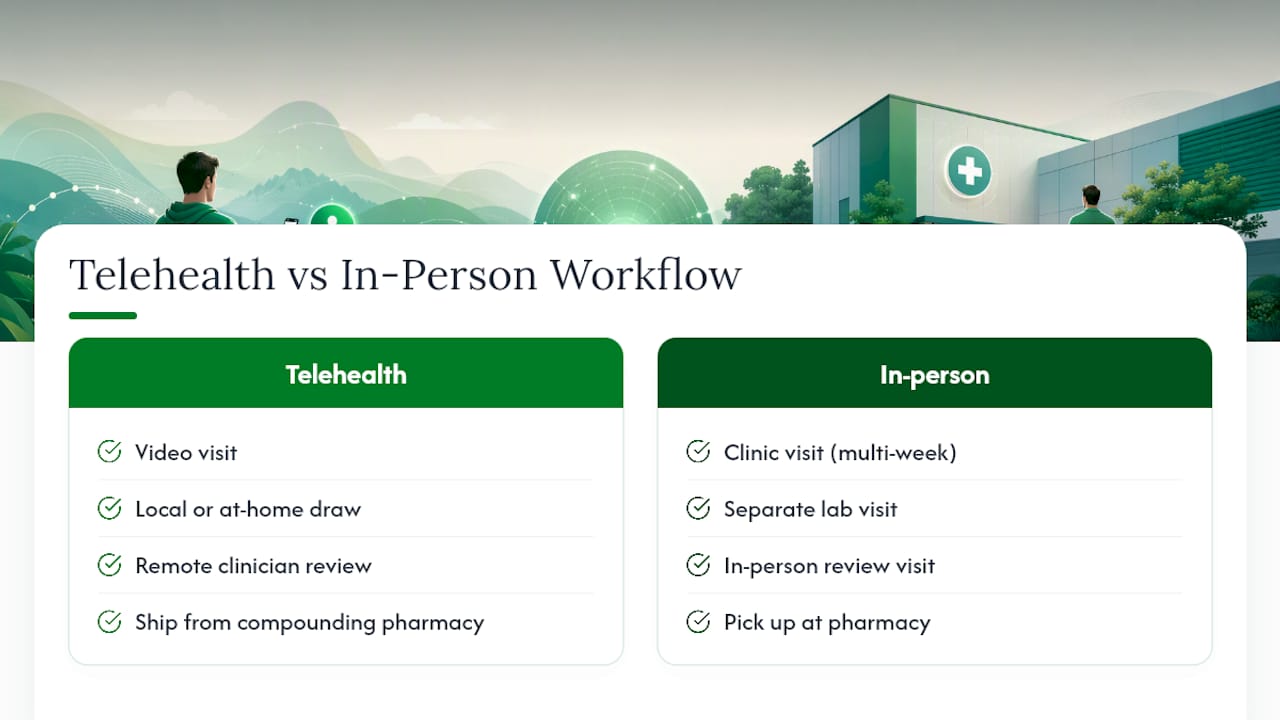
Where in-person care still has an edge is complexity. If your case involves ambiguous labs, a suspected pituitary issue, or symptoms that need a physical exam (testicular ultrasound, for instance), an in-person endocrinologist or urologist can do things a video visit can’t. Good telehealth platforms recognize this limit and refer out rather than trying to manage it remotely. For the large majority of men with straightforward secondary hypogonadism and no complicating factors, though, telehealth delivers the same clinical process with dramatically less friction.
Some telehealth platforms run the clinical backbone described throughout this guide: a licensed clinician evaluation, coordinated baseline labs, and prescriptions routed to U.S. compounding pharmacies for home delivery. If you’re comparing telehealth fertility options or trying to figure out how to get enclomiphene online without juggling separate appointments for the visit, the labs, and the pharmacy pickup, this is the kind of consolidated model built to solve exactly that.

Follow-up care isn’t an afterthought here. Some telehealth platforms build monitoring into the plan from the start, with repeat labs scheduled at the intervals your clinician recommends and secure messaging available for dose questions or side effects between visits. Starting is straightforward: have your symptom history and any recent lab results ready, complete the intake, and expect a lab order and clinician review within days rather than weeks. Pricing transparency and guidance on HSA or FSA fund usage may be available for some providers. If you’re ready to move past research mode, the telehealth consent page is the place to start the process.
Clinicians approach enclomiphene conservatively: labs drive every decision, and a clear follow-up plan is non-negotiable before a prescription goes out. That’s not bureaucracy for its own sake, it’s how dose adjustments stay grounded in data instead of guesswork.
Patients, meanwhile, care most about convenience and realistic timelines. Expect days for intake and lab scheduling, not hours, and expect symptom improvement to trail lab changes by several weeks. One honest caveat belongs here too: enclomiphene’s evidence base, while solid on mechanism and fertility preservation, is still built on a smaller body of long-term data than decades-old therapies carry. That’s exactly why ongoing monitoring matters more than a one-time prescription ever could.
— Bryan
This article is general information, not a substitute for advice from a qualified doctor. Consult a qualified healthcare professional about your own circumstances before acting on anything here.
Yes. In the U.S., licensed telehealth clinicians can prescribe enclomiphene after reviewing your intake and baseline labs, with prescriptions typically filled by a compounding pharmacy.
Most men complete intake and lab ordering within a few days; once labs come back and a clinician reviews them, a prescription can often be issued within about a week total.
Many insurance plans don’t cover compounded enclomiphene since it’s prescribed off-label, but HSA and FSA funds can generally be used for both the medication and the clinician visit.
Clinicians typically require total and free testosterone, LH, FSH, estradiol, a CBC, and a CMP to confirm secondary hypogonadism before prescribing.
Enclomiphene raises testosterone by boosting natural LH and FSH signaling rather than suppressing it, which is why it’s often preferred over exogenous testosterone for men prioritizing fertility.