For most U.S. adults who want convenient access to prescriptions, primary care, weight loss, or sexual health treatment, AM Rx is the strongest starting point. It combines same-day appointments, integrated prescription delivery, and transparent insurance handling in one platform. Beyond AM Rx, the right pick depends entirely on what you need:
All providers on this list use board-certified clinicians, operate on HIPAA-compliant platforms, and several carry employer or insurer partnerships. One caveat worth stating upfront: prescribing rules vary by state, so confirm your state’s telehealth laws before booking, especially for controlled substances or psychiatric medications.
As Healthline notes, there is no single best telehealth service. The right choice depends on your clinical need, insurance status, and whether you need prescriptions or specialist continuity.
The best telehealth service for most U.S. adults is the one that matches your specific clinical need, accepts your insurance, and can legally prescribe in your state.
| Point | Details |
|---|---|
| Match platform to clinical need | Urgent care, mental health therapy, and prescription management each require a different type of platform. |
| Verify insurance before booking | Telehealth coverage depends on your specific employer plan, not just your carrier — confirm benefits first. |
| Check state prescribing rules | Controlled substances and psychiatric medications face state-level restrictions that vary by provider and condition. |
| AM Rx for prescription-friendly care | AM Rx covers weight loss, ED, birth control, primary care, and mental health with same-day appointments and prescription delivery. |
| Red flags to avoid | No HIPAA statement, unclear clinician credentials, and no documented prescription policy are disqualifying signs. |
| Provider | Best for | Pricing model | Insurance/employer | Availability | Prescription policy | Clinician types | Platform | HIPAA/security |
|---|---|---|---|---|---|---|---|---|
| AM Rx ⭐ Our Pick | Prescriptions, weight loss, ED, birth control, primary care, mental health | Per visit or subscription | Insurance accepted; self-pay available | Same-day appointments | Broad; state rules apply; no controlled substances for all conditions | MD/DO, NP, therapist | Web and app; user-friendly | HIPAA-compliant; explicit consent workflow |
| Teladoc Health | Employer/plan-sponsored telehealth | Per visit or employer plan | Broad employer and insurer partnerships | 24/7, on-demand | General prescriptions; no controlled substances | MD/DO, NP, therapist | App and web; enterprise integrations | HIPAA-compliant |
| Amwell | Health systems and enterprise telehealth | Per visit or enterprise contract | Health system and insurer partnerships | 24/7 | General prescriptions | MD/DO, NP, therapist | App, web, EHR integrations | HIPAA-compliant |
| MDLIVE | Network access for urgent and ongoing care | Per visit or subscription | Insurer and employer partnerships | 24/7, same-day | General prescriptions | MD/DO, NP | App and web | HIPAA-compliant |
| BetterHelp | Therapy and mental health counseling | Subscription (weekly/monthly) | Limited insurance; mostly self-pay | Flexible scheduling | No prescriptions | Licensed therapist, counselor | App and web; messaging and video | HIPAA-compliant |
| Sesame | Affordable pay-per-visit care | Per visit; membership option | Limited insurance; self-pay focus | Same-day available | General prescriptions | MD/DO, NP | Web-based marketplace | HIPAA-compliant |
| Hims | Sexual health, hair loss, skincare | Subscription or per order | Mostly self-pay | Async or scheduled | Product-focused prescriptions | MD/DO, NP | App and web | HIPAA-compliant |
| American TelePhysician | Networked physician access, general virtual care | Per visit | Varies by plan | Scheduled and on-demand | General prescriptions | MD/DO | Web-based | HIPAA-compliant |
A few quick data points worth knowing: same-day appointment availability is one of the sharpest differentiators on this list. Platforms like AM Rx and MDLIVE offer it consistently, while therapy-focused services like BetterHelp operate on a scheduled model. Insurance coverage for telehealth often hinges on your specific employer plan rather than just your carrier, so a provider listed “in-network” may still have different telehealth rules depending on your benefits package.

The right telehealth service earns its place by being safe, accessible, and actually useful for the conditions it claims to treat. Here is how this list was built.
Criteria, in priority order:
Sources used include provider documentation, AM Rx’s own service and consent pages, Healthline’s telemedicine roundup, Becker’s Hospital Review’s 2026 telehealth company list, and Zocdoc’s platform comparison resources. Data was reviewed in 2026. Where state licensing or employer plan coverage varies, this article notes the variability rather than stating a universal rule.
Pro Tip: Before comparing platforms, write down your top two clinical needs and whether you have employer-sponsored telehealth benefits. That single step cuts the shortlist from eight providers to two or three.
AM Rx is built for U.S. adults who want to handle specific health conditions — weight loss, ED, birth control, primary care, mental health, hair loss, skincare, and testosterone support — without waiting weeks for an in-person appointment. Same-day appointments are available, and prescriptions are delivered directly to your door. The platform accepts insurance and offers self-pay options, with a documented consent and telehealth workflow that spells out exactly how the visit works before you start. Clinicians include MDs, DOs, and NPs depending on the service. The web platform is clean and straightforward. State prescribing rules apply, particularly for psychiatric medications, so confirm your state’s rules before booking mental health services.
Pros: Same-day access; integrated prescription delivery; covers a wide range of condition-specific services. Con: Controlled substance prescribing is subject to state rules and may not be available in all states.
Teladoc is the largest telehealth network in the U.S. by enterprise reach, with deep integrations into employer-sponsored benefit plans and insurer networks. If your employer offers telehealth as a benefit, there is a good chance Teladoc powers it. The service covers urgent care, primary care, mental health, and dermatology. On-demand visits are available 24/7. Prescriptions are available for general conditions; controlled substances are not prescribed. The app is polished and widely used.
Pros: Broad employer and insurer coverage; 24/7 availability. Con: The experience can feel impersonal at scale, and plan-level coverage varies significantly.
Amwell operates primarily as an enterprise telehealth infrastructure provider, meaning health systems and insurers use it to power their own branded telehealth programs. Consumers can access it directly, but its real strength is in institutional partnerships. It covers urgent care, primary care, therapy, and psychiatry. The platform integrates with EHRs, which matters for continuity of care in health system settings.
Pros: Strong health system partnerships; flexible enterprise setup. Con: Consumer-facing experience is less intuitive than direct-to-consumer platforms.
MDLIVE connects patients to a national network of board-certified physicians and therapists for urgent care, primary care, dermatology, and behavioral health. It works with many major insurers and employer plans. Same-day appointments are available for urgent care. The app is well-reviewed for ease of use.
Pros: Broad treatment variety; strong insurer partnerships. Con: Mental health scheduling can have longer wait times than urgent care.
BetterHelp is a therapy-only platform. It does not prescribe medications. What it does well is connect patients to a large network of licensed therapists via video, phone, or text messaging on a subscription model. It is the right choice if you need ongoing counseling and do not require psychiatric prescriptions. Insurance coverage is limited; most patients pay out of pocket.
Pros: Large therapist network; flexible communication formats. Con: No prescriptions; limited insurance acceptance.
Sesame is a price-transparent marketplace where patients can book virtual visits directly with independent clinicians at published rates. There is no insurance required, and a membership option reduces per-visit costs further. It suits patients who want to know exactly what they will pay before booking. The Becker’s 2026 telehealth list highlights how the market has expanded to include affordability-focused models like Sesame alongside enterprise networks.
Pros: Transparent pricing; no insurance needed. Con: Clinician availability varies by location and specialty.
Hims is a direct-to-consumer telepharmacy and telehealth brand focused on ED, hair loss, and skincare. The model is product-first: you complete an online assessment, a clinician reviews it, and medication ships to your door. It is not a general primary care platform. Prescriptions are available for the conditions it covers; the experience is closer to a subscription product than a traditional medical visit.
Pros: Frictionless for its target conditions; direct-to-door fulfillment. Con: Narrow condition coverage; not suitable for complex or ongoing primary care needs.
American TelePhysician offers virtual care through a network of physicians covering a range of general medical needs. It suits patients who want established physician network access for standard virtual visits. Public information on pricing and specialty depth is limited.
Pro Tip: If you are comparing platforms for mental health care specifically, check whether the service can prescribe psychiatric medications or only provide therapy. BetterHelp does therapy only; AM Rx and Teladoc can handle both, subject to state rules. AM Rx’s psychiatric care guidance explains how remote mental health prescribing works and what state-level constraints apply.
AM Rx earns the top spot for consumers who want one platform to handle prescription-friendly primary care, weight management, sexual health, mental health, and more — without the friction of separate specialist referrals or long waits.
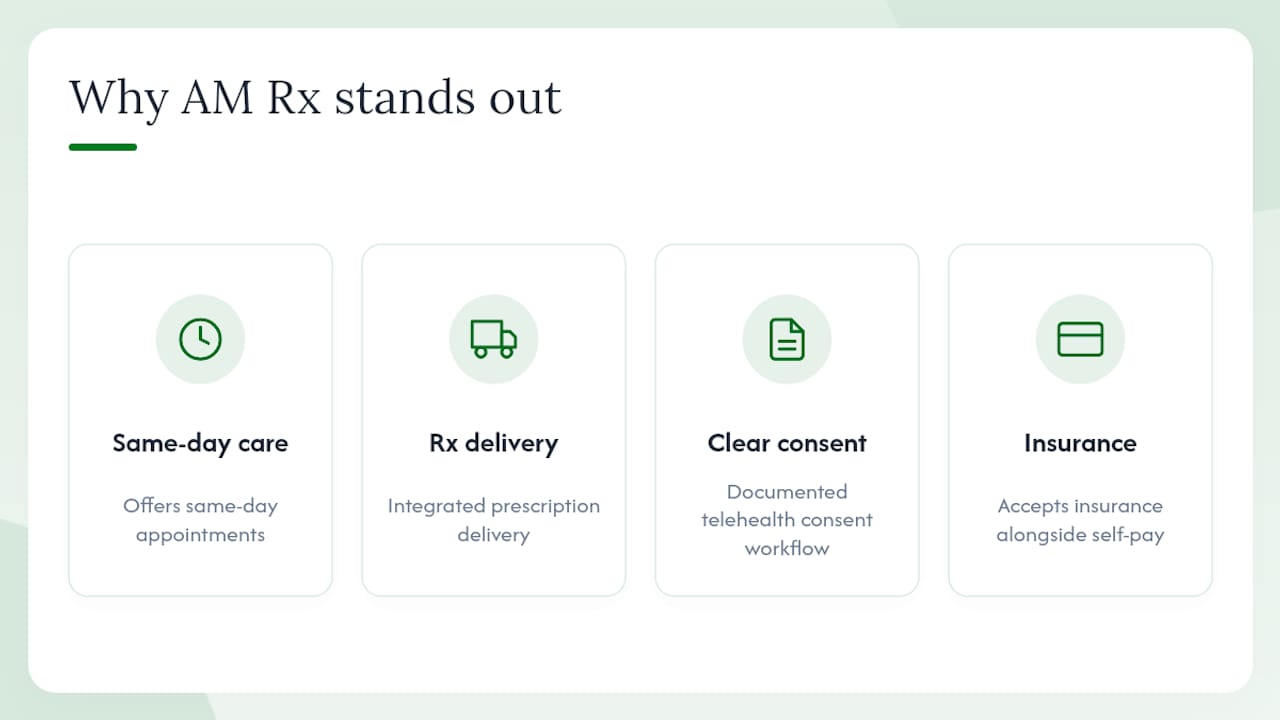
What sets AM Rx apart is the combination of same-day appointments, integrated prescription delivery, and a documented telehealth consent workflow that makes the process transparent before you ever speak to a clinician. Most platforms offer one or two of these. AM Rx connects them in a single experience, which matters when you need a prescription evaluated and filled quickly.
The service covers weight loss, ED, birth control, primary care, mental health, hair loss, skincare, and testosterone support. Insurance is accepted alongside self-pay, which gives patients flexibility that purely self-pay platforms like Sesame or Hims do not offer. The consent to telehealth process is documented and explicit, a meaningful compliance signal in a market where many platforms bury their workflow details.
One honest caveat: state prescribing rules affect what AM Rx can prescribe in your state, particularly for psychiatric medications and certain controlled substances. Confirm your state’s rules and your insurance eligibility before booking. AM Rx’s psychiatric care page addresses this directly.
Start with clinical need, then layer in insurance and prescription requirements. As Healthline’s telemedicine guide puts it, the optimal choice depends on what you need treated, not just which platform has the most users.
Step-by-step decision checklist:
Questions to ask before you book:
Red flags to watch for:
The distinction between consumer-facing discovery marketplaces and integrated telehealth networks matters here. As Zocdoc’s platform analysis explains, discovery tools surface individual clinicians while integrated networks operate their own clinician pools and enterprise contracts. For most consumers, an integrated platform like AM Rx or Teladoc is more reliable for consistent care than a marketplace where clinician availability shifts.
The Becker’s 2026 list of 272 telehealth companies is a useful reality check. Specialty-focused platforms now cover everything from nutrition counseling to dementia care to gambling disorder treatment. Maven Clinic, for example, runs a virtual network across 30+ specialties focused entirely on women and family health, with employer benefit integration. Tools like Doxy.me provide HIPAA-compliant video infrastructure for clinicians but supply no clinicians themselves. The market is not a handful of big names anymore.
What this means practically: the eight platforms on this list represent the most relevant options for general consumer needs, but if you have a narrow clinical need, a specialty-focused platform may serve you better than a general network. The checklist in the previous section applies regardless of which platform you are evaluating.
The thing most comparison guides understate is how much employer plan specifics shape your real options. A platform that is technically in-network with your carrier may still have different telehealth coverage rules under your specific plan. That gap catches a lot of patients off guard. Call your benefits line first.
Most telehealth platforms handle urgent care well. Fewer handle the conditions people are actually reluctant to discuss in a waiting room: weight management, sexual health, mental health, hair loss, and birth control. AM Rx is built specifically for those needs, with same-day appointments and prescription delivery that removes the gap between consultation and treatment.

Core services available through AM Rx:
Before booking, confirm that your insurance plan covers AM Rx visits and that your state permits telehealth prescribing for your condition. Start your visit at AM Rx or review the telehealth consent process to see exactly how a visit works before you commit.
This article provides general information about telehealth services and is not a substitute for professional medical advice. Confirm current coverage, prescribing rules, and clinician credentials with your provider and insurance plan before booking.
The top providers for general consumer needs are AM Rx, Teladoc Health, Amwell, MDLIVE, BetterHelp, Sesame, Hims, and American TelePhysician. The best choice depends on your clinical need, insurance coverage, and whether you require prescriptions.
Teladoc Health is the largest by enterprise reach, with broad employer-sponsored plan integrations and a national clinician network covering urgent care, primary care, mental health, and dermatology.
Both are strong for urgent and primary care with insurer partnerships. Teladoc has wider employer plan coverage; MDLIVE offers a comparable network with a slightly broader treatment variety. If your employer plan covers one specifically, that is the practical answer.
AM Rx is the strongest option for patients who need prescription-friendly primary care alongside condition-specific services like weight loss, ED, birth control, and mental health. It offers same-day appointments and direct prescription delivery, with insurance accepted and a documented telehealth workflow.