No single treatment erases acne scars, and any provider who promises full removal isn’t being straight with you. What works is matching the method to your scar shape and your skin tone: ice-pick scars respond to focal chemical treatment or laser, rolling scars need mechanical release before filling, boxcar scars need resurfacing, and most people need two or three of these layered together. Stabilize active acne first, then expect a staged plan over several months, not a single visit.
TL;DR:
- Combining treatments like laser, subcision, and fillers yields better results than relying on a single method for acne scars.
- Most treatments require multiple sessions spaced out over several months, with visible improvements continuing beyond immediate results.
- Identifying your scar type accurately—ice-pick, boxcar, or rolling—is crucial to selecting the most effective treatment approach.
- Active acne must be stabilized first to prevent new scars from forming during scar revision procedures.
- Costlier treatments like ablative lasers carry higher risks for hyperpigmentation, especially for darker skin types, and should be chosen carefully.
Before anyone can tell you which procedure will help, you need to know what kind of scar you’re actually dealing with. Dermatologists classify atrophic acne scars into three main shapes, and each one behaves differently under treatment.
Ice-pick scars are narrow, deep, and punch straight down into the skin, like a tiny puncture wound. They’re the hardest to treat with surface resurfacing alone because the damage sits too deep for a laser to reach without excessive tissue removal.
Boxcar scars have sharp, defined edges and a flat base, similar to chickenpox scars. They respond well to resurfacing methods because the problem is more about missing volume across a broader area than a deep tunnel.
Rolling scars create a wave-like texture from fibrous bands tethering the skin to deeper tissue. Surface treatments barely touch these because the real issue is structural, not textural.
There’s also a fourth category: raised hypertrophic or keloid scarring, where the skin overproduces collagen instead of losing it. This is the opposite problem and calls for entirely different treatments (steroid injections, silicone sheeting) rather than anything discussed below.
Why does this matter so much? Because:
Here’s what each major clinical treatment actually does, who it fits, and what to expect walking in.
These lasers vaporize tiny columns of skin in a grid pattern, triggering the body to rebuild collagen across the treated area. They’re often the first-line laser therapy for boxcar and mixed atrophic scarring, and ablative CO2 and Er:YAG lasers achieve high efficacy rates in some studies. The tradeoff is real downtime, usually a week of redness and peeling, and a meaningfully higher risk of post-inflammatory hyperpigmentation (PIH), particularly in Fitzpatrick skin types III through VI.
These work with less thermal injury to the surface, which means less downtime and a lower PIH risk. Practitioners often favor picosecond and RF microneedling devices over aggressive CO2 lasers for darker skin tones specifically because they cut PIH risk while still stimulating remodeling underneath. The catch: you’ll likely need more sessions to reach the same improvement an ablative laser might deliver in fewer visits.
Fine needles create controlled micro-injuries that trigger collagen production without removing surface tissue. It’s one of the gentler options on this list and works across most skin tones with a favorable safety profile.
Microneedling typically requires multiple sessions spaced a few weeks apart before patients see meaningful change, according to Mayo Clinic. Pairing it with PRP (platelet-rich plasma) tends to amplify the remodeling effect and cut recovery time.
This is a targeted technique: a toothpick or fine applicator delivers high-concentration trichloroacetic acid directly into an ice-pick scar, causing controlled scarring that ultimately fills the pit. Concentrations commonly range from 65% to 100% TCA, and focal 65 to 100 percent TCA CROSS shows significant improvement across atrophic scar subtypes, with even a 70% concentration producing meaningful change. It’s precise, low-downtime for the surrounding skin, and frequently paired with laser resurfacing for broader coverage.
Subcision uses a needle or cannula to physically sever the fibrous bands anchoring a rolling scar to deeper tissue, letting the skin lift back into place. It’s mechanical, not chemical, and it’s often the missing step when fillers alone haven’t held. Punch excision surgically removes an ice-pick or boxcar scar entirely, closing the site with a small graft or suture. It’s a more invasive option reserved for scars that haven’t responded to less aggressive methods.
Hyaluronic acid (HA), calcium hydroxylapatite (CaHA), poly-L-lactic acid (PLLA), and polymethylmethacrylate (PMMA) all lift depressed scars from underneath, and they work best on rolling and pliable boxcar scars. PLLA stimulates your own collagen production over time, and PLLA shows notable efficacy with high patient satisfaction at long-term follow-up in some studies. CaHA tends to hold its correction for extended periods before needing a repeat treatment. The important detail most patients miss: subcision generally needs to happen first for rolling scars, because filling a scar that’s still tethered underneath leads to rapid filler loss and a disappointing result.
Nearly every recent review on acne scarring lands on the same conclusion: combining methods outperforms relying on one. A systematic review and network meta-analysis found that CO2 laser-based combination therapies and microneedling paired with PRP ranked among the highest for both clinical improvement and patient satisfaction, well above monotherapy approaches.
What that looks like in practice, sequenced over a real treatment plan:
Spacing matters as much as sequencing. Most providers space sessions 4 to 12 weeks apart to give tissue time to heal and collagen time to rebuild. That rebuilding isn’t instant either; visible improvement from a single filler or laser session can keep evolving for months afterward as new collagen matures underneath the surface.
Pro Tip: Don’t judge any single session by its immediate result. Ask your provider for a 3 to 6 month reassessment point before deciding whether to add another modality, since collagen remodeling is still working long after the redness fades.
Walking into a consultation prepared changes the outcome as much as the treatment itself does. Start with the basics: is your acne currently under control? Experts consistently recommend stabilizing active inflammatory acne before any scar revision, because treating scars while breakouts are still happening risks creating new scars in the same session. If you’ve recently started or are about to start tretinoin, give your skin time to adjust first since the initial purge period can flare inflammation right when you don’t want it to.
A useful pre-consultation checklist:
On cost: cosmetic acne scar procedures are almost always self-pay in the United States, since insurance typically classifies them as elective. Prices vary widely by region, device, and provider experience, but expect fractional laser sessions to run several hundred dollars each, microneedling somewhat less per session, and filler priced per syringe. Because most effective plans involve multiple sessions across several months, budget for the full course rather than a single visit; a provider quoting one treatment as a total fix should raise questions.
AM Rx can’t perform lasers, subcision, or punch excision. Those require hands-on procedural specialists. What a telehealth visit can do is handle the piece that has to happen first: getting active acne under control with prescription topicals or oral medication, so you’re not layering procedures onto ongoing breakouts. A provider can also talk through which scar-specific options make sense for your history and coordinate a referral to an in-person specialist when it’s time for the procedural work itself. That’s a real, useful role, not a replacement for the dermatologist doing the resurfacing.
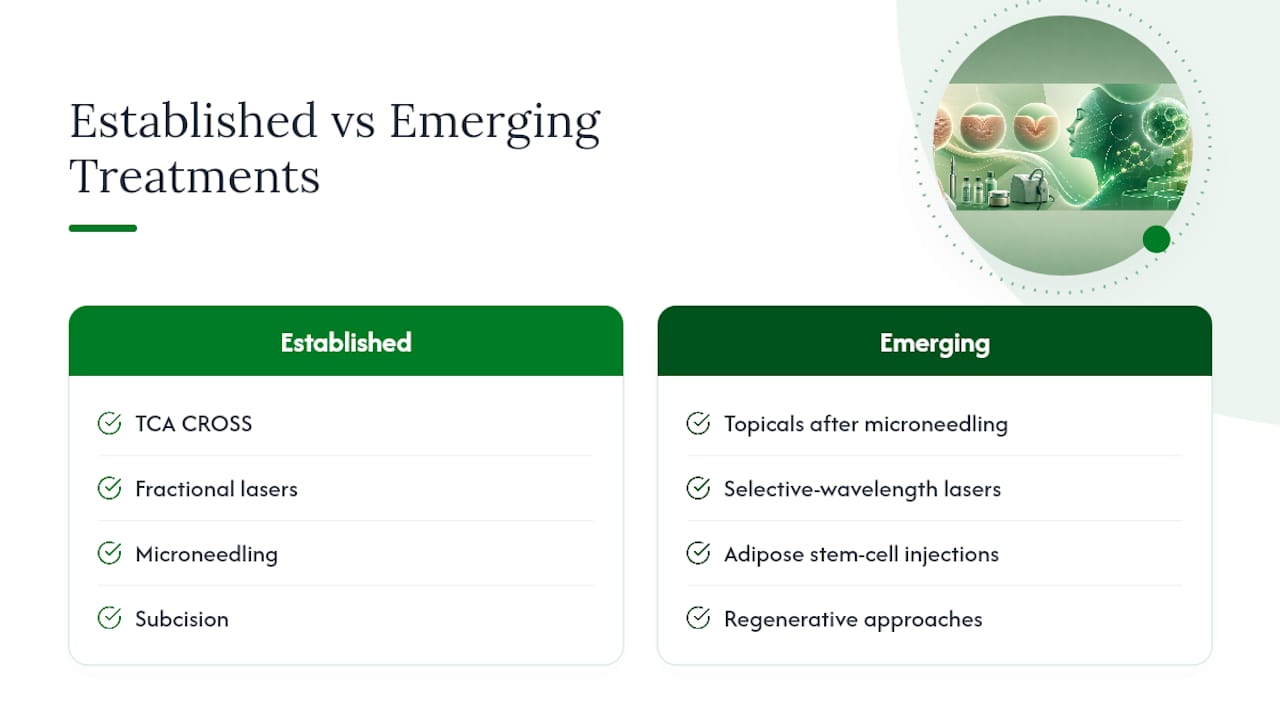
Research into acne scarring hasn’t stopped at lasers and fillers. Exosome and growth-factor topicals applied after microneedling are being studied as a way to accelerate collagen remodeling beyond what needling alone produces, though the evidence base is still developing compared to established methods like TCA CROSS or fractional resurfacing.
Novel laser platforms are also evolving toward more selective wavelengths that target scar tissue while sparing more of the surrounding skin, aiming to close the gap between the high efficacy of ablative CO2 and the safety profile of gentler picosecond devices. Stem cell and regenerative approaches, including adipose-derived stem cell injections for volume restoration, are being explored in early research settings but remain far from routine clinical use.
None of this changes the near-term picture. If you’re weighing options today, the treatments with the strongest track record, TCA CROSS, fractional lasers, microneedling, subcision, and fillers, remain the evidence-backed path. Emerging techniques are worth watching, not worth waiting for if scarring is bothering you now.
Patients often come in expecting a finish line: one procedure, scars gone. That’s not how this works, and consensus reviews are blunt about it: no therapy removes acne scarring completely, and a multimodality approach chosen by scar type is usually necessary. The goal is meaningful improvement in texture and visibility, not a return to pre-acne skin.
I’d rather see someone go into a consultation with that expectation set correctly than walk out disappointed after a $2,000 laser package because they thought it would erase everything. Skin tone deserves equal weight to scar type in the decision. If you’re Fitzpatrick IV through VI, push back on any provider defaulting straight to aggressive ablative CO2 without discussing PIH risk and alternatives first. For anything beyond focal TCA CROSS or basic microneedling, work with a board-certified dermatologist or an experienced proceduralist. This is not the category to shop on price alone.
— Bryan
Every scar treatment on this list works better when it’s not competing with active breakouts. AM Rx gets you in front of a licensed provider the same day, from your phone, to evaluate your acne and get a prescription plan moving instead of waiting weeks for an in-person dermatology appointment just to start topical or oral treatment.

A visit typically runs through your acne history, current breakout pattern, and any scarring you’re already noticing, then results in a treatment plan sent straight to your preferred pharmacy or delivered to your door. If your case calls for procedural scar work down the line, your provider can point you toward what to bring up with a specialist. If you’re ready to get active acne stabilized before booking any laser or filler consultation, you can start your telehealth visit today and get a plan in motion this week.
For more clinical depth on the options covered here, see Mayo Clinic’s guidance on acne scar treatment, Cleveland Clinic’s overview of scar removal options, and the PMC review of advances in acne scar treatment.
This article is general information, not a substitute for advice from a qualified doctor. Consult a qualified healthcare professional about your own circumstances before acting on anything here.
No single treatment ranks highest for every scar. Combination approaches, such as CO2 laser paired with subcision or microneedling paired with PRP, consistently outperform any single method in recent reviews.
No. Consensus clinical reviews are clear that no current therapy eliminates acne scarring completely; the realistic goal is significant improvement in texture and depth, not a full return to unscarred skin.
The best approach depends on your scar type: TCA CROSS for ice-pick scars, subcision plus filler for rolling scars, and resurfacing (laser or microneedling) for boxcar scars, often combined into a single staged plan.
Korean dermatology clinics commonly favor fractional laser resurfacing, microneedling, and PRP-based treatments, frequently layered together rather than used alone, alongside daily sunscreen and gentle exfoliating acids to support the skin between procedures.
Yes. Providers generally recommend getting active breakouts under control first, since procedures performed on inflamed skin risk creating new scarring on top of the old.