Most people who start tretinoin begin purging within 2 to 4 weeks, hit the roughest patch around weeks 3 to 6, and see it resolve somewhere between 4 and 12 weeks. That’s the whole arc. The single most useful thing you can do during this window is keep your routine simple and stay consistent unless you hit a genuine red flag.
Pro Tip: Don’t judge tretinoin by week 3. Judge it by week 12. Almost every dermatology source that tracks outcomes points to the 8 to 12 week mark as the real test of whether it’s working.
Stop tretinoin and contact a clinician immediately if you notice severe burning, a rash spreading beyond your usual breakout areas, swelling of the face or lips, or any sign of an allergic reaction. Those aren’t purge symptoms. According to MedlinePlus, these are warning signs that require medical attention, not patience.
The tretinoin purge typically starts within 2 to 4 weeks, peaks around weeks 3 to 6, and resolves for most people between 4 and 12 weeks with consistent use.
| Point | Details |
|---|---|
| Onset window | Most purging begins within 2 to 4 weeks of starting tretinoin. |
| Peak severity | Weeks 3 to 6 tend to bring the most visible breakouts before improvement starts. |
| Normal duration | Full resolution usually falls between 4 and 12 weeks depending on skin turnover rate. |
| Distinguish purge from reaction | Check location, lesion type, and whether the trend is improving week over week. |
| Get a clinician’s input if needed | AM Rx offers virtual consultations to review a prolonged purge and adjust your tretinoin plan. |
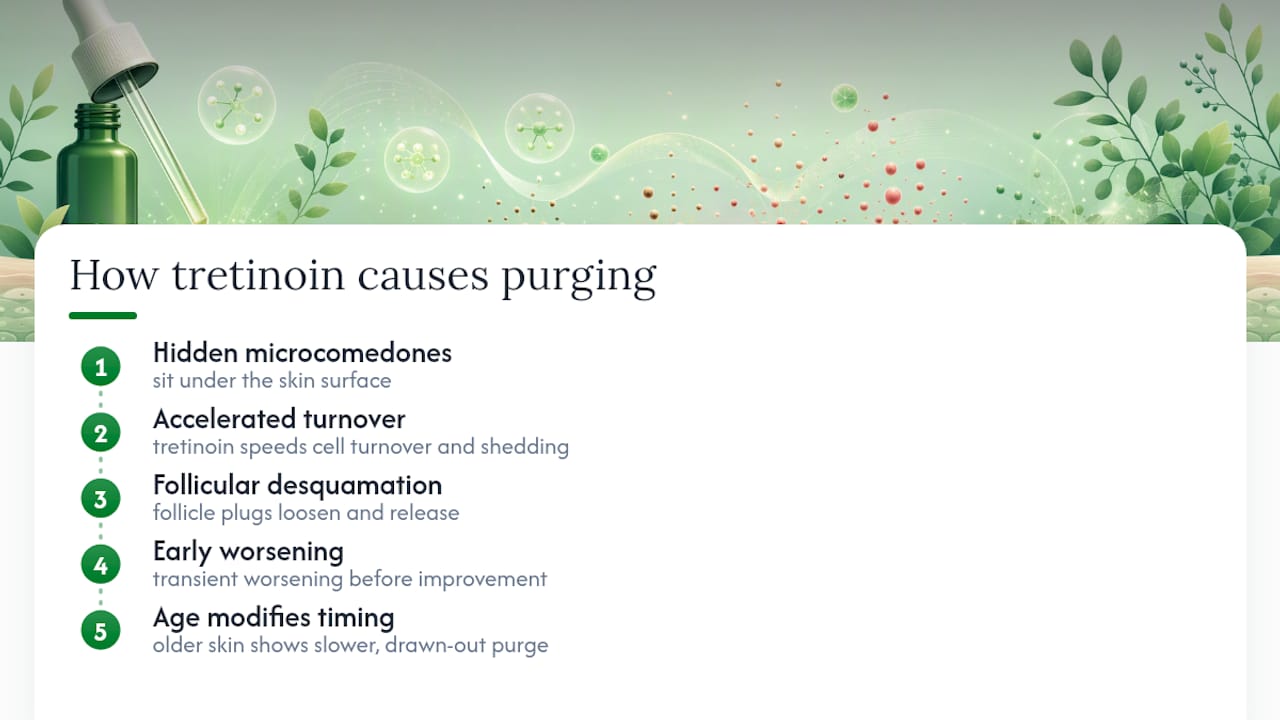
The purge is a temporary spike in visible acne that happens when tretinoin accelerates the surfacing of microcomedones, the tiny, invisible clogged pores that were already forming under your skin before you ever applied the cream. Tretinoin doesn’t create new acne. It speeds up the timeline of acne you were probably going to get anyway, compressing weeks or months of normal breakout development into a shorter, more intense window.
The American Academy of Dermatology explains that acne begins with follicular hyperkeratinization, a buildup of skin cells that clogs pores before you can see anything on the surface. Tretinoin, as a core comedonal acne therapy, pushes that hidden buildup out faster than it would surface on its own.
During an active purge, you’ll typically notice:
Tretinoin speeds up how fast your skin cells turn over and shed, which forces microcomedones already sitting under the surface to come out ahead of schedule. Normal skin cell turnover runs on roughly a monthly cycle, which tretinoin can significantly shorten according to mechanistic reviews of retinoid activity.
That faster cycle is exactly what NCBI’s review of retinoids describes: accelerated epidermal turnover and follicular desquamation, meaning the skin sheds its outer layer and the plugs inside follicles loosen and release faster than usual. A review of topical retinoids and skin renewal documents this same pattern across clinical use, transient early worsening followed by measurable improvement once the skin adapts.
Older clinical reports back this up over decades of use. Documented cases from the early 1980s recorded initial acne flares in the first weeks of tretinoin treatment, followed by steady improvement with continued use. That pattern hasn’t changed; it’s one of the most consistent findings in retinoid research.
Age plays a role too. DermNet NZ notes that skin cell renewal naturally slows as we get older, which means someone starting tretinoin at 45 may see a slower, more drawn-out purge than someone starting at 22. Your baseline turnover speed shapes how the whole timeline unfolds.
The earliest signs show up fast, often within the first few days, well before any actual purging begins. You’ll likely notice mild dryness and peeling in the first week just from the drug’s direct irritant effect. The purge itself, meaning new comedones and breakouts pushed to the surface, commonly shows up between weeks 2 and 4.
Days 1 to 7: Skin feels tight, maybe a little pink. Some flaking around the nose and mouth. This is irritation, not purging yet.
Weeks 2 to 4: New whiteheads and small bumps appear, usually in the same spots you’d normally break out. This is the purge kicking in.
Pro Tip: Starting three nights a week instead of nightly, and using a pea-sized amount rather than a full fingertip, often softens the initial purge without slowing your results. Going in aggressive on day one is the fastest way to quit by week three.
Here’s the full arc: irritation and early dryness in the first two weeks, active purging that peaks somewhere between weeks 3 and 6, gradual calming through weeks 6 to 8, and visible clearing for many people by weeks 8 to 12. Full clinical response, the kind dermatologists actually measure in trials, tends to be evaluated at 8 to 12 weeks and beyond, particularly for texture and comedonal acne.
| Weeks | What’s typically happening | Lesion type | What to do |
|---|---|---|---|
| 1 to 2 | Dryness, mild redness, tightness | Irritation, not acne | Moisturize heavily, apply every other night |
| 2 to 4 | New whiteheads and small comedones appear | Comedonal (blackheads, whiteheads) | Continue routine, resist the urge to pick |
| 3 to 6 | Peak breakout activity, most visible purging | Mixed comedonal and mild inflammatory | Hold steady frequency, add buffering if needed |
| 6 to 8 | Breakouts start slowing, skin less reactive | Fewer new lesions, existing ones healing | Consider increasing to nightly if tolerated |
| 8 to 12 | Visible improvement for most users | Fewer comedones overall | Take progress photos, evaluate results |
| 12+ | Skin should show clear improvement trend | Occasional normal breakouts only | Consult a clinician if no improvement |
This is about tolerance, not results. Your job is to build a buffer against irritation, not to chase clearer skin yet.
Expect new comedones. This is normal and expected, not a sign the product is wrong for you.
Most people describe this stretch as the hardest, and also the one where quitting does the most damage to eventual results.
This is where most people start to see the payoff. Clinical evidence reviews note that full response often takes months, but by this point the direction should be obvious even if you’re not fully clear.
If your skin is still actively worsening rather than improving at this point, something other than a normal purge may be going on, and that’s worth a real conversation with a clinician rather than more waiting.
Most people finish purging somewhere between 4 and 12 weeks. Four to eight weeks is the most common window; stretching to 8 or 12 weeks isn’t unusual, especially for people with slower baseline skin turnover or who started at a higher strength. Clinical evidence converges on this same range across multiple studies of topical retinoid use.
Purging that runs past the 12 week mark deserves a second look. That doesn’t necessarily mean stopping tretinoin, but it does mean getting a clinician’s eyes on what’s happening rather than assuming it will resolve on its own.
Red flags that suggest something other than a standard purge:
Three signals separate a purge from an unrelated breakout or reaction: location matches your usual acne zones, the lesion type matches what you normally get, and the trend improves week over week rather than staying flat or worsening.
| Characteristic | Typical purge | Irritation or adverse reaction |
|---|---|---|
| Timing | Starts weeks 2 to 4, improves by week 8 to 12 | Can appear anytime, doesn’t follow a clear arc |
| Lesion type | Matches your usual acne (comedones, mild inflammatory) | New lesion types, hives, or blistering |
| Distribution | Same areas you normally break out | Spreads beyond usual zones |
| Pain level | Mild tenderness | Significant burning or pain |
| Healing speed | Gradual weekly improvement | Static or worsening over time |
If what you’re seeing matches the left column, keep going with supportive care. If it leans toward the right column, reduce frequency first. If it doesn’t improve within a few days of backing off, pause tretinoin entirely and get a clinician’s opinion before restarting.
The single most effective approach is starting low and going slow while protecting your skin barrier and wearing sunscreen daily. Everything else is a refinement of that core idea.
Sample routines look different depending on your skin type:
Avoid layering in these during your first 4 to 6 weeks: strong chemical exfoliants like glycolic or salicylic acid at high concentrations, physical scrubs, and benzoyl peroxide in some combinations, since it can oxidize and inactivate tretinoin when applied at the same time. Each of these compounds irritation you’re already managing and makes it harder to tell what’s actually causing a flare.
Pro Tip: If you’re pregnant, breastfeeding, or planning pregnancy, talk to a clinician before starting or continuing tretinoin. Topical retinoids carry pregnancy cautions, and resources on retinoid safety during nursing are worth reading if you’re navigating this while breastfeeding.

Stop and contact a clinician if you notice signs of an allergic reaction, severe pain, a rash spreading well beyond your normal breakout areas, or scarring, or if you see zero improvement past the expected review window.
Mayo Clinic advises stopping tretinoin and seeking medical care promptly if you experience severe skin reactions, since these situations call for evaluation rather than waiting it out.
Before any telehealth visit, take dated photos of your skin from the same angles and note when symptoms started. That timeline makes it much easier for a provider to tell purge from a genuine problem in a five-minute video call.
People consistently underestimate two things: how early the purge starts and how rough the peak actually feels compared to what they pictured going in. Most expect a mild adjustment, not a visible flare that makes them second-guess the whole plan around week 3 or 4.
Pro Tip: Take a photo on day one, even if your skin looks fine. You’ll want that comparison point later, and giving tretinoin a genuine 12-week trial before judging it is the difference between quitting too early and actually seeing what it can do.
Waiting out a rough patch is easier when someone qualified is actually watching your progress with you. AM Rx offers virtual dermatology-adjacent consultations that let you get a clinician’s read on whether what you’re seeing is a normal purge or something that needs a different approach, without booking a weeks-out in-person appointment.

A typical visit works best when you come prepared: bring dated photos of your skin, a rough timeline of when symptoms started, and a list of every product currently in your routine. Providers on the platform can review your current tretinoin strength and frequency, suggest adjustments if the purge is running longer than expected, and prescribe alternatives if tretinoin isn’t the right long-term fit for your skin. Appointments are typically available same-day, and prescriptions, when appropriate, ship directly to you.
If your skin has been in purge mode for more than 12 weeks, or you’re just not sure whether what you’re seeing is normal, start a skincare consultation and get a clinician’s opinion before you decide whether to keep going, adjust, or switch course.
This article is general information, not a substitute for advice from a qualified doctor. Consult a qualified healthcare professional about your own circumstances before acting on anything here.
Most people purge for somewhere between 4 and 12 weeks, with 4 to 8 weeks being the most common range before visible improvement sets in.
The peak usually falls between weeks 3 and 6, after the initial purge starts but before your skin has had time to adjust and calm down.
The uglies, meaning the combined dryness, flaking, and breakout phase, typically run for 4 to 8 weeks and start improving noticeably by weeks 8 to 12.
Breakouts persisting well past the typical 12-week purge window usually aren’t a purge anymore and may point to an unrelated acne trigger, an unsuitable strength, or another skin condition worth reviewing with a clinician, an option AM Rx offers through virtual skincare consultations.
No, unless you notice red flags like severe pain, spreading rash, or signs of allergic reaction, in which case you should stop and seek medical care immediately.