Most mild-to-moderate acne can be diagnosed and treated remotely by a board-certified dermatologist, and the clinical evidence backs it up. AM Rx offers a dermatologist-reviewed process: submit photos, answer a focused history, and get a personalized prescription plan with home delivery and ongoing messaging support. If your skin has been stuck in the same frustrating cycle, the fastest path forward is preparing a few clear photos and starting an online visit today.
TL;DR:
- Most mild-to-moderate acne can be effectively diagnosed and treated remotely, often with prescriptions delivered directly to your home.
- Photo-based consultations are faster and cheaper but depend heavily on image quality, while live video offers more detailed assessment at a higher cost and longer process.
- Standard medications for acne include topical retinoids, benzoyl peroxide, antibiotics, hormonal therapies like spironolactone, and in some cases, referral for in-person testing for isotretinoin.
- Telehealth is best suited for straightforward cases, but complex or rapidly worsening acne, signs of infection, or presence of nodules call for in-person evaluation.
- Follow-up and patience are crucial, as visible improvement may take 6 to 12 weeks, and consistent engagement improves treatment success.
Acne telehealth treatment usually runs through one of three formats: asynchronous photo review, live video, or secure chat. Asynchronous photo review is the most common setup for acne specifically, because clear images paired with a detailed history often give a dermatologist everything needed to build a stepwise treatment plan, according to a systematic review of teledermatology for acne management. Live video gets reserved for cases where a provider needs to see texture, scarring depth, or ask follow-up questions in real time.
Here’s the typical sequence from sign-up to prescription:
The trade-off is straightforward. Photo-based visits are faster and cheaper, but they depend entirely on image quality. Video visits take more of your time and often cost more, but they let a provider probe details a still photo can’t capture, like how a lesion feels or whether there’s active drainage. For garden-variety acne, asynchronous review tends to be the more efficient choice. For anything unusual, ask your platform whether a video upgrade is available.
Teledermatology providers draw from the same medication toolbox as in-person dermatologists. The American Academy of Dermatology lists topical retinoids, benzoyl peroxide, topical and oral antibiotics, and hormonal therapies like spironolactone as standard-of-care options, and most virtual acne doctor visits start with one or a combination of these.
A quick stat worth knowing: a review covering 21 studies and over 7,000 patients found that teledermatology produced acne-grading outcomes comparable to in-person dermatology visits, with high patient satisfaction across the board. That’s a meaningful data point if you’ve wondered whether a screen visit really stacks up against sitting in an exam room.
Mild-to-moderate acne, including most comedonal and inflammatory presentations, fits well within what a virtual acne doctor can manage. Many moderate cases respond fine to a topical or oral regimen prescribed remotely. Where telehealth reaches its limit is isotretinoin candidacy and anything that looks like it’s spiraling fast.
Isotretinoin’s FDA labeling requires pregnancy testing, monthly lab monitoring, and enrollment in a federal risk-management registry. That combination usually makes fully remote isotretinoin management impractical, which is why most legitimate platforms will route you to in-person steps once that medication becomes the right call rather than pretend they can handle it end to end.
Watch for these red flags that call for in-person evaluation instead of, or in addition to, online acne consultations:
Pro Tip: If you’re not sure whether your case qualifies for remote care, submit anyway. A good provider will tell you plainly if you need an in-person referral instead of guessing on your own.
Photo quality is the single biggest factor separating a smooth acne telehealth treatment visit from a delayed or bounced-back one. Mobile phone photos are the standard format teledermatology platforms rely on, and poor lighting or blurry close-ups are the most common reason a review gets held up.
Follow this checklist before you upload anything:
On the history side, have this ready: your current skincare routine and any active medications, past acne prescriptions and how you responded, known allergies, and if relevant, notes on your menstrual cycle and pregnancy or breastfeeding status. Missing pregnancy status is one of the fastest ways to stall a review, since several acne medications carry restrictions there.
Pro Tip: Take your photos at the same time of day and same spot in your home for every follow-up. It makes before-and-after comparisons far more useful for your provider.

Pricing models vary, but most platforms charge either a flat single-visit fee, a subscription that bundles visits and messaging, or a medication subscription that includes the prescription cost. Priority review or a specialist-level consult typically bumps the price up.
Ask upfront whether your acne treatment cost online includes follow-up messaging or if that’s billed separately. That detail changes the real cost of care more than the sticker price of the first visit.
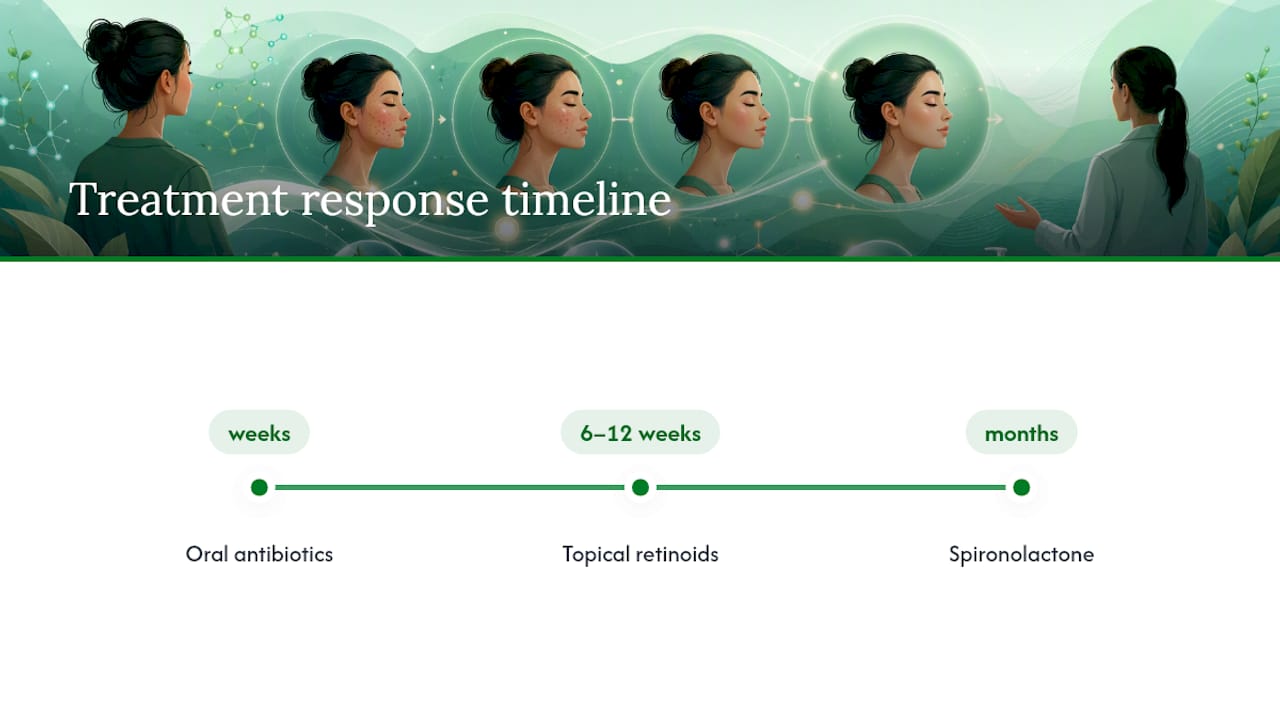
Patience matters more than people expect. Topical retinoids typically take 6 to 12 weeks to show visible improvement, and skin often looks slightly worse before it gets better as your face adjusts. Oral antibiotics work faster on inflammation but are meant as a short-term bridge, not a long-term solution. Spironolactone responses build gradually over several months as hormonal effects shift.
The same teledermatology review that found comparable clinical outcomes to in-person care also flagged a real weak spot: follow-up rates can lag behind in-person treatment in some studies. That gap usually comes down to patients treating the first prescription as a one-time fix instead of staying engaged with check-ins.
A solid acne management online workflow avoids that trap with scheduled photo check-ins, secure messaging for reporting side effects, and clear pathways for refills or escalation if the plan isn’t working. Treat those follow-up messages as part of the treatment, not an optional extra.
Not every telehealth dermatology option is built the same. AM Rx pairs board-certified provider review with same-day appointment access, direct prescription delivery, secure messaging, and transparent insurance handling. That combination matters clinically, not just for convenience: faster access to a provider means faster adjustments when a regimen isn’t working, and easy messaging keeps people from quietly abandoning treatment when they hit a rough patch. The AM Rx skincare program builds individualized regimens around exactly this kind of ongoing support rather than a one-and-done prescription.
— Bryan
AM Rx cuts out the waiting room entirely: no scheduling around a dermatologist’s calendar three weeks out, no sitting in traffic for a fifteen-minute appointment. You get board-certified provider review, a personalized plan, and prescription delivery to your door, often starting the same day you submit your visit.

Getting started takes a few steps. Review the AM Rx telehealth consent page to understand how visits, privacy, and prescriptions work, then create your account. Upload your photos following the checklist above, fill out your medical history, and note your insurance information if you plan to use it. Once you submit, a dermatologist reviews your case and sends back a treatment plan, with your prescription routed to a pharmacy of your choice. If you’re ready to stop guessing at drugstore products that aren’t working, start your visit today.
For deeper reading beyond this guide: the teledermatology outcomes review on PMC covers 21 studies on acne management, the AAD’s acne treatment overview details standard medication classes, and the FDA isotretinoin label spells out the monitoring requirements behind that specific drug.
This article is general information, not a substitute for advice from a qualified doctor. Consult a qualified healthcare professional about your own circumstances before acting on anything here.
Yes. Board-certified dermatologists can diagnose most mild-to-moderate acne through photos or video and prescribe topical or oral treatments without an in-person visit, with outcomes comparable to in-person care in reviewed studies.
Korean skincare routines often emphasize gentle, layered hydration and consistent sun protection rather than one specific acne cure, but for actual acne diagnosis and prescription treatment, a board-certified dermatologist visit, whether in person or through telehealth, remains the evidence-backed approach.
Generally, no, not fully. Isotretinoin’s FDA-mandated pregnancy testing and monthly lab monitoring usually require in-person steps, so most telehealth platforms evaluate candidacy and then refer patients for the local monitoring the medication’s safety label requires.
There’s no single fastest fix, since results depend on acne type and severity, but combination therapy (a topical retinoid plus benzoyl peroxide or a short course of oral antibiotics) tends to show improvement sooner than any single treatment alone, with visible changes typically appearing within 6 to 12 weeks.