TL;DR:
- A simple urinary tract infection can be diagnosed and treated through telehealth without an in-person visit if symptoms are uncomplicated. Patients with classic symptoms and no red flags qualify for remote care, but urgent signs like fever or back pain necessitate in-person evaluation. Clinicians review medical history and prescribe antibiotics the same day, ensuring safe and effective treatment while avoiding unnecessary visits.
Yes, an uncomplicated UTI can be diagnosed and treated through telehealth without an in-person visit. For adults with classic lower urinary tract symptoms and no complicating factors, symptom-based diagnosis is clinically appropriate when a licensed clinician reviews your history, confirms eligibility, and prescribes accordingly. The Mayo Clinic and NIDDK both recognize outpatient oral antibiotics as the standard first-line approach for uncomplicated cases.
You are likely a good candidate for telehealth UTI treatment if:
Seek in-person or emergency care immediately if you have fever, chills, flank or back pain, nausea, vomiting, or any sign of sepsis. These symptoms suggest the infection may have spread to the kidneys (pyelonephritis) or beyond, and telehealth is not appropriate for that situation.
The process is faster than most people expect. Here is the typical flow from start to prescription.
You begin by completing an online intake form covering your symptoms, their duration, your medication list, allergies, and relevant medical history, which is typically quick to complete. A licensed clinician then reviews your responses, either asynchronously (reading and responding to your questionnaire) or through a scheduled live video call, depending on the platform and your state’s regulations. Some states require a live video visit before a prescription can be issued; others permit asynchronous review alone.
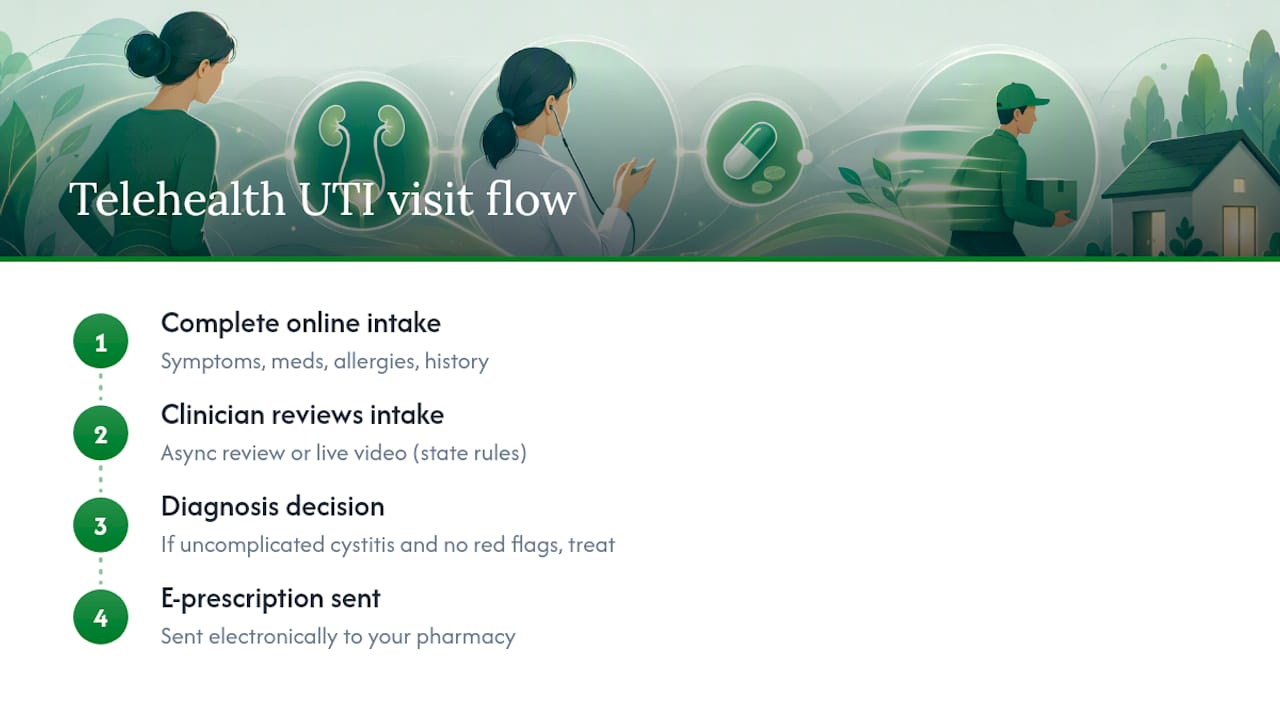
After review, the clinician makes a diagnosis decision. If your symptoms fit uncomplicated cystitis and no red flags appear, they send an electronic prescription directly to your preferred pharmacy. That whole window, from submitting your intake form to receiving a prescription notification, can be as short as within the same day on platforms with timely service. Learn more about how telehealth treats infections online and what clinical safety checks are involved.
One practical note: telehealth platforms rely on symptom-based diagnosis and medical history rather than a urine dipstick or culture. That works well for straightforward first presentations. For anything more complex, the clinician will direct you to in-person testing.
Most telehealth platforms follow similar eligibility criteria, though specifics vary by service and state.
Typical inclusion criteria:
Common exclusions:
State-level rules add another layer. A handful of states require a live synchronous video visit before any prescription can be issued. If your state has that requirement, the platform will prompt you to schedule a video call rather than complete an asynchronous questionnaire.
Some symptoms mean the infection has moved beyond the bladder, and those situations need hands-on evaluation.
For people assigned male at birth, UTI symptoms almost always warrant an in-person visit. The Urology Care Foundation notes that UTIs in men are uncommon and frequently signal an underlying structural or prostate issue that requires physical examination and further testing.
Pregnancy is a separate, firm exclusion. Even a mild UTI during pregnancy carries a higher risk of progressing to kidney infection and preterm labor, so ACOG recommends in-person evaluation and close follow-up for all UTI symptoms in pregnant patients.
If you are unsure whether your symptoms are serious enough for the ER versus urgent care, a good rule of thumb: fever plus flank pain equals urgent care or ER, no exceptions. For a comparison of when telehealth vs. in-person care is appropriate, that resource breaks down the decision clearly.
Cash-pay telehealth visits for UTI treatment typically run $25–$99 depending on the platform and your state. Some services charge a flat visit fee; others bundle the consultation with prescription handling.
Same-day pickup at a local pharmacy is the fastest route if you need relief quickly. Most major chains (CVS, Walgreens, Rite Aid) can fill a standard UTI antibiotic within an hour of receiving the electronic prescription.
Preparing a few details before you start the intake form makes the visit faster and increases the chance of a smooth prescription decision.
Core questions the clinician will ask:
Have these ready before you start:
One thing telehealth clinicians cannot do: order a urine culture or perform a physical exam. If your symptom picture is ambiguous, a responsible clinician will decline to prescribe and direct you to in-person testing rather than guess. That is the right call, not a failure of the platform.
For uncomplicated lower UTIs in adults who meet eligibility criteria, symptom-based diagnosis guided by clinical protocols is well-supported. NIDDK clinical guidance confirms that many uncomplicated bladder infections are diagnosed and treated empirically based on symptoms when standard safety checks are applied. The key phrase is “when protocols are followed” — a clinician who skips allergy checks, ignores red flags, or prescribes without reviewing your history is not practicing good stewardship, whether in-person or online.
Antibiotic stewardship principles that responsible telehealth platforms follow:
When cultures and follow-up are non-negotiable: treatment failure (symptoms persist or return within two weeks), recurrent infection, any sign of pyelonephritis, or a complicated UTI history all require in-person culture-guided therapy. The Urology Care Foundation reinforces that recurrent or complicated cases need specialist evaluation, not repeated empirical prescriptions.
Pro Tip: If your symptoms are not clearly improving within 48 hours of starting antibiotics, message your telehealth clinician right away. Do not wait until the course is finished. Early follow-up can prevent a simple bladder infection from becoming a kidney infection.

Telehealth is a clinically appropriate and convenient option for many adults with uncomplicated UTI symptoms who meet standard eligibility criteria.
| Point | Details |
|---|---|
| Telehealth works for uncomplicated UTIs | Adults assigned female at birth with classic symptoms and no red flags are strong candidates for online treatment. |
| Know your red flags | Fever, flank pain, nausea, or pregnancy require in-person or emergency care, not a telehealth visit. |
| Common antibiotics and timelines | Nitrofurantoin, TMP-SMX, and fosfomycin are the standard first-line agents; most courses run 3–7 days. |
| Prescriptions fill the same day | Electronic prescriptions go directly to your pharmacy for same-day pickup or home delivery. |
| AM Rx for fast telehealth UTI care | AM Rx offers clinician-reviewed telehealth visits with same-day prescription handling and insurance or self-pay options. |
Telehealth for UTIs gets a bad reputation in some clinical circles, usually because of platforms that rubber-stamp prescriptions without real clinician review. That criticism is fair when it applies. But it misses the larger point: for a straightforward uncomplicated cystitis in an otherwise healthy adult, the diagnostic workup is genuinely simple. Classic symptoms, no red flags, no complicating history. A competent clinician can assess that in minutes, and the evidence supports treating it empirically.
What matters is the quality of the review, not the medium. A clinician who checks your allergies, screens for red flags, prescribes the shortest effective course, and tells you exactly when to escalate is practicing good medicine, whether you are sitting in an exam room or typing from your couch at 10 PM. The problem is never telehealth itself. It is telehealth done carelessly.
The stewardship piece is where I think patients can push back constructively. If a platform issues a prescription in under two minutes with no allergy check and no red-flag screening, that is a warning sign. A visit that takes a few extra minutes because a clinician is actually reading your history is the one worth paying for.
Getting treated for a UTI used to mean blocking out half a day for a clinic visit. AM Rx changes that equation. You complete a short online intake, a licensed clinician reviews your case, and if you are eligible, your prescription goes to your pharmacy the same day — no waiting room, no scheduling a week out.

AM Rx handles insurance when applicable, and the visit fee is HSA/FSA-eligible for patients paying out of pocket. Prescription fulfillment works through your local pharmacy for same-day pickup or home delivery, whichever fits your day. Clinician oversight is built into every visit: your history is reviewed, your allergies are checked, and you get clear guidance on when to escalate to in-person care if your symptoms change.
Start your telehealth visit through AM Rx’s secure consent and booking page to get clinician-reviewed UTI care today. If you want to understand the consent process first, review how AM Rx handles telehealth consent before you begin.
These are the primary clinical references used throughout this article. Each one is worth bookmarking if you want to go deeper on any specific point.
This article is for general informational purposes only and does not constitute medical advice. Confirm current treatment guidelines and your personal eligibility with a licensed healthcare provider or the relevant clinical authority.
Yes, for most adults with uncomplicated lower UTI symptoms and no red flags, telehealth diagnosis and antibiotic prescription is clinically appropriate, as supported by NIDDK guidance.
A licensed telehealth clinician can prescribe antibiotics for an uncomplicated UTI after reviewing your symptoms, medical history, and allergy information — the same evaluation an in-office provider performs.
E. coli is responsible for roughly 80% of community-acquired UTIs, which is why a short course of a targeted oral antibiotic resolves most uncomplicated cases without a urine culture.
Yes. Telehealth platforms allow a licensed clinician to evaluate your symptoms remotely and send an electronic prescription to your pharmacy if you meet eligibility criteria, with no in-person visit required.
Fever, flank pain, nausea, vomiting, pregnancy, or any sign of sepsis all require in-person or emergency evaluation, as these symptoms can indicate kidney infection or a more serious condition that telehealth cannot safely manage.