Mounjaro vs Ozempic: different ingredients, different evidence, different prices
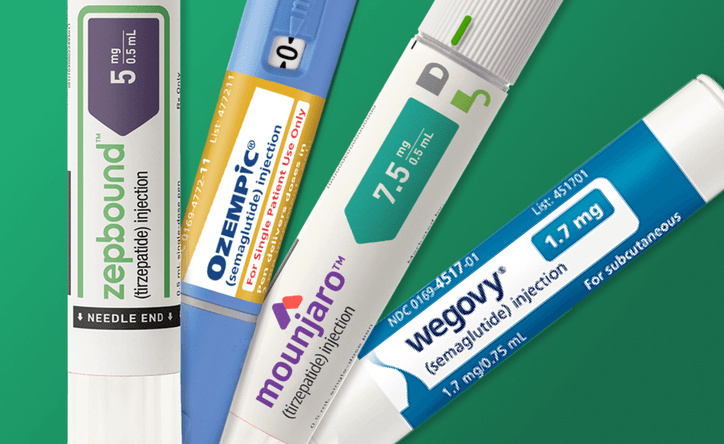
Mounjaro® and Ozempic® are not two versions of one medicine. Eli Lilly makes Mounjaro, whose ingredient is tirzepatide. Novo Nordisk makes Ozempic, whose ingredient is semaglutide.1,2 In a 40-week trial that pitted one against the other, every Mounjaro dose produced a larger fall in blood sugar and in weight than Ozempic 1 mg.3 The FDA approved both for type 2 diabetes, not for weight loss.
Key points
- Mechanism: tirzepatide activates two receptors (GIP as well as GLP-1). Semaglutide activates one, GLP-1.
- Weight management approval belongs to their sister brands: Zepbound® (tirzepatide) and Wegovy® (semaglutide).4,5
- Head to head: A1C fell 2.0 to 2.3 points on Mounjaro and 1.9 on Ozempic 1 mg. Weight fell 7.6 to 11.2 kg, against 5.7 kg.
- Cost: $25 a month is possible for either one when commercial insurance covers it. Self-pay starts at $499 for Mounjaro and $199 for Ozempic, as of November 2026.6,7
How do Mounjaro and Ozempic differ?
They differ first in the active ingredient. Tirzepatide is a single molecule that switches on the GIP receptor and the GLP-1 receptor. Semaglutide switches on GLP-1 alone. Either way the stomach empties more slowly and insulin release rises when blood sugar is high.1,2
| At a glance | Mounjaro | Ozempic |
|---|---|---|
| Ingredient, maker | Tirzepatide, Eli Lilly | Semaglutide, Novo Nordisk |
| Receptors | GIP and GLP-1 | GLP-1 |
| First U.S. approval | 2022 | 2017 |
| Approved uses, all in type 2 diabetes | Glucose control from age 10. Fewer major cardiovascular events in adults whose risk is high. | Glucose control in adults. Fewer major cardiovascular events in adults with established cardiovascular disease. Slower kidney decline in adults who also have chronic kidney disease. |
| Approval for weight loss | None. Zepbound has it. | None. Wegovy has it. |
| Weekly dose range | 2.5 mg to 15 mg | 0.25 mg to 2 mg |
| Forms | Injection | Injection, or a daily tablet |
| List price | $1,112.16 for four pens | $1,027.51 a pen |
Uses and doses come from the two labels.1,2 List prices are the manufacturers’ published figures as of November 2026.8,9
Mounjaro vs Ozempic for weight loss: the trial evidence
More weight came off with Mounjaro than with Ozempic 1 mg in SURPASS-2, the single trial that set the two against each other at diabetes doses.3 Neither drug is approved for losing weight, so a prescription written for weight alone is off-label.1,2
SURPASS-2: who, what, how long
The 1,879 participants were adults who had type 2 diabetes and were already taking metformin. For 40 weeks they injected tirzepatide at 5, 10 or 15 mg, or semaglutide 1 mg, once a week. The trial was open-label, meaning people knew which drug they had, and Eli Lilly paid for it. Average starting A1C was 8.28% and average starting weight 93.7 kg, about 207 pounds.3
| At week 40 | Weight change | A1C change | A1C under 7% |
|---|---|---|---|
| Mounjaro 5 mg | −7.6 kg (16.8 lb) | −2.0 points | 82% |
| Mounjaro 10 mg | −9.3 kg (20.5 lb) | −2.2 points | 86% |
| Mounjaro 15 mg | −11.2 kg (24.7 lb) | −2.3 points | 86% |
| Ozempic 1 mg | −5.7 kg (12.6 lb) | −1.9 points | 79% |
As reported in the Mounjaro label.1 The trial had no placebo group. Individual results vary.
Tirzepatide’s margin over semaglutide was 1.9 kg at 5 mg, 3.6 kg at 10 mg and 5.5 kg at 15 mg, or roughly 4 to 12 pounds.1 One limit matters: the 2 mg Ozempic dose was left out of the trial.
The same ingredients at weight management doses
SURMOUNT-5 compared the ingredients at the doses sold as Zepbound and Wegovy. Its 751 participants had obesity but not type 2 diabetes. For 72 weeks, open-label, each took the highest dose they could tolerate: 10 or 15 mg of tirzepatide, or 1.7 or 2.4 mg of semaglutide. Average change in body weight: −20.2% in the tirzepatide group and −13.7% in the semaglutide group. Lilly funded this trial as well.10
For weight management without diabetes, those are the approved brands. See Zepbound and Wegovy.
An average is not a forecast
A trial average blends people who lost a great deal with people who lost little. Diabetes changes the picture too: the Wegovy label reports 9.6% weight reduction in a trial of adults who had type 2 diabetes and 14.9% in a trial of adults who did not.5
Blood sugar, heart and kidney results
Blood sugar
Both lower A1C by about two points. To two decimals, the SURPASS-2 report gives 2.01, 2.24 and 2.30 points for the three tirzepatide doses and 1.86 for semaglutide 1 mg.3
Heart
Each label includes lowering the risk of cardiovascular death, heart attack and stroke for certain adults with type 2 diabetes, but the proof differs in kind. Ozempic was tested against placebo in 3,297 adults at high cardiovascular risk. An event occurred in 8.9% of the placebo group and 6.6% of the Ozempic group, a hazard ratio of 0.74.2
Mounjaro was tested against dulaglutide 1.5 mg, another GLP-1 medicine, in more than 13,000 adults with established cardiovascular disease. Over a median of 210.1 weeks, events were recorded in 12.1% of the Mounjaro group and 13.0% of the dulaglutide group (hazard ratio 0.92). The label calls that non-inferior and says superiority was not established.1
Kidneys
Only Ozempic has a kidney indication. In a trial of 3,533 adults who had chronic kidney disease along with type 2 diabetes, Ozempic 1 mg cut the main kidney outcome by 24% against placebo (hazard ratio 0.76).2
Side effects: Mounjaro vs Ozempic
Stomach and bowel symptoms dominate with both, and they peak while the dose is rising. SURPASS-2 gives the direct comparison. Nausea: 17% to 22% with tirzepatide, 18% with semaglutide. Diarrhea: 13% to 16% against 12%. Vomiting: 6% to 10% against 8%. Any serious adverse event: 5% to 7% against 3%.3
Each label also has its own placebo-controlled figures, shown below with placebo in parentheses.
| Label trials | Mounjaro5, 10 or 15 mg | Ozempic0.5 or 1 mg |
|---|---|---|
| Nausea | 12 to 18% (4%) | 16 to 20% (6%) |
| Diarrhea | 12 to 17% (9%) | 9% (2%) |
| Vomiting | 5 to 9% (2%) | 5 to 9% (2%) |
| Constipation | 6 to 7% (1%) | 3 to 5% (2%) |
| Quit over stomach symptoms | 3.0 to 6.6% (0.4%) | 3.1 to 3.8% (0.4%) |
Separate trials in different people, so the columns cannot be compared directly.1,2
Warnings in both labels
Both labels open with the same boxed warning, on thyroid C-cell tumors. Neither drug may be used by people who have had medullary thyroid carcinoma, whose relatives have had it, or who have MEN 2. Both also warn of pancreatitis, gallbladder disease, kidney injury from dehydration, severe stomach reactions, diabetic retinopathy complications, aspiration under anesthesia and, alongside insulin or a sulfonylurea, low blood sugar.1,2
The FDA announced on November 9, 2026 that both labels must add a warning about a rare eye condition, NAION. Neither label PDF contains it yet.1,2,11
Where the labels part ways
Birth control pills may work less well with Mounjaro. For 4 weeks from the first dose, and for 4 weeks following each increase, its label recommends a non-oral method or a barrier method on top. Nothing like that appears in the Ozempic label. Ozempic’s label does ask for a 2-month gap between the last dose and a planned pregnancy, which Mounjaro’s does not.1,2
Our Mounjaro and Ozempic pages each have a side effects section, and the GLP-1 side effects guide covers the whole class.
Mounjaro vs Ozempic doses
Each is a once-weekly injection under the skin, given at any time of day, with or without a meal. Each begins low and moves up no sooner than every 4 weeks. Past the first steps, the labels tie further increases to a need for more blood sugar control.1,2
| Dosing | Mounjaro | Ozempic |
|---|---|---|
| Start | 2.5 mg weekly | 0.25 mg weekly for 4 weeks, then 0.5 mg |
| Increases | In 2.5 mg increments | To 1 mg, then to 2 mg |
| Top dose | 15 mg weekly for adults | 2 mg weekly |
| Missed dose | Take it if 4 days or fewer have passed. Otherwise skip it. | Take it if 5 days or fewer have passed. Otherwise skip it. |
| Moving your day | Leave 3 days or more between doses | Leave 2 days or more between doses |
| Where to inject | Abdomen or thigh. Upper arm if someone else injects. | Abdomen, thigh or upper arm |
| Device | Single-dose pen. The label also lists vials and a four-dose KwikPen. | One pen holds several doses |
Milligrams do not translate between the two, because the molecules differ. Ozempic is also sold as a once-daily tablet, in strengths of 1.5, 4 and 9 mg.7 For week-by-week schedules, see Ozempic dosage and Mounjaro doses.
Mounjaro vs Ozempic cost and savings programs
If commercial insurance covers the prescription, the maker’s savings program can bring either drug down to $25 a month. Without coverage, Ozempic costs less at most doses. Every figure here is as of November 2026.6,7
| If you have | Mounjaro | Ozempic |
|---|---|---|
| A commercial plan that covers the drug | From $25 per fill of 1, 2 or 3 months using the Mounjaro Savings Card. The card saves at most $150 a month and $1,950 a year.6 | From $25 using the Ozempic savings offer, which saves at most $100 a month.7 |
| A commercial plan that leaves it out | $499 per monthly fill at the lowest, using the card | The self-pay prices below |
| No coverage (self-pay) | $499 a month and up through LillyDirect, at every strength12 | $349 a month for the pen that gives 0.25 or 0.5 mg, or the 1 mg pen. $499 for the 2 mg pen. A new patient’s first two fills at 0.25 or 0.5 mg cost $199 each. |
| Medicare, Medicaid, TRICARE, VA or other government coverage | The card cannot be used | The offer cannot be used |
Dates matter. The Mounjaro card expires on December 31, 2026, and Ozempic’s $199 introductory price runs through the same day. For the Mounjaro card, the prescription must also be for a use the FDA has approved, which means type 2 diabetes.6,7
On Medicare, Lilly says many Part D plans cover Mounjaro for type 2 diabetes, and Novo Nordisk says most Part D plans cover Ozempic.6,7 What you pay depends on the plan. Our Mounjaro and Ozempic pages go deeper, and the insurance checker is a quick first look.
What AM Rx adds, and what it charges
The first month of AM Rx membership costs $39. After that it is $135 monthly, and medication is not part of that price. Our insurance coordination team files the prior authorization for a brand-name medication. When your plan covers it, the copay may be $25 a month at the lowest. No plan’s approval is guaranteed.
When an AM Rx provider judges a compounded medication appropriate, compounded tirzepatide costs $329 monthly (from $216 a month when ordered as a 3-month supply) and compounded semaglutide $199 monthly (from $106 a month ordered the same way). Compounded drugs are not FDA-approved. The FDA does not review them for safety, effectiveness or quality, and a compounded product is not Mounjaro or Ozempic.13 See tirzepatide and semaglutide.
Switching between Mounjaro and Ozempic
Neither label gives a conversion from one drug to the other, so a switch is planned by your prescriber, not worked out from the milligrams.1,2 The two are not used together: the labels for the same ingredients sold as Zepbound and Wegovy advise against combining either with another GLP-1 medicine.4,5
If you move to Mounjaro and take birth control pills, the 4-week backup advice starts with your first dose. Change nothing until your prescriber has told you what to stop, what to start and when.
Which is better, Mounjaro or Ozempic? How a provider chooses
Neither is better for everyone. On average Mounjaro lowers A1C and weight more, but a provider starts from your diagnosis and works through the points below.
| Your situation | What the evidence says |
|---|---|
| Type 2 diabetes, with A1C and weight to bring down as far as possible | Tirzepatide beat semaglutide 1 mg on both in SURPASS-2. |
| Chronic kidney disease alongside type 2 diabetes | A kidney indication appears only in the Ozempic label. |
| Cardiovascular disease alongside type 2 diabetes | Both have a cardiovascular indication. Ozempic’s trial was against placebo, Mounjaro’s against another GLP-1. |
| You rely on birth control pills | With Mounjaro a backup method is advised for 4 weeks from the first dose and from every increase. |
| You would rather not inject | Ozempic has a tablet. Mounjaro does not. |
| Weight management without diabetes | Zepbound and Wegovy are the approved brands. |
| No insurance coverage | Ozempic is the cheaper of the two at most doses. |
Getting either one through AM Rx
You fill in a health intake online. A U.S.-licensed provider reviews it, usually within 1 to 2 business days, and replies by secure message, with no live appointment needed to start. If a brand-name medication is appropriate, the prescription goes to the pharmacy you choose. AM Rx serves eligible adults in all 50 states and Washington, DC.
Questions people ask about Mounjaro and Ozempic
Do people lose more weight on Mounjaro than on Ozempic?
In the one direct comparison, yes. Over 40 weeks in SURPASS-2, adults who had type 2 diabetes lost 7.6 to 11.2 kg (16.8 to 24.7 lb) on Mounjaro and 5.7 kg (12.6 lb) on Ozempic 1 mg. Results vary from person to person, and neither drug is approved for losing weight.1
Are Mounjaro and Ozempic the same medicine?
No. Mounjaro contains tirzepatide and comes from Eli Lilly. Ozempic contains semaglutide and comes from Novo Nordisk. Tirzepatide activates GIP and GLP-1 receptors, while semaglutide activates only GLP-1. Dose ranges, devices, approved uses and prices are all different too, although both are weekly injections used in type 2 diabetes.1,2
Does a higher milligram number make Mounjaro stronger?
No. The milligrams belong to different molecules, so 5 mg of one cannot be measured against 1 mg of the other. What the head-to-head trial showed is that all three Mounjaro doses tested produced bigger falls in A1C and weight than Ozempic 1 mg. The 2 mg Ozempic dose was left out.3
What happens if I change from Ozempic to Mounjaro?
Your prescriber sets the plan, because neither label gives a dose conversion between the two. Mounjaro’s label starts everyone at 2.5 mg a week. If you take birth control pills, its 4-week backup advice applies from the first dose. Do not overlap the two medicines or adjust doses yourself.1
Why are Mounjaro and Ozempic not prescribed together?
Both act on the GLP-1 receptor. The labels for the same ingredients sold as Zepbound and Wegovy say not to use them with another GLP-1 medicine, and neither the Mounjaro label nor the Ozempic label describes taking the two at once. A provider chooses one or the other.4,5
Is nausea worse on Mounjaro or on Ozempic?
About the same. In SURPASS-2, nausea was reported by 17% to 22% of people on tirzepatide and 18% on semaglutide 1 mg. In each drug’s own placebo-controlled trials the figures were 12% to 18% for Mounjaro and 16% to 20% for Ozempic. Nausea is most frequent while the dose is being raised.1,2,3
What does each cost a month without insurance?
As of November 2026, Lilly sells Mounjaro to self-pay patients at $499 a month and up, whatever the strength. Novo Nordisk charges self-pay patients $349 a month for the Ozempic pens that deliver 0.25, 0.5 or 1 mg, and $499 a month for the 2 mg pen. Through December 31, 2026, a new patient’s first two fills of the lowest doses cost $199 each.7,12
Does the FDA approve either one for weight loss?
It does not. Type 2 diabetes is the approved use of both. The weight management approvals belong to their sister brands: Zepbound, which contains tirzepatide like Mounjaro, and Wegovy, which contains semaglutide like Ozempic. A provider who prescribes Mounjaro or Ozempic for weight alone is prescribing off-label.4,5
Important safety information
Boxed warning: risk of thyroid C-cell tumors
Tirzepatide and semaglutide cause thyroid C-cell tumors in rodents. It is not known whether they cause them, including medullary thyroid carcinoma (MTC), in humans. Tell your provider about a lump or swelling in the neck, hoarseness, trouble swallowing or shortness of breath.1,2
Do not use if
- you or a family member has had MTC, or you have Multiple Endocrine Neoplasia syndrome type 2 (MEN 2)
- you have had a serious allergic reaction to the medicine or any of its ingredients
Serious side effects
Pancreatitis, low blood sugar (mainly with insulin or a sulfonylurea), serious allergic reactions, kidney injury from dehydration, severe stomach problems, diabetic retinopathy complications, gallbladder problems, and food or liquid entering the lungs during anesthesia. The FDA is adding a potential risk of NAION, a rare cause of sudden vision loss in one eye.
Most common side effects
Mounjaro: nausea, diarrhea, decreased appetite, vomiting, constipation, indigestion and abdominal pain. Ozempic: nausea, vomiting, diarrhea, abdominal pain and constipation.
Mounjaro and Ozempic are approved for type 2 diabetes, not for weight loss. Compounded tirzepatide and compounded semaglutide are not FDA-approved. Report side effects to the FDA at 1-800-FDA-1088.
Sources
- Mounjaro (tirzepatide) Prescribing Information. Eli Lilly and Company. Revised 08/2026. https://pi.lilly.com/us/mounjaro-uspi.pdf
- Ozempic (semaglutide) Prescribing Information. Novo Nordisk. Revised 05/2026. https://www.novo-pi.com/ozempic.pdf
- Frías JP, Davies MJ, Rosenstock J, et al. Tirzepatide versus semaglutide once weekly in patients with type 2 diabetes (SURPASS-2). N Engl J Med. 2021;385(6):503-515. https://pubmed.ncbi.nlm.nih.gov/34170647/
- Zepbound (tirzepatide) Prescribing Information. Eli Lilly and Company. Revised 08/2026. https://pi.lilly.com/us/zepbound-uspi.pdf
- Wegovy (semaglutide) Prescribing Information. Novo Nordisk. Revised 06/2026. https://www.novo-pi.com/wegovy.pdf
- Eli Lilly and Company. Mounjaro Savings & Coverage, including Savings Card terms. Accessed November 19, 2026. https://mounjaro.lilly.com/savings-coverage
- Novo Nordisk. Ozempic cost and savings. Accessed November 19, 2026. https://www.ozempic.com/savings-and-resources/save-on-ozempic.html
- Eli Lilly and Company. Mounjaro cost information (list price). Accessed November 19, 2026. https://pricinginfo.lilly.com/mounjaro
- Novo Nordisk. Ozempic list price (NovoPricing). Accessed November 19, 2026. https://www.novopricing.com/ozempic.html
- Aronne LJ, Horn DB, le Roux CW, et al. Tirzepatide as compared with semaglutide for the treatment of obesity (SURMOUNT-5). N Engl J Med. 2025;393(1):26-36. https://pubmed.ncbi.nlm.nih.gov/40353578/
- FDA. FDA Requires Safety Labeling Changes for Glucagon-Like Peptide-1 Receptor Agonists (GLP-1 RAs) Due to Potential Increased Risk of Rare But Serious Eye Condition. November 9, 2026. https://www.fda.gov/drugs/drug-safety-communications/fda-requires-safety-labeling-changes-glucagon-peptide-1-receptor-agonists-glp-1-ras-due-potential
- Eli Lilly and Company. Mounjaro through LillyDirect. Accessed November 19, 2026. https://www.lilly.com/lillydirect/medicines/mounjaro
- FDA. FDA’s Concerns with Unapproved GLP-1 Drugs Used for Weight Loss. October 1, 2026. https://www.fda.gov/drugs/drug-alerts-and-statements/fdas-concerns-unapproved-glp-1-drugs-used-weight-loss
Ask a licensed provider which GLP-1 fits you
The health questionnaire takes a few minutes and is read by a licensed provider. Your first month of AM Rx membership is $39.

A provider weighs the choice with your whole history in view
Diagnosis, kidney and heart health, other medicines and what your plan covers all bear on whether Mounjaro, Ozempic or something else fits. An AM Rx provider reviews those before prescribing anything.
The AM Rx care team checks the medical content of this page against FDA prescribing information and published clinical trials. It is general health education and does not replace advice from your own provider.
AM Rx members, in their own words
One of the things I appreciate most about semaglutide is its convenience. The once-weekly dosing schedule has made it incredibly easy to integrate into my routine. It's a relief to know that I don't have to worry about multiple daily injections or complicated medication schedules.
I started semaglutide at the recommendation of my AM Rx provider and I'm so happy with that decision. I signed up for their weight loss program and they've been giving me everything I need to make better lifestyle choices to get results that last. And the program's super affordable. 10/10 I can't recommend this enough.
Getting support a weight loss program has always been hard for me. I had been wanting to start one with a medication component for a while and AM Rx was the first one that made it easy for me with weight loss shots sent to me. They made it SO affordable and the medical team is great.
Since I started AM Rx, I have already lost 35 pounds and feel so much better. My doctor also helped me get a prescription for ozempic and he is always available to answer my questions in the message portal. This made me feel a lot more comfortable and excited to lose weight.
The weight loss program is fantastic. Everyone has been so helpful and has helped me feel much more excited about the process. I was nervous to see my weight loss treatment plan, since I have done programs in the past, but they always wanted me to make drastic changes. I mentioned all of this to my weight loss coach and she was very understanding and made a customized plan for me.
I've been a member for 6 months now and have received all my medication every 3 months. Everyone has been so helpful and my care team is always available to help me!
Individual results may vary. These reviews describe the experience of individual AM Rx members and do not promise any result. Medication is prescribed only if a licensed provider considers it appropriate.
The GLP-1 medications AM Rx providers prescribe
Four brand-name medications and two compounded options. Which one you are offered depends on your health history and a licensed provider’s judgment, and our insurance coordinators file the prior authorization when a brand-name drug is prescribed.
Zepbound®
Weekly tirzepatide. FDA-approved for chronic weight management and for obstructive sleep apnea in adults with obesity.
Zepbound cost, coupons and side effects →Wegovy®
Semaglutide for chronic weight management, FDA-approved as a weekly injection and as a once-daily tablet.
Wegovy pill, price and side effects →Mounjaro®
Weekly tirzepatide with an FDA approval for type 2 diabetes. It shares its active ingredient with Zepbound.
Mounjaro doses and savings card →Ozempic®
Weekly semaglutide with an FDA approval for type 2 diabetes. Using it for weight loss is off-label.
Ozempic side effects and cost →Compounded semaglutide
$199 a month, or from $106 a month when you order a 3-month supply. Shipping is included. Not FDA-approved.
Semaglutide cost and dosing →Compounded tirzepatide
$329 a month, or from $216 a month when you order a 3-month supply. Shipping is included. Not FDA-approved.
Tirzepatide dosage and cost →A partner pharmacy prepares compounded medication for one patient’s prescription at a time. Compounded drugs are not FDA-approved: the FDA does not review them for safety, effectiveness or quality. AM Rx membership costs $39 for the first month and $135 a month after that, and is charged separately from medication. Nothing is prescribed unless a licensed provider finds it appropriate.