GLP-1 side effects by the numbers: what the label trials show and what to do
Between half and three quarters of adults in the weight management trials reported a stomach complaint: 73% with Wegovy® 2.4 mg and 56% with Zepbound®, versus 47% and 30% with placebo.1,2 Few stopped treatment over it. Here are the rates, the advice printed in the medication guides, and the symptoms that need a provider or an emergency room.
Key points
- Nausea is reported most: by 12% to 44% of participants across Ozempic®, Wegovy, Mounjaro® and Zepbound, and by 4% to 16% of those given placebo.1,2,3,4
- Trouble clusters around dose increases and eases once the dose holds steady.
- A boxed warning on thyroid C-cell tumors heads all four labels, and in November 2026 the FDA ordered a new warning on NAION, a rare eye condition.5
- Get help right away for a swelling throat or face, difficult breathing, stomach pain that is severe and persistent, or sudden loss of sight in one eye.
Which side effects do GLP-1 medications cause most often?
Nausea comes first on every label, then diarrhea, vomiting, constipation and abdominal pain. The cause lies in how the drugs work: the stomach empties more slowly, and signals reach the parts of the brain that govern appetite and food intake.1,5
Cells show the percentage of adults reporting each reaction, with placebo in parentheses.
| Reaction | Ozempic0.5 mg or 1 mg | Wegovy2.4 mg dose | Mounjaro5 mg to 15 mg | Zepbound5 mg to 15 mg |
|---|---|---|---|---|
| Any stomach or bowel reaction | 33 to 36% (15%) | 73% (47%) | 37 to 44% (20%) | 56% (30%) |
| Nausea | 16 to 20% (6%) | 44% (16%) | 12 to 18% (4%) | 25 to 29% (8%) |
| Diarrhea | 9% (2%) | 30% (16%) | 12 to 17% (9%) | 19 to 23% (8%) |
| Vomiting | 5 to 9% (2%) | 24% (6%) | 5 to 9% (2%) | 8 to 13% (2%) |
| Constipation | 3 to 5% (2%) | 24% (11%) | 6 to 7% (1%) | 11 to 17% (5%) |
| Abdominal pain | 6 to 7% (5%) | 20% (10%) | 5 to 6% (4%) | 9 to 10% (5%) |
Rounded from the adverse reaction tables in the four labels.1,2,3,4 Ozempic and Mounjaro are diabetes medicines: the FDA approved them for type 2 diabetes, and weight loss is not an approved use. Their trials enrolled people with diabetes; the Wegovy and Zepbound trials enrolled people seeking weight management. No column can be ranked against another.
Plenty of people on placebo felt sick too, so the drug accounts for the difference between the two figures, not the whole of the first. And because tirzepatide shows 25% to 29% nausea as Zepbound but 12% to 18% as Mounjaro, the labels caution against comparing rates across trials.2
Less common reactions
- Headache: Wegovy 14%, placebo 10%.1
- Tiredness: Wegovy 11% versus 5% with placebo; Zepbound 5% to 7% versus 3%.1,2
- Injection site reactions: Zepbound 6% to 8% versus 2%.2
- Hair loss: Wegovy 3%, Zepbound 4% to 5%, placebo 1% in both.1,2
- Altered skin sensation: 2% at Wegovy 2.4 mg and 22% at 7.2 mg.1
How long do side effects from a GLP-1 last?
You will not find a day count in any label. What they report is timing relative to dose: the bulk of the nausea, vomiting and diarrhea came during dose escalation and became less frequent afterwards.2,3
Escalation takes months. Weekly injections rise at intervals of four weeks or longer, so Wegovy arrives at 2.4 mg in week 17 at the earliest, and Zepbound cannot get to 15 mg before week 21.1,2 Those first four to five months are the bumpiest.
Numbers from the trials
- Quitting over any adverse reaction: 6.8% with Wegovy against 3.2% with placebo, and 4.8% to 6.7% with Zepbound against 3.4%.1,2
- One exception to the fading pattern: of the people who developed altered skin sensation at Wegovy 7.2 mg, 18% did not report recovery while the trial lasted.1
What the course usually looks like
First doses bring the first symptoms. Each step up can bring them back for a spell, and a steady dose usually brings calm. With tirzepatide, the label notes, the delay in stomach emptying peaks after dose one and shrinks with later doses.4 Symptoms that hang on are a reason to ask about a slower schedule.
Serious side effects: warning signs to know
Few trial participants had a serious reaction. The medication guides spell out which symptoms matter and what to do.1,3,6
Emergency: call 911 or get to an emergency room if your throat, tongue, lips or face swell, if breathing or swallowing becomes difficult, or if you faint or feel your heart racing. The medication guides treat these as a serious allergic reaction: stop the medicine and get medical help right away.6
| Condition | What to look for | Action |
|---|---|---|
| Pancreatitis | Severe pain in the stomach area that does not let up and may spread to the back. | Stop the medicine. Call your provider right away. |
| Gallbladder disease | Pain high in the abdomen, clay-colored stools, yellow skin or eyes, fever. | Call your provider right away. |
| Dehydration, kidney injury | Vomiting, diarrhea or nausea that keeps going. | Keep drinking fluids. Call your provider right away. |
| Low blood sugar | Shakiness, sweating, dizziness, confusion. The risk is higher alongside insulin or a sulfonylurea. | Settle a plan with your provider beforehand. |
| Eye problems | One eye suddenly losing vision without pain. With type 2 diabetes, any change in vision. | Contact a health care professional right away. |
Then there is the boxed warning. In rodent studies the drugs produced thyroid C-cell tumors, and nobody knows whether people are affected the same way. Anyone who has had medullary thyroid carcinoma, has a relative who did, or has MEN 2 should not use them (see the safety information).
NAION, the eye warning of November 2026
The FDA announced on November 9, 2026 that makers of all GLP-1 medicines, Ozempic, Wegovy, Mounjaro and Zepbound among them, must add a Warnings and Precautions statement on a potential increased risk of non-arteritic anterior ischemic optic neuropathy (NAION), a rare condition in which one eye loses vision suddenly, painlessly and sometimes permanently.5
Pooling 126 randomized trials, the agency counted 6.4 cases in every 100,000 person-years with GLP-1 medicines and 3.8 with comparators.5 The four label PDFs had not been updated with the statement as of November 19, 2026.1,2,3,4
Surgery and anesthesia
Anyone operating on you or sedating you needs to know about your GLP-1. The labels mention rare cases in which stomach contents were inhaled into the lungs under general anesthesia or deep sedation, despite fasting.1,2 Five medical societies advised in October 2024 that most patients can stay on the medicine before elective surgery, as a joint decision with the care teams.7 Do not pause a dose on your own.
Depression and suicidal thoughts
A warning on suicidal behavior and ideation used to appear in the Wegovy, Zepbound and Saxenda® labels. The FDA requested its removal on January 13, 2026, after a review that pooled 107,910 patients from 91 placebo-controlled trials turned up no increase in risk.8 Zepbound’s label now reads “Suicidal Behavior and Ideation (Removed) 02/2026”, and depression and thoughts of suicide are gone from its Medication Guide.2,6
Even so, the FDA wants new or worsening depression, suicidal thoughts and unusual mood changes reported to a health care professional. The 988 line takes calls and texts.8
Side effects of each GLP-1 medication
The four brands share the reactions above. Ingredient, dose and form explain the differences.
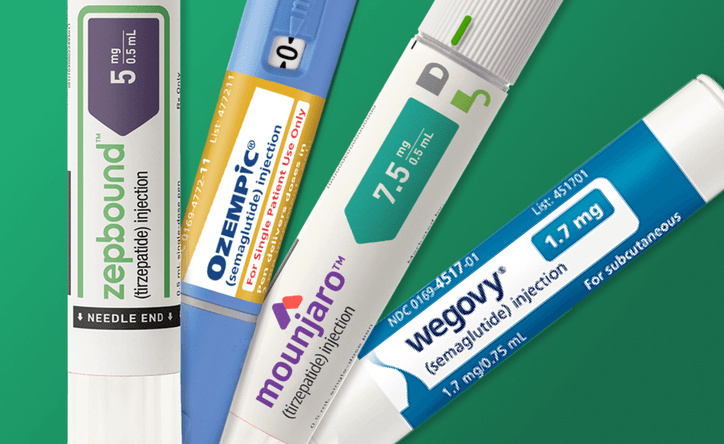
Ozempic and Wegovy (semaglutide)
Semaglutide targets one receptor, GLP-1. Nausea was reported by 16% to 20% of adults at Ozempic’s 0.5 mg and 1 mg doses and by 44% at Wegovy’s 2.4 mg. A separate trial of Wegovy 7.2 mg put it at 39%.1,3 See our Ozempic, Wegovy and semaglutide pages.
Mounjaro and Zepbound (tirzepatide)
Tirzepatide targets two receptors, GIP and GLP-1.5 Its nausea rates were 12% to 18% as Mounjaro and 25% to 29% as Zepbound. When the two ingredients were tested against each other for 72 weeks in 751 adults with obesity, gastrointestinal events were the most frequent in both arms and mostly mild to moderate.9
Of the four brands, only the tirzepatide pair warns that birth control pills may work less well. For 4 weeks from the first dose, and for 4 weeks following every increase, the labels advise a non-oral method or an added barrier method.2,4 Our Mounjaro, Zepbound and tirzepatide pages go further, as does Mounjaro vs Ozempic.
Tablets
Swallowing a GLP-1 does not spare the stomach. According to the Wegovy label, its 25 mg tablet produced common reactions similar in type and frequency to the 2.4 mg injection.1 See our Wegovy page.
Compounded versions
Neither compounded semaglutide nor compounded tirzepatide is FDA-approved, and the FDA does not review compounded drugs for safety, effectiveness or quality.10 Every rate quoted here was measured with a brand-name product.
Vials add a risk of their own. In one FDA alert, patients confused milliliters, milligrams and units and drew up between 5 and 20 times what was intended; some ended up in hospital.11 Have your provider or pharmacy show you the measurement, and see the tirzepatide units page.
How to ease GLP-1 side effects, according to the guides
Two sources stand behind this section: the medication guides, and a 2025 joint advisory from four medical and nutrition societies.12 Check with your prescriber before changing a dose or adding a remedy.
Nausea
Go for small meals, often. The advisory’s example is a small breakfast followed by further small meals 3 to 4 hours apart, with enough to drink. For the first few days of treatment it suggests steering clear of fatty and high-fiber foods.12
Vomiting or diarrhea
Fluids matter most, because losing them can harm the kidneys. The medication guides say drinking fluids helps reduce the chance of dehydration, and that vomiting, diarrhea or nausea that does not go away should be reported right away.6 With diarrhea, the advisory adds, large or high-fat meals are worth avoiding.12
Constipation
More fluids and more fiber from food, increased gradually. That differs from the nausea advice only in timing: go easy on fiber during the first days if you feel sick, then build it up if constipation sets in. Ask a pharmacist or your provider before adding a laxative.12
Reflux, burping and bloating
The advisory traces bloating and fullness to slower stomach emptying. Alcohol can worsen nausea and reflux and is best kept to a minimum.12
Low energy
No label suggests a remedy. The advisory points out that a shrunken appetite can leave you short of nutrients, so regular small meals and enough protein matter.12 Try the protein calculator.
Sore injection sites
Pick a new spot for every weekly injection, even if you stay in one area of the body.6
A slower schedule
Under the Wegovy label a prescriber can postpone a step up for 4 weeks if a dose is poorly tolerated, and under the Zepbound label can settle on a lower maintenance dose.1,2 Do not skip, split or space out doses yourself. AM Rx membership includes unlimited secure messaging with your provider and care team.
What about side effects over the long term?
Label trials have followed people for a median of 41.8 months (Wegovy) and 210.1 weeks (Mounjaro).1,4 Much of what shows up over time is linked in the labels to losing weight.
Muscle
Lean tissue goes along with fat. Among 160 SURMOUNT-1 participants who had body scans, roughly 75% of the weight lost over 72 weeks with tirzepatide was fat and 25% lean mass.13 The advisory recommends resistance training to protect muscle and bone.12
Gallstones
With Wegovy injection, 1.6% of adults developed gallstones, against 0.7% with placebo. Acute gallbladder events were associated with weight reduction, the Zepbound label says.1,2
Hair
Women reported hair loss far more than men in the Zepbound trials (7.1% against 0.5%). The label links it to weight reduction and notes that no one stopped treatment over it.2
“Ozempic face”
The phrase is a nickname. Neither the Ozempic label nor the Wegovy label lists it as an adverse reaction.1,3 See our Ozempic page.
Regain after stopping
In the SURMOUNT-4 trial, adults moved from tirzepatide to placebo put back 14.0% of body weight in 52 weeks, and those kept on tirzepatide lost another 5.5%.14 Individual results vary.
Open questions
Whether the rodent thyroid tumors matter for people is not known, and the FDA calls NAION a potential risk.5 Labels will keep changing as data come in.
Who should avoid GLP-1 medications?
The labels rule out semaglutide and tirzepatide after medullary thyroid carcinoma (MTC) in you or a blood relative, with MEN 2, and after a serious allergic reaction to the drug itself.1,2
For Wegovy and Ozempic the labels set a gap of at least 2 months between the last dose and a planned pregnancy. Zepbound is to be discontinued once pregnancy is recognized.1,2,3
Before you start, your provider needs to hear about past pancreas problems, gastroparesis or other severe stomach problems, diabetic retinopathy, any surgery on the calendar, breastfeeding, and insulin or sulfonylurea use.6 List every other medicine too, since slow stomach emptying can change how pills are absorbed.
At AM Rx, a U.S.-licensed provider reads your health history and current medicines, and only then decides whether to prescribe.
Questions people ask about GLP-1 side effects
Which GLP-1 side effect is reported most often?
Nausea. In the trials behind each label it was reported by 12% to 18% of adults on Mounjaro, 16% to 20% on Ozempic, 25% to 29% on Zepbound and 44% on Wegovy 2.4 mg. In the placebo groups the range was 4% to 16%.1,2,3,4
Does nausea from a GLP-1 go away?
It usually eases. According to the labels, the bulk of the nausea, vomiting and diarrhea came during dose escalation and became less frequent afterwards. None of them says how many days a bout lasts.2,3 If nausea is severe or refuses to ease, message your provider.
Which GLP-1 is easiest on the stomach?
Nobody has run the trial that would settle it. Label rates come from separate studies of different people, which rules out ranking them. When tirzepatide and semaglutide were tested against each other in obesity, gastrointestinal events were the most frequent in both arms.9
Can GLP-1 medications cause vision loss?
Rarely, and the link is not proven. In November 2026 the FDA ordered labels to describe a potential increased risk of NAION, an optic nerve condition in which one eye suddenly and painlessly loses vision. Report any sudden change in sight to a health care professional right away.5
Do GLP-1 drugs cause depression or suicidal thoughts?
The FDA looked and found no increased risk. In January 2026 it asked for the warning to come off the Wegovy, Zepbound and Saxenda labels. Still report new or worsening depression or unusual mood changes to a health care professional. The 988 line takes calls and texts.8
Do I have to stop my GLP-1 before surgery?
Often not. Five medical societies advised in October 2024 that most patients can stay on a GLP-1 before elective surgery, and that patient and care teams should decide together. Make sure every team knows you take one, and leave your dose alone unless they say otherwise.7
When is a GLP-1 side effect an emergency?
A serious allergic reaction is the clearest case: swelling in the throat, tongue, lips or face, difficulty breathing or swallowing, fainting or a racing heart. Call 911. Stomach pain that is severe and does not let up means stopping the medicine and calling your provider right away.6
Are side effects different with compounded semaglutide or tirzepatide?
There are no trial rates to quote. No compounded drug has FDA approval, and the FDA does not check compounded drugs for safety, effectiveness or quality. The figures on this page all come from brand-name trials. The FDA has warned about dosing mistakes with compounded semaglutide in vials.10,11
Important safety information
Boxed warning: risk of thyroid C-cell tumors
Semaglutide and tirzepatide cause thyroid C-cell tumors in rodents. Whether they cause such tumors in humans, including medullary thyroid carcinoma (MTC), is not known. Report a lump or swelling in the neck, hoarseness, trouble swallowing or shortness of breath to your provider.1,2,3,4
Do not use if
- you have a personal or family history of MTC, or have Multiple Endocrine Neoplasia syndrome type 2 (MEN 2)
- you have had a serious allergic reaction to semaglutide, tirzepatide or any ingredient in the product
Serious side effects
Pancreatitis, gallbladder problems, kidney injury from dehydration, severe stomach problems, serious allergic reactions, low blood sugar (mainly with insulin or a sulfonylurea), diabetic retinopathy complications in type 2 diabetes, and food or liquid entering the lungs during anesthesia. The FDA is adding a potential risk of NAION.5
Most common side effects
Nausea, diarrhea, vomiting, constipation, abdominal pain and indigestion.
Compounded semaglutide and compounded tirzepatide are not FDA-approved, and the FDA does not review them for safety, effectiveness or quality.10 Ozempic and Mounjaro are approved for type 2 diabetes, not for weight loss. Report side effects to the FDA at 1-800-FDA-1088.
Sources
- Wegovy (semaglutide) Prescribing Information and Medication Guide. Novo Nordisk. Revised 06/2026. https://www.novo-pi.com/wegovy.pdf
- Zepbound (tirzepatide) Prescribing Information. Eli Lilly and Company. Revised 08/2026. https://pi.lilly.com/us/zepbound-uspi.pdf
- Ozempic (semaglutide) Prescribing Information and Medication Guide. Novo Nordisk. Revised 05/2026. https://www.novo-pi.com/ozempic.pdf
- Mounjaro (tirzepatide) Prescribing Information. Eli Lilly and Company. Revised 08/2026. https://pi.lilly.com/us/mounjaro-uspi.pdf
- FDA. FDA Requires Safety Labeling Changes for Glucagon-Like Peptide-1 Receptor Agonists (GLP-1 RAs) Due to Potential Increased Risk of Rare But Serious Eye Condition. November 9, 2026. https://www.fda.gov/drugs/drug-safety-communications/fda-requires-safety-labeling-changes-glucagon-peptide-1-receptor-agonists-glp-1-ras-due-potential
- Zepbound (tirzepatide) Medication Guide. Eli Lilly and Company. Revised 08/2026. https://pi.lilly.com/us/zepbound-us-mg.pdf
- American Society of Anesthesiologists. Most Patients Can Continue Diabetes, Weight Loss GLP-1 Drugs Before Surgery. October 29, 2024. https://www.asahq.org/about-asa/newsroom/news-releases/2024/10/new-multi-society-glp-1-guidance
- FDA. FDA Requests Removal of Suicidal Behavior and Ideation Warning from Glucagon-Like Peptide-1 Receptor Agonist (GLP-1 RA) Medications. January 13, 2026. https://www.fda.gov/drugs/drug-safety-communications/fda-requests-removal-suicidal-behavior-and-ideation-warning-glucagon-peptide-1-receptor-agonist-glp
- Aronne LJ, Horn DB, le Roux CW, et al. Tirzepatide as compared with semaglutide for the treatment of obesity (SURMOUNT-5). N Engl J Med. 2025;393(1):26-36. https://pubmed.ncbi.nlm.nih.gov/40353578/
- FDA. FDA’s Concerns with Unapproved GLP-1 Drugs Used for Weight Loss. October 1, 2026. https://www.fda.gov/drugs/drug-alerts-and-statements/fdas-concerns-unapproved-glp-1-drugs-used-weight-loss
- FDA. FDA alerts health care providers, compounders and patients of dosing errors associated with compounded injectable semaglutide products. July 26, 2024. https://www.fda.gov/drugs/human-drug-compounding/fda-alerts-health-care-providers-compounders-and-patients-dosing-errors-associated-compounded
- Mozaffarian D, et al. Nutritional priorities to support GLP-1 therapy for obesity: a joint Advisory from the American College of Lifestyle Medicine, the American Society for Nutrition, the Obesity Medicine Association, and The Obesity Society. Obesity (Silver Spring). 2025;33(8):1475-1503. https://pmc.ncbi.nlm.nih.gov/articles/PMC12304835/
- Look M, et al. Body composition changes during weight reduction with tirzepatide in the SURMOUNT-1 study of adults with obesity or overweight. Diabetes Obes Metab. 2025;27(5):2720-2729. https://pubmed.ncbi.nlm.nih.gov/39996356/
- Aronne LJ, Sattar N, Horn DB, et al. Continued treatment with tirzepatide for maintenance of weight reduction in adults with obesity: the SURMOUNT-4 randomized clinical trial. JAMA. 2024;331(1):38-48. https://pubmed.ncbi.nlm.nih.gov/38078870/
Start GLP-1 treatment with a care team you can message
The health questionnaire takes a few minutes and is read by a licensed provider. Your first month of AM Rx membership is $39.

A licensed provider to ask when a side effect shows up
An AM Rx provider reads your health history and medication list before prescribing, and you can message the same care team about nausea, a dose that feels too strong, or a symptom you are unsure about.
The AM Rx care team checks the medical content of this page against FDA prescribing information and published clinical trials. It is general health education and does not replace advice from your own provider.
AM Rx members, in their own words
One of the things I appreciate most about semaglutide is its convenience. The once-weekly dosing schedule has made it incredibly easy to integrate into my routine. It's a relief to know that I don't have to worry about multiple daily injections or complicated medication schedules.
I started semaglutide at the recommendation of my AM Rx provider and I'm so happy with that decision. I signed up for their weight loss program and they've been giving me everything I need to make better lifestyle choices to get results that last. And the program's super affordable. 10/10 I can't recommend this enough.
Getting support a weight loss program has always been hard for me. I had been wanting to start one with a medication component for a while and AM Rx was the first one that made it easy for me with weight loss shots sent to me. They made it SO affordable and the medical team is great.
Since I started AM Rx, I have already lost 35 pounds and feel so much better. My doctor also helped me get a prescription for ozempic and he is always available to answer my questions in the message portal. This made me feel a lot more comfortable and excited to lose weight.
The weight loss program is fantastic. Everyone has been so helpful and has helped me feel much more excited about the process. I was nervous to see my weight loss treatment plan, since I have done programs in the past, but they always wanted me to make drastic changes. I mentioned all of this to my weight loss coach and she was very understanding and made a customized plan for me.
I've been a member for 6 months now and have received all my medication every 3 months. Everyone has been so helpful and my care team is always available to help me!
Individual results may vary. These reviews describe the experience of individual AM Rx members and do not promise any result. Medication is prescribed only if a licensed provider considers it appropriate.
The GLP-1 medications AM Rx providers prescribe
Four brand-name medications and two compounded options. Which one you are offered depends on your health history and a licensed provider’s judgment, and our insurance coordinators file the prior authorization when a brand-name drug is prescribed.
Zepbound®
Weekly tirzepatide. FDA-approved for chronic weight management and for obstructive sleep apnea in adults with obesity.
Zepbound cost, coupons and side effects →Wegovy®
Semaglutide for chronic weight management, FDA-approved as a weekly injection and as a once-daily tablet.
Wegovy pill, price and side effects →Mounjaro®
Weekly tirzepatide with an FDA approval for type 2 diabetes. It shares its active ingredient with Zepbound.
Mounjaro doses and savings card →Ozempic®
Weekly semaglutide with an FDA approval for type 2 diabetes. Using it for weight loss is off-label.
Ozempic side effects and cost →Compounded semaglutide
$199 a month, or from $106 a month when you order a 3-month supply. Shipping is included. Not FDA-approved.
Semaglutide cost and dosing →Compounded tirzepatide
$329 a month, or from $216 a month when you order a 3-month supply. Shipping is included. Not FDA-approved.
Tirzepatide dosage and cost →A partner pharmacy prepares compounded medication for one patient’s prescription at a time. Compounded drugs are not FDA-approved: the FDA does not review them for safety, effectiveness or quality. AM Rx membership costs $39 for the first month and $135 a month after that, and is charged separately from medication. Nothing is prescribed unless a licensed provider finds it appropriate.