Minoxidil shedding is real, it’s common, and for most people it’s a sign the treatment is working. When you start minoxidil, whether topical or oral, many users experience a noticeable increase in hair loss during the first few weeks. That spike is temporary. It reflects follicles resetting their growth cycle, not the drug failing.
The bottom line: Increased shedding after starting minoxidil is expected for many patients and usually resolves on its own. Stop treatment and see a clinician only if shedding is severe, lasts beyond 4 months, or comes with scalp pain, patchy loss, or signs of an allergic reaction.
Minoxidil shedding is a temporary, expected response for many users that typically peaks in weeks 4–8 and resolves by months 3–4, often preceding measurable hair regrowth.
| Point | Details |
|---|---|
| Shedding is usually temporary | Most users see the shed peak around weeks 4–8 and stabilize by months 3–4. |
| Continue treatment through the shed | Stopping during the expected window interrupts the follicular reset and is the most common reason treatment fails. |
| Track objectively, not emotionally | Monthly photos and a 1-week hair count give you real data to assess progress and share with a clinician. |
| Know the red flags | Patchy loss, scalp inflammation, or shedding that keeps increasing past month 4 requires clinical evaluation. |
| AM Rx for clinical support | AM Rx telehealth offers same-day hair-loss visits to review your minoxidil regimen, assess shedding patterns, and adjust treatment if needed. |
Hair grows in three phases: anagen (active growth, lasting 2–7 years), catagen (a brief transition), and telogen (resting, roughly 3 months before the hair sheds naturally).
Minoxidil shortens the telogen phase and pushes follicles into anagen earlier than they would naturally transition. The catch: a follicle can’t start a new anagen cycle without first shedding the old telogen hair. When minoxidil activates many follicles at once, those telogen exits happen in a synchronized wave rather than the staggered pattern your scalp normally runs. The result is a visible, temporary spike in fallen hairs, sometimes called the “minoxidil initial shed” or anagen effluvium.

The speed and intensity of that spike depend partly on sulfotransferase enzyme activity in your scalp skin. This enzyme converts topical minoxidil into its active metabolite, minoxidil sulfate. People with higher scalp sulfotransferase activity tend to respond faster and may experience a more pronounced early shed; those with lower activity respond more slowly and may barely notice a shed at all.
Concentration matters too:
Low-dose oral minoxidil requires medical supervision: it can cause fluid retention, a faster heart rate, and lowered blood pressure, so clinicians typically monitor blood pressure and ask about heart conditions before prescribing. It is not recommended during pregnancy or breastfeeding. Discuss these risks with a physician before starting.
The timeline varies by person and formulation, but clinical observations give a useful working range.
Typical shedding windows:
How much shedding is normal?
A healthy baseline is generally considered dozens of hairs per day. During the minoxidil shedding phase, that number can increase temporarily. The Cleveland Clinic’s drug information for topical minoxidil lists temporary increased shedding among expected early effects and notes it typically resolves with continued use.
What you’re watching for is a transient increase, not a progressive one. If the count keeps climbing past month 4 with no sign of leveling off, that’s worth a clinical conversation.
A simple three-step tracking method:
| Timeframe | What’s typically happening | What to do |
|---|---|---|
| Weeks 1–4 | Follicles begin synchronized telogen exit; shedding may start | Continue treatment; begin photo log |
| Weeks 4–8 | Peak shedding for most topical users | Track daily counts; don’t stop unless red flags appear |
| Months 2–3 | Shedding begins to slow; early regrowth may be visible | Compare monthly photos; note any new fine hairs |
| Months 3–4 | Most topical users stabilize; regrowth becomes more visible | Continue treatment; reassess with a clinician if shedding persists |
| Month 4+ | Shedding should be at or below baseline | Seek evaluation if shedding remains elevated |
Keep going. Stopping during the expected shedding window interrupts the hair-cycle reset and can worsen outcomes, according to Mayo Clinic’s guidance on hair-loss treatment. The shed is the mechanism, not a malfunction.
Daily care during active shedding:
Pro Tip: Switching from liquid to foam minoxidil can reduce scalp irritation for people who find the propylene glycol in the solution causes redness or itching, which is a separate issue from the expected shedding.
Red flags that mean you should stop and get evaluated:
The American Academy of Dermatology recommends evaluation when shedding persists or presents alongside inflammation or patchy loss, because those patterns can indicate telogen effluvium, thyroid disease, iron deficiency, or scarring alopecia, all of which require different treatment.
What to bring to a clinical visit:
A clinician can order a scalp exam, a basic metabolic panel, thyroid function tests, and ferritin levels to rule out concurrent causes before adjusting your treatment plan.
Combining treatments is common in androgenetic alopecia care, and the combination can change what you experience during the shedding phase.
Finasteride (oral) and topical finasteride: Oral finasteride reduces DHT systemically and is frequently prescribed alongside minoxidil for male-pattern hair loss. Topical finasteride delivers the same DHT-blocking effect with lower systemic absorption. Neither finasteride form eliminates the minoxidil-driven shedding phase, but some clinicians observe that the combination can produce a more robust regrowth response once the shed resolves, because finasteride addresses the androgen-driven miniaturization that minoxidil alone doesn’t target. Topical finasteride is available through AM Rx’s oral minoxidil telehealth service as part of a combination hair-loss assessment.
Finasteride is FDA-indicated for men only. Women who are or may become pregnant must not handle crushed or broken finasteride tablets, due to the risk of harm to a male fetus. It can also cause sexual side effects (reduced libido, erectile dysfunction) in a minority of men, which usually resolve after stopping treatment. Discuss these risks with a physician before starting.
Low-level laser therapy (LLLT) and microneedling: LLLT devices (FDA-cleared caps and combs) and microneedling sessions are sometimes added to a minoxidil regimen. The evidence for LLLT improving density is modest but consistent. Microneedling may enhance topical minoxidil absorption by creating microchannels in the scalp. Neither is likely to dramatically shorten the shedding window, but both may support follicular health during the transition period.
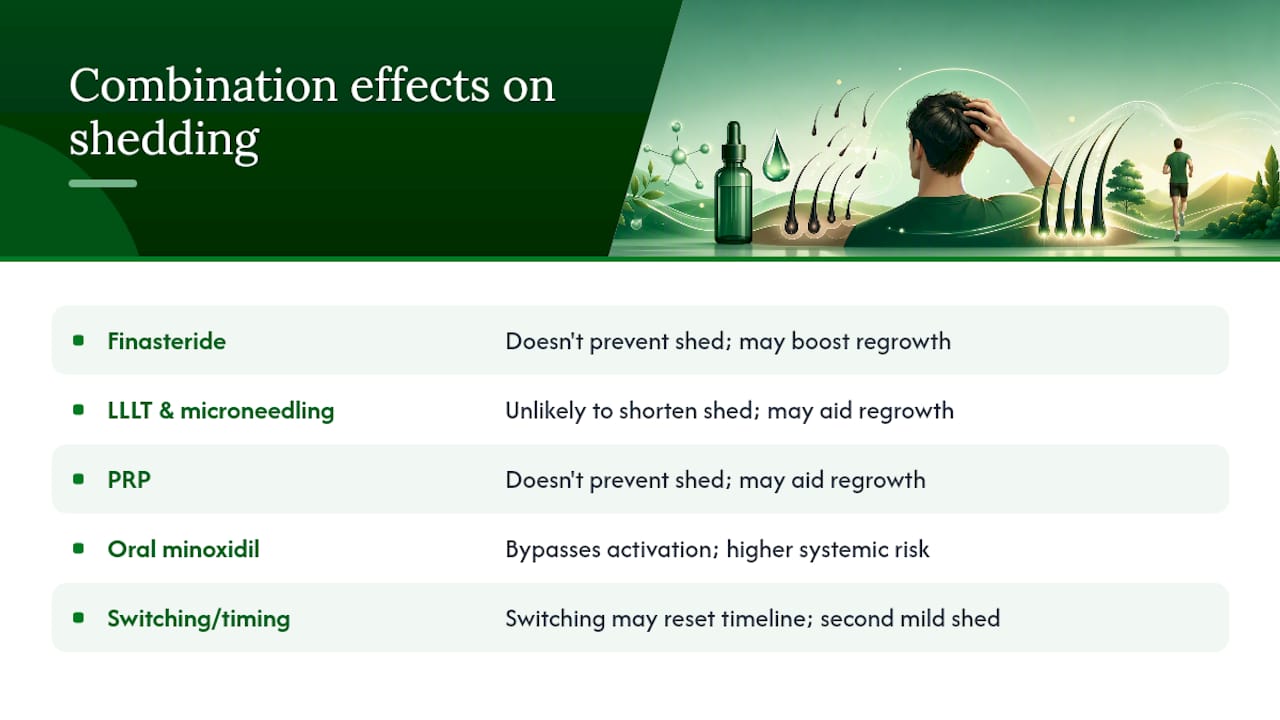
Platelet-rich plasma (PRP): PRP injections are used in some dermatology practices as an adjunct. The mechanism involves growth-factor delivery to the follicular environment. Like LLLT, PRP doesn’t appear to eliminate the initial shed but may contribute to the regrowth phase that follows.
Oral vs. topical minoxidil: Oral minoxidil bypasses the sulfotransferase activation step entirely, which means it works regardless of your scalp’s enzyme activity. That’s an advantage for people who don’t respond to topical formulations. The trade-off is systemic exposure: fluid retention, hypertrichosis (unwanted body hair growth), and cardiovascular monitoring needs are real considerations. Starting oral minoxidil should always involve a clinician review of your baseline blood pressure and cardiovascular history.
A note on combination therapy: Adding or switching treatments mid-cycle can reset the shedding timeline. If you start finasteride after two months on minoxidil, some patients report a second, milder shed as the finasteride begins to affect the follicular environment. Coordinate any combination changes with a clinician rather than self-adjusting.
The short answer: it may be a positive signal, but absence of shedding doesn’t mean the treatment is failing.
A retrospective study of 49 patients using topical 2% or 5% minoxidil measured shedding weekly for 24 weeks. The study found a statistically significant increase in hair shedding at week 4, with counts declining toward and below baseline by weeks 16–24. The study’s 49-patient size limits how broadly these findings generalize, but the direction of the signal is consistent with the biological mechanism.
A separate analysis published via Tandfonline supports the observation that higher-concentration topical minoxidil produces a quicker, sometimes shorter shedding window, which may partly explain the stronger correlation in the 5% group.
| Study characteristic | Retrospective cohort (PubMed) | Multicenter prospective (JAAD) |
|---|---|---|
| Patient count | 49 | Multicenter (size not specified in abstract) |
| Formulation studied | Topical 2% and 5% | Topical minoxidil |
| Key finding | Peak shedding correlated with later improvement; stronger in 5% group | Temporary shedding is common; monitoring reduces premature discontinuation |
| Main limitation | Small sample; retrospective design | Monitoring protocols not yet standardized |
What this means practically: A pronounced early shed at 5% topical minoxidil may be a sign that follicles are responding. But plenty of people who see minimal shedding still achieve good regrowth. The shed is not a prerequisite for success.
Most of the anxiety around minoxidil shedding comes from a mismatch between what patients expect and what actually happens. Nobody warns you that the drug might make things look worse before they get better, and when it does, the instinct is to stop.
That instinct is usually wrong. The clinical evidence, from the retrospective cohort data to the multicenter prospective monitoring work, consistently points in the same direction: the shed is temporary, it often precedes improvement, and stopping early is the single most common reason people don’t see results.
What I’d tell anyone starting minoxidil is this: take your first photo the day you start, write down the date, and commit to a 6-month window before drawing any conclusions. Track the shed objectively rather than emotionally. A hair on your pillow is not a data point; a month of daily counts is. The patients who get the best outcomes are almost always the ones who stayed consistent through the uncomfortable early weeks.
The red flags are real and worth knowing, but they’re also specific. Diffuse shedding that slows after month 2 is not the same as patchy loss with scalp inflammation. If you know the difference, you can make a rational decision instead of a panicked one.
If you’re watching hairs accumulate in the shower drain and wondering whether what you’re experiencing is normal minoxidil shedding or something that needs a closer look, a telehealth visit is a practical next step.

AM Rx offers virtual hair-loss consultations where a provider reviews your medication history, symptom timeline, and photos to distinguish expected shedding from patterns that warrant further evaluation. If your current regimen needs adjustment, whether that means switching concentrations, adding a combination treatment, or transitioning to oral minoxidil, a provider can assess that during the same visit. Labs or in-person referrals can be arranged when needed. Appointments are available same-day, with prescription delivery handled directly. Bring your timed photos, your minoxidil start date, and your symptom list. Start your hair-loss visit at AM Rx to get a clinical read on where you are in the process.
This article is for general informational purposes only and is not a substitute for professional medical advice. Consult a qualified clinician for diagnosis and treatment decisions.
For most topical minoxidil users, shedding peaks around weeks 4–8 and stabilizes by months 3–4. A multicenter prospective study confirmed this pattern is common and that shedding persisting well beyond that window warrants clinical evaluation.
Not everyone experiences a noticeable shed. Sulfotransferase enzyme activity in the scalp varies between individuals, meaning some people activate topical minoxidil faster and shed more visibly, while others see little to no increase in daily hair loss.
Apply topical minoxidil to a dry scalp and let it absorb without rubbing aggressively. Gentle spreading with fingertips is fine; vigorous rubbing doesn’t improve absorption and can increase scalp irritation.
No. A retrospective cohort study found that a measurable shedding peak occurred in the first 12 weeks for many patients, but the intensity varied considerably between individuals and concentrations.