You may have clinically significant low testosterone if you have persistent low libido, fewer morning erections, and unexplained fatigue alongside a confirmed low result on two early-morning blood tests. That combination, not any single symptom alone, is what clinicians look for.
The Endocrine Society identifies these as the most predictive signs of male hypogonadism:
Pro Tip: Fatigue and low mood by themselves are not reliable indicators of low T. They show up in dozens of conditions. The sexual symptoms, especially the loss of morning erections, are far more specific and should carry more weight when you’re deciding whether to get tested.
Sexual symptoms are the most specific signs of low testosterone, and diagnosis requires two early-morning blood tests showing levels below approximately 300 ng/dL alongside clinical symptoms.
| Point | Details |
|---|---|
| Sexual symptoms are most predictive | Loss of morning erections and low libido are more specific for low T than fatigue or mood changes. |
| Two morning tests required | Diagnosis requires two separate early-morning testosterone draws; a single result is not sufficient. |
| 300 ng/dL is the common threshold | Most guidelines use approximately 300 ng/dL as the biochemical cutoff, but clinical judgment matters for borderline results. |
| Fix reversible causes first | Obesity, sleep apnea, diabetes, and certain medications can lower testosterone and should be addressed before starting TRT. |
| AM Rx for telehealth evaluation | AM Rx coordinates same-day visits, morning lab testing, and treatment options including TRT and enclomiphene. |
Testosterone deficiency in men rarely announces itself with one dramatic sign. It tends to accumulate, quietly, across several systems at once. Knowing which domain a symptom belongs to helps you describe it accurately to a clinician.
These are the signs that most reliably point toward low T rather than another condition:
According to the Cleveland Clinic, decreased spontaneous erections and reduced libido are among the symptoms most suggestive of hypogonadism, and they recommend two confirmatory morning tests before any treatment decision.
These tend to develop more slowly, often over months or years of chronically low testosterone:
The Endocrine Society notes that gynecomastia, progressive muscle loss, and decreased bone density are long-term signs of chronic androgen deficiency, often developing over months to years.
Low testosterone over time reduces bone mineral density, raising the risk of osteoporosis and fractures. This is one of the more serious long-term consequences and often goes undetected until a fracture occurs. Some men also develop mild anemia, since testosterone supports red blood cell production.
Important context: These cognitive and mood symptoms are real, but they are not specific to low T. Depression, sleep apnea, thyroid disease, and chronic stress produce nearly identical presentations. Sexual symptoms are the more diagnostically useful clues.
Pro Tip: Keep a simple log for two weeks before your appointment: note morning erection frequency, libido on a 1–10 scale, energy level, and mood. That data gives your clinician something concrete to work with instead of a vague “I’ve been tired.”
Most low T symptoms develop gradually, and a routine primary-care or telehealth visit is the right first step. A few presentations, though, warrant faster attention.
See a clinician within the same week if you notice:
The last cluster, headaches plus vision changes plus sexual symptoms, is the one that should prompt a same-week call rather than a scheduled appointment. A pituitary tumor is rare but treatable, and delay matters.
For most men, the appropriate path is a routine telehealth or primary-care visit where you can order morning labs and discuss symptoms without urgency.
Pro Tip: Before your visit, write down when each symptom started, whether it came on suddenly or gradually, and any medications you’ve started or stopped in the past year. A timeline is more useful to a clinician than a symptom list alone.
Understanding the cause matters because some contributors are reversible. Treating the underlying problem can normalize testosterone without any hormone therapy at all.
The distinction shapes both diagnosis and treatment. StatPearls explains that clinicians distinguish the two using LH and FSH levels:
Harvard Health notes that obesity and type 2 diabetes are among the most common contributors to low testosterone, and they create a feedback loop: excess fat tissue converts testosterone to estradiol, which suppresses the pituitary signal, which lowers testosterone further, which promotes more fat gain.
Other contributors worth checking:
Risk-factor self-check before testing:
Pro Tip: Bring a complete medication list to your appointment, including supplements and over-the-counter products. Several common supplements (high-dose zinc, DHEA) can affect testosterone readings, and your clinician needs the full picture before interpreting labs.
Getting the blood draw right matters as much as getting it done. A result drawn at 3 PM can look low even in a man with normal testosterone.
StatPearls on NCBI is clear: diagnosis requires two separate early-morning total testosterone measurements, ideally drawn between 7 and 10 AM, on different days. A single low result is not enough to diagnose hypogonadism or start treatment.
Most guidelines use a biochemical cutoff near 300 ng/dL as the threshold for low testosterone, but lab reference ranges vary, and clinical judgment matters. A man with a level of 310 ng/dL and significant sexual symptoms may still warrant evaluation and treatment, while a man at 280 ng/dL with no symptoms may not.
“Testosterone fluctuates, and a single borderline result doesn’t tell the whole story. Symptomatic men with borderline labs may still be evaluated clinically.” PubMed research on testosterone measurement variability
| Test | What it measures | What an abnormal result suggests |
|---|---|---|
| Total testosterone (AM) | Overall testosterone level | Low: possible hypogonadism; confirm with second test |
| LH (luteinizing hormone) | Pituitary signal to testes | High LH + low T = primary hypogonadism; Low LH + low T = secondary |
| FSH (follicle-stimulating hormone) | Pituitary signal for sperm production | Elevated: testicular failure; Low: pituitary/hypothalamic issue |
| Prolactin | Pituitary hormone | Elevated: possible prolactinoma (pituitary tumor) |
| TSH | Thyroid function | Abnormal: thyroid disease mimicking low T symptoms |
| Morning cortisol | Adrenal function | Low: adrenal insufficiency as alternate cause |
| Semen analysis | Sperm count and quality | Ordered when fertility is a concern |
A pituitary MRI is ordered when prolactin is elevated, when LH and FSH are both low without an obvious cause, or when a patient has headaches and visual symptoms.
Pro Tip: When using a telehealth service, ask specifically for a fasting, early-morning lab draw. Some at-home testing kits allow you to collect a sample at the right time and mail it in. AM Rx can help coordinate morning testosterone testing so your results are actually interpretable.
Before attributing every symptom to low T, a clinician will rule out conditions that produce an almost identical picture. This isn’t skepticism; it’s good medicine, because treating the wrong thing rarely helps.
The most common mimics:
Pro Tip: Before your appointment, do a quick self-check: Are you sleeping fewer than 6 hours a night, or waking up feeling unrefreshed? Do you snore? Have you started any new medications in the past year? These three questions can point your clinician toward a mimic diagnosis before any labs come back.
Management follows a logical sequence: fix what’s fixable first, then consider hormone therapy if symptoms persist and labs confirm deficiency.
When lifestyle changes and reversible-cause treatment aren’t enough, and two morning tests confirm low testosterone alongside clinical symptoms, TRT is a reasonable next step. MedlinePlus summarizes the available delivery options:
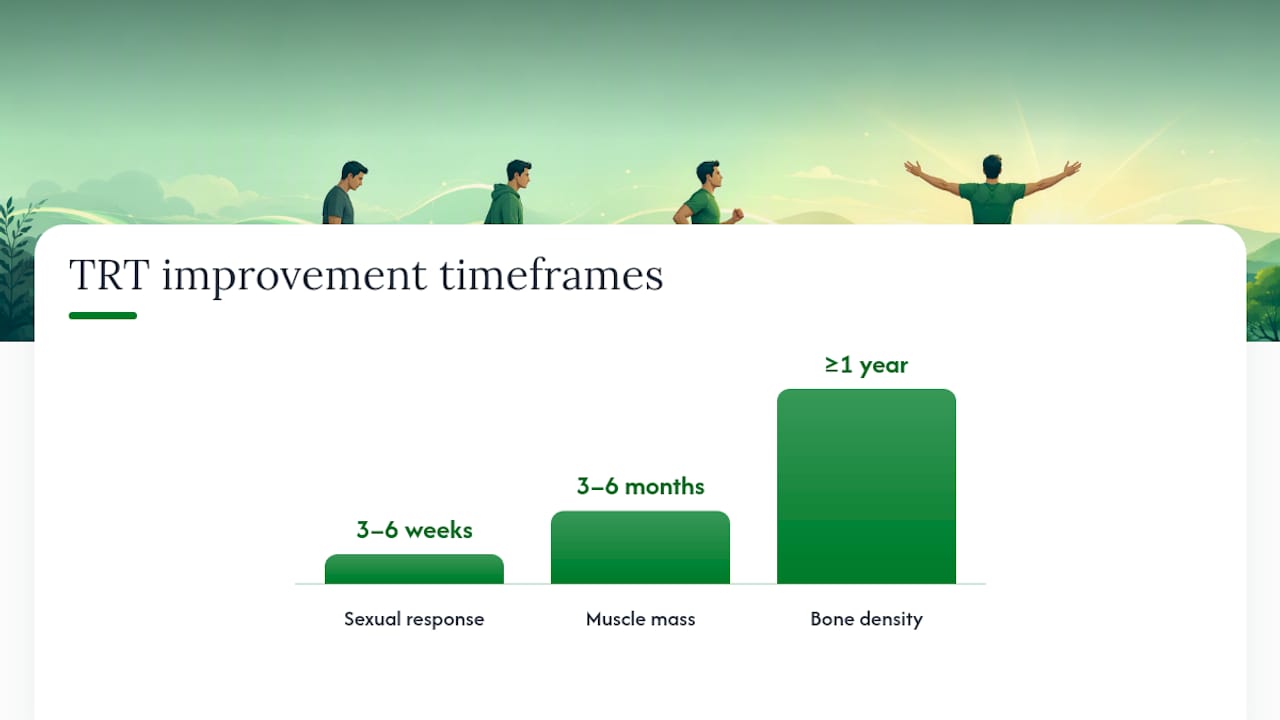
What TRT tends to improve: Sexual desire and morning erections typically respond within 3–6 weeks. Muscle mass and body composition changes take longer, often 3–6 months. Bone density improvements require at least a year of consistent therapy.
What TRT often doesn’t resolve: Mood and energy improvements are more variable. Men with very low baseline testosterone levels tend to see clearer benefits; men in the borderline range often see modest or inconsistent results for fatigue and mood.
Common side effects and monitoring: Clinicians check PSA (prostate-specific antigen) and hematocrit at baseline and during treatment. TRT raises red blood cell count, which can increase clotting risk if hematocrit climbs too high. It also suppresses sperm production.
If symptoms don’t improve meaningfully after about three months on TRT, most clinicians will reassess the diagnosis and consider stopping or changing therapy rather than escalating the dose.
TRT suppresses the pituitary signal for sperm production, which can cause infertility. Men who want to preserve fertility have options. Enclomiphene, a selective estrogen receptor modulator, stimulates the pituitary to increase LH and FSH, which raises testosterone while maintaining sperm production. It’s worth discussing with your clinician if you’re not done having children. AM Rx offers enclomiphene as part of its testosterone support options.
Pro Tip: Tell your clinician your fertility plans before any treatment decision. TRT and enclomiphene have very different implications for sperm production, and the right choice depends on whether you want to father children in the next few years.
A well-prepared appointment, whether in person or via telehealth, gets you answers faster and avoids the frustrating “come back in three months” loop.
A clinician will typically do a brief physical exam (or review your self-reported history via telehealth), order two morning testosterone draws on separate days, and may add LH, FSH, prolactin, TSH, and a metabolic panel. The conversation will cover your symptoms, their duration, and any reversible contributors.
Pro Tip: If you’re using a telehealth service, ask whether they can send a lab order to a local Quest or LabCorp location for a properly timed morning draw. AM Rx coordinates morning lab testing so you’re not guessing at timing or collection method.
The clinical community is consistent on this point: symptoms of testosterone deficiency in men overlap too heavily with other conditions to serve as a standalone diagnosis.
Dr. Shalender Bhasin has emphasized that sexual symptoms, particularly reduced libido and loss of spontaneous erections, are more specific for low testosterone, while fatigue and mood symptoms overlap with too many other conditions to be diagnostically useful on their own. Addressing obesity, diabetes, sleep disorders, or vitamin deficiencies can often improve symptoms without any hormone therapy.
“The symptoms most highly suggestive of male hypogonadism include reduced sexual desire, decreased spontaneous and morning erections, erectile dysfunction, unexplained fatigue, and smaller-than-usual testicular volume.” Endocrine Society
The evidence-based approach requires two early-morning total testosterone measurements, with LH and FSH added to distinguish primary from secondary hypogonadism. For borderline results, clinical judgment, meaning how significant the symptoms are and how much they affect quality of life, carries real weight in the treatment decision.
This is why a telehealth evaluation that includes proper lab coordination is worth more than an at-home test kit used at the wrong time of day. The result has to be interpretable.

The most common mistake men make is expecting a testosterone result to explain everything. Sometimes it does. A man with a level of 180 ng/dL, no morning erections, and significant fatigue who responds dramatically to TRT within six weeks, that’s a clear case. But many men fall in the gray zone: levels between 250 and 350 ng/dL, symptoms that could fit several diagnoses, and a treatment response that’s partial at best.
TRT tends to deliver the clearest benefit for sexual symptoms, particularly libido and erections, especially in men with very low baseline levels. The evidence for mood and energy improvement is real but more variable. Some men feel dramatically better; others notice modest change and wonder if it’s placebo.
What actually helps most men in the gray zone: fixing sleep, losing weight, reviewing medications, and getting a proper thyroid workup first. These steps are less exciting than starting TRT, but they’re more likely to produce lasting improvement without the monitoring burden that comes with hormone therapy.
If you do start TRT and don’t notice meaningful improvement within about three months, that’s a signal worth discussing with your clinician. Staying on a therapy that isn’t working isn’t a neutral choice.
Figuring out whether you have low T shouldn’t require weeks of waiting for an in-person appointment or navigating a confusing lab order. AM Rx offers same-day telehealth visits with experienced providers who can evaluate your symptoms, coordinate properly timed morning lab draws, and discuss treatment options including TRT and fertility-preserving alternatives like enclomiphene, all from home.

If your labs confirm low testosterone, AM Rx manages the follow-up, monitors your labs during treatment, and handles prescription delivery directly to your door. For men dealing with sexual symptoms while waiting on test results, fast-acting ED support is also available through the platform.
Ready to get a clear answer? Start your telehealth evaluation with AM Rx and get your morning labs ordered the right way.
These are the primary clinical resources used in this article. Each is worth bookmarking if you want to go deeper before or after your evaluation.
This article is general information, not a substitute for advice from a qualified doctor. Consult a qualified healthcare professional about your own circumstances before acting on anything here.
The most specific signs are loss of morning or spontaneous erections, reduced libido, and difficulty maintaining erections, according to the Endocrine Society. Fatigue and mood changes are common but not specific enough on their own to point to low T.
You can’t confirm it without labs. Symptoms like low libido and loss of morning erections are suggestive, but many conditions produce the same picture. Two early-morning testosterone tests are required for a clinical diagnosis.
Addressing reversible causes first, including losing excess weight, treating sleep apnea, and reviewing medications, can raise levels without hormone therapy. When lifestyle changes aren’t enough and labs confirm deficiency, TRT or fertility-preserving options like enclomiphene are available through a clinician.
Encourage him to track specific symptoms (morning erections, libido changes, fatigue) and see a clinician for two properly timed morning blood tests. A telehealth evaluation through a service like AM Rx can make that first step easier and faster than waiting for an in-person appointment.
Most labs consider total testosterone above 300 ng/dL within the normal range, though symptom presence matters more than any specific number. The number matters less than whether symptoms are present, since some men function well at lower levels and others have significant symptoms at levels just below normal.