If you’re shedding more than usual, the most useful starting panel is ferritin plus a full iron panel (serum iron, TIBC, transferrin saturation), TSH with free T4, a complete blood count (CBC), and 25-hydroxy vitamin D. Add targeted sex-hormone tests — free testosterone, SHBG, DHEAS — only when your history points that way (patterned thinning, acne, irregular periods). That short list covers the majority of treatable, lab-identifiable causes of diffuse hair shedding.
Two nuances worth knowing before you even book the appointment:
Pro Tip: Ask your clinician to order “ferritin” and “transferrin saturation” explicitly. Many standard annual panels skip both. Also, if you take high-dose biotin supplements, pause them 48–72 hours before blood draw — biotin interferes with several immunoassays and can skew thyroid and hormone results.
The most effective first step for hair loss is a targeted blood panel — ferritin with transferrin saturation, TSH with free T4, CBC, and 25-hydroxy vitamin D — interpreted by a clinician alongside your clinical history.
| Point | Details |
|---|---|
| Start with four core tests | Ferritin + transferrin saturation, TSH + free T4, CBC, and 25-OH vitamin D cover most treatable causes. |
| Functional ferritin target | Many dermatologists look for ferritin above 40 ng/mL for hair health, not just the lab deficiency cutoff of ~12–15 ng/mL. |
| Normal labs don’t rule out causes | Telogen effluvium and early thyroid disease can present with a normal standard panel. |
| Expect a lag in hair response | Even after correcting iron or thyroid levels, visible regrowth typically takes 3–6 months. |
| AM Rx for evaluation and treatment | AM Rx offers same-day telehealth visits to order labs, interpret results, and prescribe options like oral minoxidil when indicated. |
Common blood tests for hair loss include CBC, iron studies, TSH, vitamin D, and hormone panels when indicated. The right combination depends on your shedding pattern and clinical history. Here is what each test actually measures and why it matters.
Ferritin reflects stored iron. It is the highest-yield single test for diffuse, diffuse-pattern shedding because iron is required for normal hair-follicle cycling. The problem is that standard lab reference ranges flag deficiency only below about 12–15 ng/mL, while many dermatologists target ferritin above typical laboratory deficiency cutoffs and consider 40–70 ng/mL the functional range for hair improvement.
Ferritin is also an acute-phase reactant, meaning inflammation — from infection, autoimmune disease, or chronic illness — can push ferritin artificially upward. Serum iron and TIBC round out the picture. A PMC review on iron status and hair loss details exactly how inflammation complicates ferritin interpretation and why the full panel beats a single number.
Both hypothyroidism and hyperthyroidism cause diffuse shedding, and the mechanism is the same in both directions: disrupted thyroid hormone signaling pushes follicles prematurely into the resting (telogen) phase. TSH is the standard screen, with the a standard reference band for TSH in a typical clinical range. But TSH alone can miss early Hashimoto’s thyroiditis, where TSH sits within range while TPO antibodies are already elevated and free T4 is trending down. Adding free T4 is standard practice; adding TPO antibodies and free T3 makes sense when autoimmune thyroid disease is clinically suspected.
A CBC detects frank anemia — low hemoglobin, low hematocrit, small red cells — and can flag macrocytic anemia pointing toward B12 or folate deficiency. Its limitation in hair-loss workups is that hemoglobin stays normal until iron depletion is severe. Order the CBC as a baseline, but never rely on a normal CBC to rule out iron-related shedding.
Vitamin D receptor signaling is involved in hair cycling, and low 25-hydroxy vitamin D levels have been associated with several hair disorders, with the strongest evidence in alopecia areata. Evidence for routine vitamin D testing in every hair-loss patient is mixed, but most clinicians include it given how common insufficiency is in the U.S. population. Labs typically define deficiency below 20 ng/mL and insufficiency between 20–29 ng/mL; some practitioners aim for levels above 40 ng/mL when managing hair disorders, though that target is not universally standardized.
B12 deficiency causes macrocytic anemia and can contribute to diffuse shedding, particularly in people who follow plant-based diets, take metformin long-term, or have absorption issues. Folate deficiency follows a similar pattern. Zinc is less commonly ordered but relevant when dietary intake is poor or when inflammatory bowel disease is in the picture. These are add-on tests, not first-line for everyone.
Hormone blood tests become relevant when the shedding pattern is patterned (frontal recession, crown thinning) rather than diffuse, especially alongside signs of hyperandrogenism — acne, irregular periods, hirsutism. The useful panel in that context includes free testosterone, SHBG, DHEAS, and often LH/FSH and prolactin. Androgen testing in hair loss is most informative when ordered with a clear clinical question, not as a reflex screen. SHBG is particularly useful because low SHBG raises free androgen activity even when total testosterone looks normal.
For women with suspected female-pattern hair loss, the AM Rx female hair loss page outlines how hormone evaluation fits into the broader workup.
ANA (antinuclear antibody) testing is appropriate when alopecia areata or a connective tissue disorder is suspected — patchy, well-demarcated hair loss, nail pitting, or a personal or family history of autoimmune disease. CRP and ESR help contextualize ferritin and can flag systemic inflammation driving shedding. These are not routine for every patient; they are ordered when the clinical picture points toward an autoimmune process.
| Test | What it measures | Why it matters for hair |
|---|---|---|
| Ferritin | Stored iron | Highest-yield single test; functional target 40–70 ng/mL |
| Serum iron + TIBC | Circulating iron and binding capacity | Transferrin saturation <20% signals functional deficiency |
| TSH + free T4 | Thyroid function | Both hypo- and hyperthyroidism cause diffuse shedding |
| CBC | Red cell count, hemoglobin | Detects frank anemia; normal result does not exclude iron depletion |
| 25-OH vitamin D | Vitamin D status | Deficiency linked to alopecia areata; insufficiency common |
| Free testosterone + SHBG + DHEAS | Androgen activity | Ordered for patterned thinning with hyperandrogenism signs |
| ANA, CRP, ESR | Autoimmune and inflammatory activity | Relevant for patchy loss or suspected connective tissue disease |
Pro Tip: Standard annual wellness panels often omit ferritin and free thyroid hormones. When you call to schedule labs, ask specifically for “ferritin,” “transferrin saturation,” and “free T4” — not just “thyroid” or “iron.” The billing codes are different, and a vague order may not capture what you need.
Clinicians read patterns across tests and clinical findings, not single values in isolation. Diagnostic algorithms for hair disorders combine targeted labs, clinical pattern recognition, and histology when required — labs alone rarely provide a definitive diagnosis without exam correlation.
Here is how the stepwise interpretation typically unfolds:
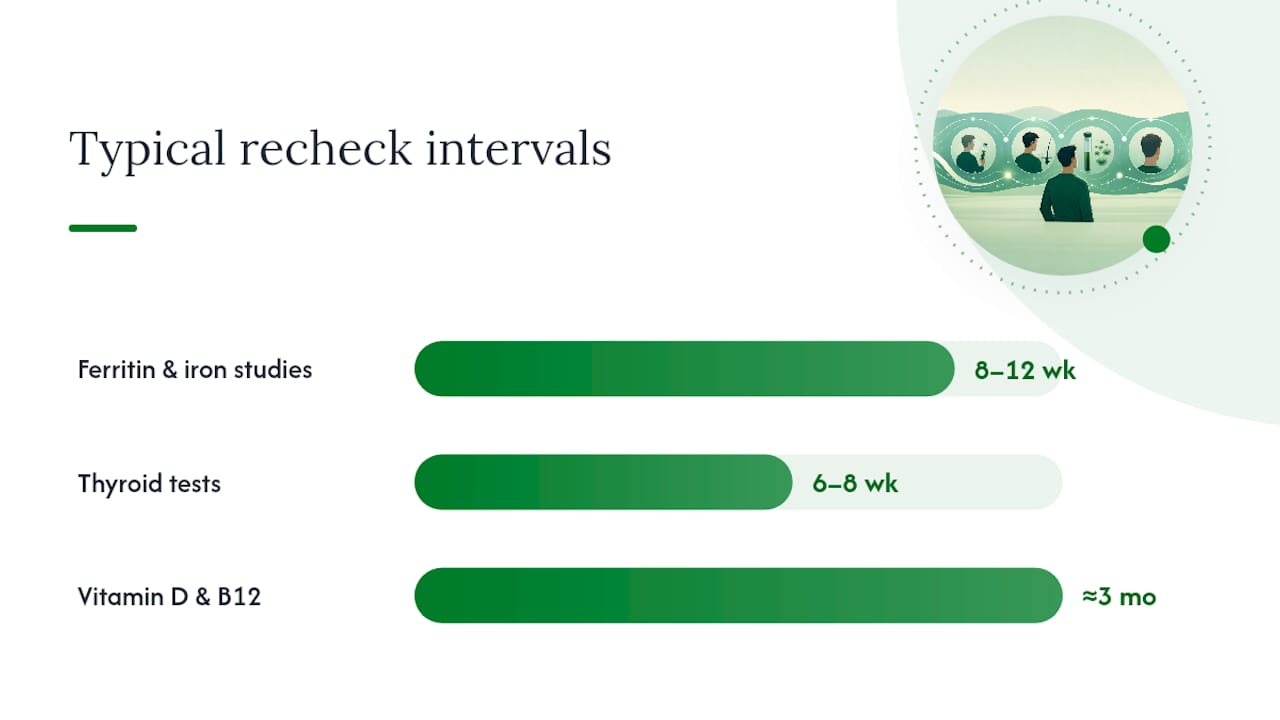
Low ferritin or low transferrin saturation. Iron repletion is the first move — oral iron supplementation, dietary changes, or investigation of blood loss (heavy periods are a common culprit). Ferritin and iron studies are typically rechecked at 8–12 weeks. Hair shedding often continues for several months after iron stores normalize because the follicle cycle lags behind the biochemical correction.
Abnormal TSH or free T4. An out-of-range thyroid result warrants endocrine referral or, at minimum, close primary care management. Treating the thyroid disorder usually reduces shedding over 3–6 months, though full hair recovery can take longer. Harvard Health notes that hair treatments often require months to show improvement — thyroid-related shedding is no exception.
Elevated androgens or low SHBG with compatible history. This pattern, particularly in women with irregular periods or signs of PCOS, points toward hormonal therapy options. Further workup may include pelvic ultrasound and endocrine evaluation. A PMC review on diagnostic approaches to alopecia supports integrating lab findings with clinical pattern recognition before committing to a treatment path.
Normal labs with acute diffuse shedding. This is the telogen effluvium scenario. Telogen effluvium typically appears weeks to a few months after a physiological trigger — illness, surgery, significant weight loss, childbirth, or severe stress. Labs may look entirely normal because the trigger has already resolved. The expected course is spontaneous recovery over 3–6 months once the trigger is removed, with no specific treatment required beyond addressing any nutritional gaps found.
Monitoring follow-up: Ferritin and iron studies are typically repeated 8–12 weeks after starting supplementation. Thyroid tests are rechecked 6–8 weeks after a dose adjustment. Vitamin D and B12 are rechecked at roughly 3 months when correction is underway. Periodic monitoring matters because over-correcting iron or vitamin D carries its own risks.
Labs are one piece. According to Mayo Clinic, clinicians also use physical exam maneuvers, scalp biopsy, and a thorough medical history to reach a diagnosis. Here is what that looks like in practice.
Medical and medication history comes first. Medications are a frequently overlooked cause — beta-blockers, retinoids, anticoagulants, and certain antidepressants can all trigger shedding. A timeline of when shedding started, any recent illness or major stressor, and menstrual history in women all shape which tests get ordered.
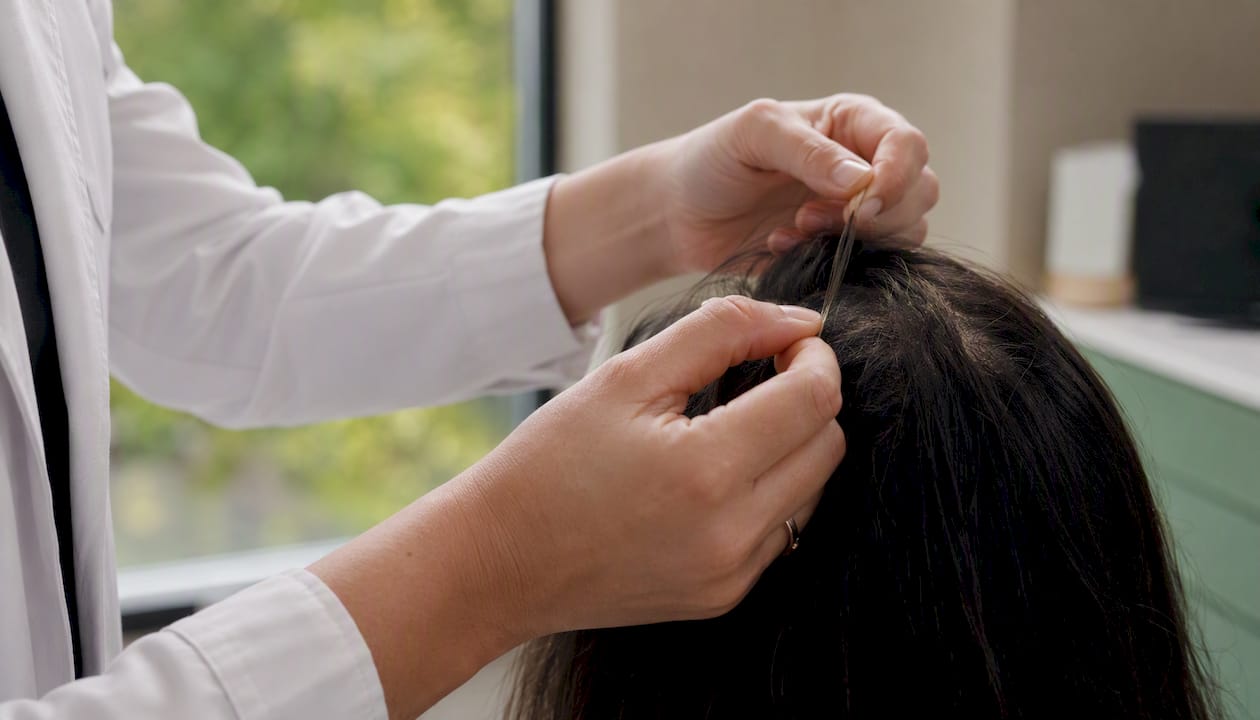
The hair-pull test is simple but informative. The clinician grasps 40–60 hairs between thumb and forefinger and pulls gently along the shaft. Extracting more than 6 hairs is considered a positive result, suggesting active shedding. A positive pull test in the telogen phase points toward telogen effluvium or early androgenetic alopecia.
Trichoscopy is a noninvasive magnified exam of the scalp using a dermatoscope. Dermatologists use it to identify miniaturized follicles (a sign of androgenetic alopecia), yellow dots (seen in alopecia areata), or peripilar signs that distinguish scarring from non-scarring patterns. It can change the differential diagnosis before a single lab result comes back.
Scalp biopsy is reserved for cases where the pattern is unclear, scarring alopecia is suspected, or the diagnosis will meaningfully change treatment. Two 4mm punch biopsies from affected areas, processed for both horizontal and vertical sectioning, give the most diagnostic information.
Referral timing: A primary care clinician can reasonably manage the initial lab workup and treat straightforward iron deficiency or thyroid-related shedding. Refer to a board-certified dermatologist when the pattern is scarring, when shedding is rapid or severe, when initial treatment has not helped after 4–6 months, or when the diagnosis remains unclear after basic labs.
Pro Tip: Before your appointment, photograph your scalp under good lighting (part the hair in several places) and keep a brief hair diary for 2–3 weeks — noting daily shed counts on a pillow or in the shower. That data gives your clinician a baseline and helps track whether shedding is improving or worsening over time.
You have several practical routes to get a hair-loss blood panel, and the right one depends on your insurance situation, how quickly you want results, and whether you want clinical interpretation built in.
Turnaround: Routine panels (ferritin, CBC, TSH, vitamin D) typically process in 1–3 business days at major reference labs. Specialty hormone assays — free testosterone, DHEAS, SHBG — can take 3–5 business days. Plan accordingly if results will guide a medication decision.
Cost: Lab costs vary significantly by site and insurer. Institutional standard charges illustrate how widely list prices differ across facilities — the same ferritin test can range from under $20 to over $100 depending on where it is drawn and how it is billed. Insurance coverage depends on whether the test is coded as medically necessary.
Pro Tip: Before your draw, call your insurer and confirm which reference lab is in-network. Out-of-network lab draws — even when ordered by an in-network clinician — can result in unexpected bills. Ask the ordering clinician to include a diagnosis code (ICD-10) that supports medical necessity, which reduces the chance of a denial.
Normal labs do not rule out treatable causes. Telogen effluvium and early autoimmune thyroid disease are two of the most common culprits when a standard panel looks clean.
Three specific scenarios explain most “normal labs, real hair loss” situations:
Ferritin within lab range but below the functional target. A ferritin of 18 ng/mL passes most lab reference ranges but falls well below the 40–70 ng/mL range many dermatologists consider adequate for hair cycling. Inflammation compounds this: because ferritin is an acute-phase reactant, active inflammation can push ferritin to 35–40 ng/mL even when true iron stores are depleted. Checking transferrin saturation alongside ferritin catches this. A PMC review on iron and hair loss addresses exactly this interpretive complexity.
TSH inside the reference range while antibodies are elevated. Early Hashimoto’s thyroiditis can present with a TSH within the reference range while TPO antibodies are elevated and free T4 trends low. Hair shedding can precede an overtly abnormal TSH by months or years. This is why free T4 and TPO antibodies matter when clinical suspicion is present.
Timing mismatch. Telogen effluvium typically appears 6–12 weeks after the triggering event. By the time shedding is noticeable, the trigger (illness, crash diet, surgery) may have resolved and labs may have normalized. The hair is shedding because of what happened months ago, not because of anything currently detectable in blood.
A note on test selection: Ordering a broad, unfocused hormone panel rarely changes management and adds cost without clarity. Focused testing driven by history — as Healthline’s clinical overview notes — is more efficient and reduces the risk of chasing incidental findings that have nothing to do with hair loss.
Start with the smallest panel that can change what you do: ferritin plus transferrin saturation, CBC, TSH with free T4, and 25-hydroxy vitamin D. That four-test cluster catches the most common, most treatable causes of hair shedding. Add hormone tests only if the history points there.
Here is how I’d prioritize the ordering conversation with a clinician:
One thing most people underestimate: the gap between correcting a lab value and seeing hair respond. Iron stores can normalize in 8–12 weeks, but the follicle cycle means visible regrowth often lags 3–6 months behind. That delay causes people to abandon treatment that is actually working. Set the expectation before you start, not after you get frustrated.
Getting the right hair loss blood tests ordered, interpreted, and acted on is where most people stall. AM Rx closes that gap with same-day telehealth visits — a clinician reviews your history, orders the targeted panel described above, and follows up on results with a clear treatment plan.

When labs point toward a treatable cause, AM Rx clinicians can prescribe directly. That includes oral minoxidil via telehealth, which is increasingly used under medical supervision as a first-line option alongside topical formulations. Prescriptions ship to your door, and the platform coordinates with insurance where applicable. No waiting weeks for a specialist slot.
Low-dose oral minoxidil requires medical supervision: it can cause fluid retention, a faster heart rate, and lowered blood pressure, so clinicians typically monitor blood pressure and ask about heart conditions before prescribing. It is not recommended during pregnancy or breastfeeding. Discuss these risks with a physician before starting.
Ready to stop guessing and get a real answer? Book a hair-loss visit at AM Rx and get the panel that actually matters, ordered by a clinician who will read it in context.
This article is general information, not a substitute for advice from a qualified doctor. Consult a qualified healthcare professional about your own circumstances before acting on anything here.
Yes, in many cases — particularly when a treatable cause like iron deficiency, thyroid dysfunction, or vitamin D insufficiency is identified and corrected. Androgenetic alopecia responds to treatments like minoxidil, though ongoing use is typically required to maintain results.
Normal standard labs don’t exclude all causes. Ferritin may be within the lab reference range but below the functional threshold many dermatologists use for hair health (40–70 ng/mL), or TSH may be normal while TPO antibodies are elevated. Telogen effluvium also presents with normal labs because the triggering event typically occurred 6–12 weeks before shedding becomes noticeable.
Correcting an underlying deficiency (iron, thyroid, vitamin D) is the most direct path when a cause is identified. Topical minoxidil is FDA-approved as a first-line therapy for pattern hair loss; oral minoxidil is increasingly used under medical supervision. Platelet-rich plasma remains investigational with variable evidence.
Ferritin is the single highest-yield test for diffuse shedding. Request it alongside transferrin saturation, TSH with free T4, and 25-hydroxy vitamin D as a starting panel — and ask explicitly for each by name, since standard annual panels often omit ferritin and free T4.
A primary care clinician can order and interpret the core panel and manage straightforward causes like iron deficiency or thyroid disease. Refer to a board-certified dermatologist when the pattern is scarring, the diagnosis is unclear after initial labs, or hair loss is progressing rapidly despite treatment.