Send the prescription to the pharmacy first. The pharmacy will run the claim, and if it comes back denied for lack of authorization, that denial is what triggers the prior authorization request your provider needs to answer. For eligible Medicare Part D beneficiaries, the Medicare GLP-1 Bridge is now the central pathway starting mid-2026, and providers should submit the Bridge PA form electronically through a service like CoverMyMeds or by fax once the pharmacy’s request comes through.
TL;DR:
- Prior authorization for Medicare GLP-1 medications begins after the pharmacy’s claim is denied, avoiding premature submissions that cause delays.
- Eligibility requires a BMI of 30 or higher, or 27 with at least one qualifying comorbidity, along with documentation of lifestyle modification efforts.
- Electronic submission through platforms like CoverMyMeds is preferred, and proper clinical documentation must be complete to increase approval chances.
- Many denials occur due to exclusion riders, missing step therapy evidence, incorrect diagnosis codes, or lack of documented lifestyle program enrollment.
- Using a standardized process, verifying plan exclusions early, and ensuring complete paperwork significantly improve approval success rates.
The Medicare GLP-1 Bridge is a CMS demonstration program that gives eligible Part D beneficiaries a path to coverage for certain GLP-1 medications used for weight management. It runs outside the normal Part D payment structure, and a single central processor handles both prior authorization and claims adjudication for every participating plan. That matters operationally: Part D sponsors don’t need to opt in individually, because the Medicare GLP-1 Bridge program processes requests through one channel rather than dozens of plan-specific workflows.
Eligibility hinges on clinical criteria CMS spells out clearly, and providers need to check these before submitting anything:
Not every Part D plan participates in the exact same way, and beneficiaries who already have a GLP-1 covered under a different indication, like type 2 diabetes, follow a separate authorization track rather than the Bridge. According to Medicare’s own coverage guidance, some prior authorizations issued under the Bridge remain valid through late 2027, covering refills and dose adjustments, as long as the patient doesn’t switch to a different GLP-1 molecule. Switch drugs, and you restart the clock.
The sequence matters more than most clinics realize, and getting it out of order is the single biggest source of wasted time.
CMS explicitly recommends waiting for the pharmacy’s PA trigger rather than front-running it. Clinics that build this into their scheduling, rather than trying to submit proactively, avoid the bulk of the rejected-on-technicality delays.
The Medicare Bridge PA form asks for specific data points, and missing even one slows the whole review. You’ll need the patient’s full identifiers, the BMI recorded at the time of initiation (with the measurement date), the specific indication being requested, and checkboxes confirming which qualifying comorbidities apply.
A letter of medical necessity (LMN) is not always mandatory, but it’s often the difference between a first-pass approval and a request for more information. Eli Lilly’s own access guidance for Zepbound recommends attaching an LMN whenever a PA is required, and the strongest ones read as a narrative rather than a checklist. Name the therapies already tried, the exact doses, the dates they were used, and why each one failed or wasn’t tolerated. A payer reviewer responding to “metformin trial, 2024, discontinued for GI intolerance” moves faster than one staring at a bare diagnosis code.
Supporting documents to attach alongside the form:
Pro Tip: Build a one-page LMN template in your EHR with fillable fields for prior therapies, dates, and outcomes. Clinics that standardize this cut days off their average turnaround because staff aren’t drafting narrative language from scratch on every request.
Prior authorization requirements for GLP-1 medications didn’t creep up gradually. They jumped from under 25% of Medicare Advantage and standalone Part D plans in Q3 2023 to roughly 83% of plans by Q3 2024, covering injectable semaglutide, tirzepatide, and oral semaglutide alike. That kind of shift means more denials, and most of them trace back to a handful of repeat causes.
If a denial comes back, move fast: gather the missing documentation first, then submit an updated LMN addressing the specific denial reason rather than a generic resubmission. Request a peer-to-peer review with the plan’s medical director when the denial hinges on clinical judgment rather than missing paperwork, and reference the plan’s own policy language when you push back. For Medicare Bridge cases, the CMS call center can clarify why a request was rejected before you resubmit blind. Most successful appeals turn around within one to two weeks when the added documentation directly answers the stated denial reason.
Yes, and prescribing under the wrong indication is one of the most common reasons a request stalls. A GLP-1 prescribed for type 2 diabetes usually moves through diagnosis-driven review with straightforward step-therapy checks, since these drugs have been approved for T2D far longer and most payers have established pathways. Learn more about how different GLP-1 molecules affect which indication and dosing pathway applies.
Weight management, by contrast, runs through the anti-obesity medication (AOM) pathway, which layers BMI thresholds and lifestyle-program attestation on top of the standard clinical review. Cardiovascular risk reduction is its own track again, with different age and BMI parameters and often longer authorization windows once approved, since the clinical evidence for CV risk reduction is treated differently from weight loss alone.
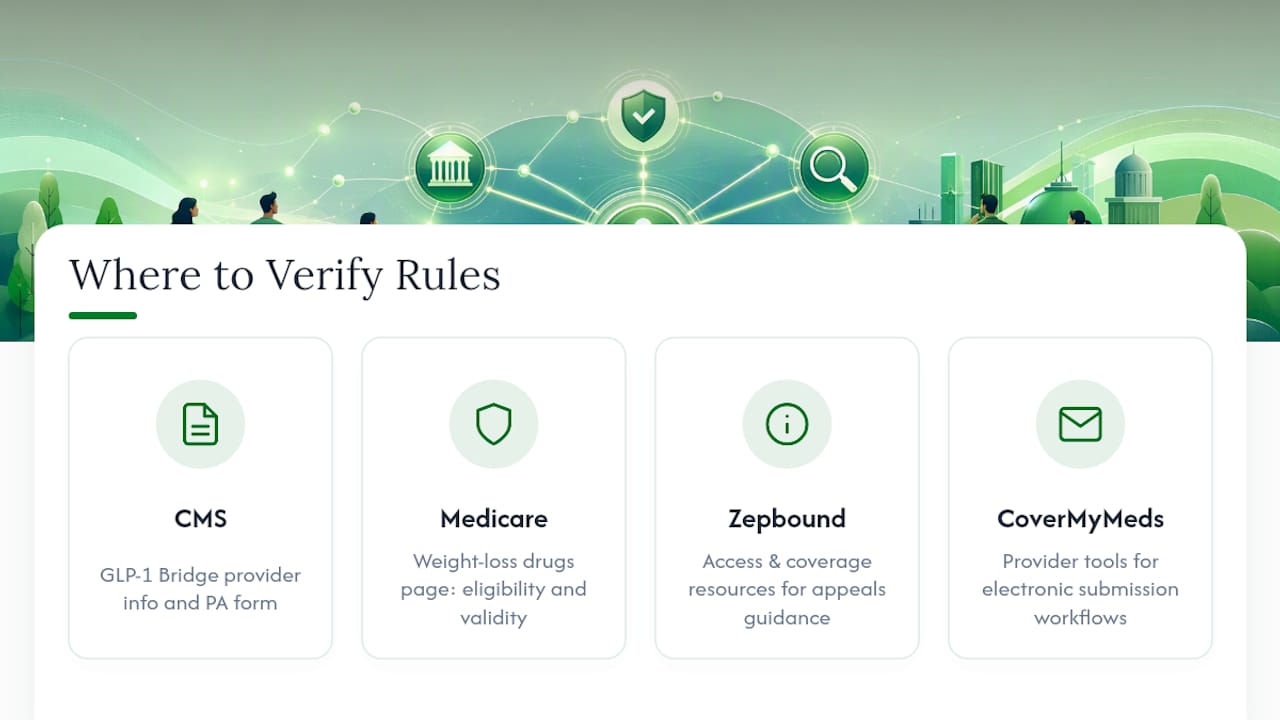
Everything routes through a small set of official channels, and knowing them ahead of time saves a scramble mid-denial.
Peer-reviewed data on the surge in GLP-1 prior authorization requirements makes one thing clear: this isn’t going away, so clinics need a repeatable process rather than a case-by-case scramble. A short checklist, applied consistently, beats improvising every time.
Pro Tip: Designate one staff member as the GLP-1 PA point person for the clinic. Splitting this task across whoever’s free that day is how denied claims go unnoticed and requests get submitted before the pharmacy’s denial ever posts.
AM Rx’s telehealth model builds prior authorization support directly into the visit rather than treating it as a separate headache after the fact. Providers document BMI, comorbidities, and prior treatment history during the consult itself, so the clinical record needed for a PA or LMN already exists the moment a pharmacy flags a denial.
Insurance verification happens before the prescription goes out, which catches AOM exclusion riders and plan-specific requirements early instead of after a rejected claim. When documentation support is needed, coordination with the pharmacy keeps the Bridge BIN/PCN sequence in order, so patients aren’t stuck in a “patient not found” loop. Starting is simple: complete an online visit, and the same team handles the insurance side while you focus on treatment.
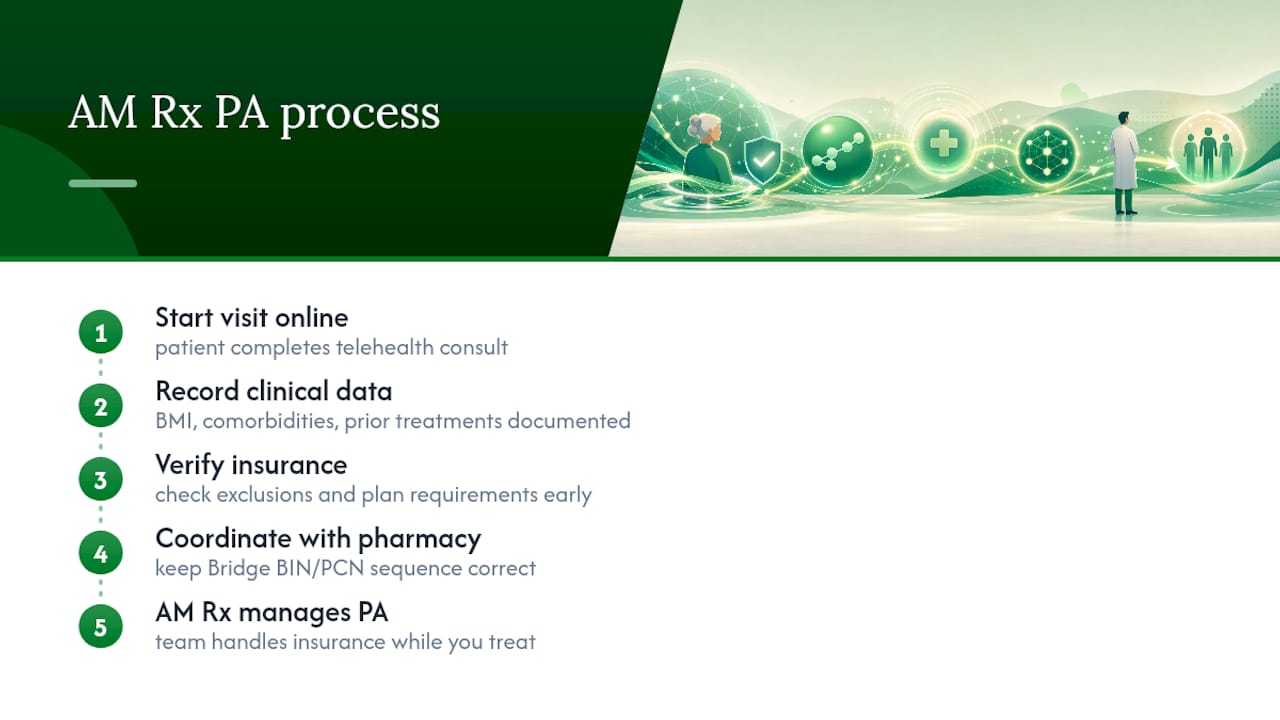
Fighting through a prior authorization on your own, whether you’re a patient staring down a denied pharmacy claim or a provider juggling fax queues, eats hours you don’t have. AM Rx handles the visit, the insurance verification, and the documentation coordination in one place, so the pharmacy claim, the PA trigger, and the paperwork move in the right order the first time.

That means less time re-explaining your case to a call center and more time actually getting the medication. AM Rx checks your plan for exclusions before you’re prescribed anything, coordinates directly with pharmacies on Bridge BIN/PCN documentation when applicable, and keeps your visit notes structured so a letter of medical necessity is ready to go if a denial comes back. If you’re ready to find out whether weight loss injections are right for you, start your telehealth consent and visit today and let the AM Rx team manage the insurance side while you focus on your treatment plan.
For the most current program details, go straight to the source: CMS publishes the Medicare GLP-1 Bridge provider information and PA form, and Medicare’s weight loss drugs coverage page covers eligibility and authorization validity. For appeals guidance, see Zepbound’s access and coverage resources, and for electronic submission workflows, CoverMyMeds offers provider-facing tools.
This article is general information, not a substitute for advice from a qualified doctor. Consult a qualified healthcare professional about your own circumstances before acting on anything here.
Submit a complete PA form with the correct diagnosis code, documented BMI and dates, evidence of any required step therapy, and a letter of medical necessity that explains prior treatment failures in detail rather than just checking boxes.
The Medicare GLP-1 Bridge is a CMS program launching July 1, 2026, that covers certain GLP-1 medications for weight management for eligible Part D beneficiaries who meet BMI and comorbidity criteria, with some approvals valid through December 31, 2027.
Follow the same Bridge process if you’re a Medicare beneficiary who qualifies, and attach the letter of medical necessity manufacturer guidance recommends, since Zepbound’s access resources note that appeals with added clinical detail can overturn an initial denial.
Don’t submit the PA request before the pharmacy’s claim comes back denied against the Bridge BIN/PCN. Submitting early produces a “patient not found” error and forces a resubmission later.
Yes. AM Rx documents the clinical details a PA request needs during the telehealth visit itself and verifies insurance coverage before the prescription is sent, which helps avoid the delays that come from incomplete documentation or AOM exclusion surprises.