Expect to pay anywhere from pennies per dose for an FDA-approved generic with a coupon to $12,000 or more for surgery. The gap comes down almost entirely to which treatment modality you and your doctor choose. Oral pills sit at the cheap end, injections and clinic procedures sit in the middle to high end, and penile implant surgery anchors the top, though it can end recurring costs for good.
TL;DR:
- Generic ED medications with coupons can cost less than a dollar per dose, while injections and surgeries can reach thousands of dollars annually or as a one-time expense.
- Injections and vacuum devices tend to have the highest annual costs, especially when used for patients with nerve or vascular damage that makes oral medications ineffective.
- Shockwave therapy and PRP treatments are expensive per session, often costing over $2,400, and are generally not reimbursed by insurance due to limited evidence.
- Insurance coverage varies based on whether treatments are billed as medical or pharmacy benefits, with implants often more likely to be partially covered when deemed medically necessary.
- To minimize costs, start with FDA-approved generics using coupons, verify coverage details, and request itemized estimates for surgeries and expensive procedures beforehand.
The spread across ED treatments is wider than almost any other men’s health category. Generic tablets are often very inexpensive, while implant surgery can be very costly.
Here’s how the major modalities stack up on typical U.S. pricing:
| Treatment | Typical cost | Payment pattern |
|---|---|---|
| Generic sildenafil/tadalafil (coupon) | $0.19–$1 per dose | Cash, often cheaper than insurance copay |
| Telehealth/compounded oral meds | several to twenty dollars or more per dose | Usually cash-pay subscription |
| Brand-name Viagra/Cialis (retail) | Up to $25 per dose | Sometimes insured, often cash |
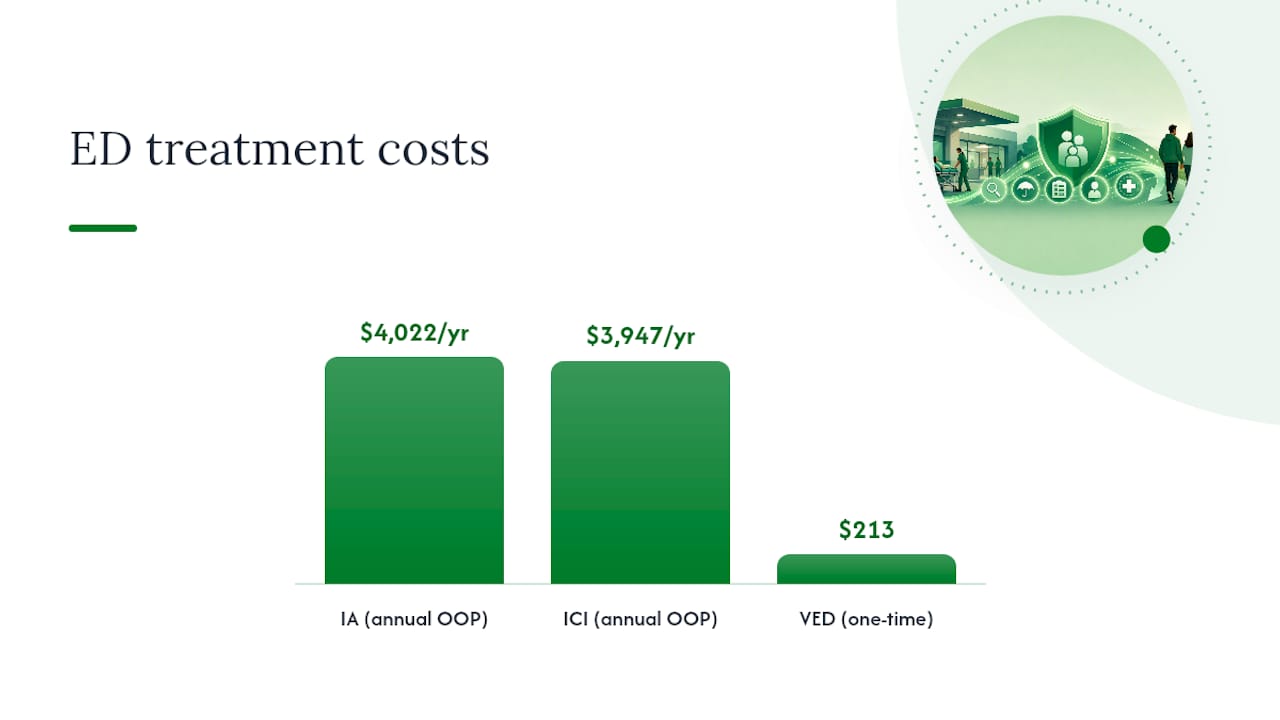
| Injections (ICI/IA) | approximately four thousand dollars per year | Inconsistent insurance coverage |
| Vacuum erection device (VED) | ~a few hundred dollars one-time | Rarely covered by Medicare |
| Shockwave therapy (ESWT) course | $2,400–$7,200 per course | Almost always cash-pay |
| Penile implant surgery | $12,000 or more one-time | Often covered when medically necessary |
Three numbers are worth memorizing. First, the per-dose spread for ED medications runs from about $0.19 to $25, depending entirely on whether you use a generic coupon or a brand-name prescription. Second, penile implants typically run a range of several thousands to tens of thousands of dollars, the single largest one-time cost in this entire category. Third, injections carry the highest recurring annual burden of any guideline-recommended treatment, according to Medicare cost modeling.
Oral PDE5 inhibitors, the drug class that includes sildenafil (generic Viagra) and tadalafil (generic Cialis), remain the cheapest effective option for most men. But “oral medication” covers three very different price tiers, and the gap between them is the single most avoidable expense in ED care.
At the low end, a 30-count supply of generic sildenafil runs about $12.44 with a retail pharmacy coupon, or roughly $0.41 per pill. That’s the floor. At the high end, brand-name tablets purchased without insurance can run close to $25 per dose. In between sits telehealth: many online ED medication prices land in an $8 to $22 per dose range for compounded or subscription formats, even though the active ingredient is often chemically identical to the discounted generic. You’re not paying for a different drug. You’re paying for the convenience layer wrapped around it.
Statistic Callout: Filling generic tadalafil with a pharmacy coupon instead of a telehealth compounded subscription can mean the difference between roughly $5 and $200+ per month for the identical dose, purely based on format.
Medicare Part D and most commercial pharmacy benefits treat oral ED medications as lifestyle drugs, meaning coverage is limited or excluded entirely in many plans. A Medicare cost-modeling analysis pegged annual patient out-of-pocket spending for PDE5 inhibitors at roughly just under seven hundred dollars, among the lowest of any guideline treatment. Run the math yourself: a man using generic tadalafil with a coupon program three times a week might spend under $100 a year. The same frequency through an unmanaged telehealth subscription could top $1,500 to $2,000 annually.

Intracavernosal injections (ICI) and intraurethral alprostadil (IA) sit near the top of the annual cost chart, not because the drugs themselves are exotic, but because they require ongoing clinical support and specialty pharmacy pricing. The same Medicare cost model that found PDE5 inhibitors cheap found the opposite for injectable therapy.
Why would anyone choose a $4,000-a-year injection over a $700-a-year pill? Because PDE5 inhibitors don’t work for every man, especially those with nerve damage from prostate surgery or diabetes-related vascular changes. When oral medication fails, injections and vacuum devices become the next guideline-recommended step, not a luxury upgrade. The cost jump reflects the clinical reality that these options require more supervision, specialty formulation, and in some cases in-office training before a man can self-administer at home.
VEDs occupy an odd middle ground: a low one-time cost but almost no insurance help, since Medicare’s coverage stance on erection devices treats them the same way it treats oral drugs.
Low-intensity extracorporeal shockwave therapy (ESWT) and platelet-rich plasma (PRP) injections have become popular at men’s health clinics, largely because they’re marketed as regenerative rather than symptomatic. They also tend to be the most expensive per-session option outside of surgery, and almost none of that cost gets reimbursed.
A full ESWT course typically runs $2,400 to $7,200, spread across six to twelve sessions depending on the clinic’s protocol. PRP pricing varies even more widely because there’s no standardized dosing or session count across providers. Medicare’s own cost model placed ESWT at roughly $3,445 per course in patient responsibility, almost entirely cash-pay.
Pro Tip: Ask any shockwave or PRP clinic for their total course price in writing before booking session one. Package pricing quoted per-session almost always undercounts the real total, and some clinics upsell add-on sessions once you’re partway through the protocol.
An inflatable penile prosthesis (IPP) is the most expensive single ED treatment and, paradoxically, one of the more insurable ones once medical necessity is documented. Surgery pricing in the U.S. typically ranges from a range of several thousands to tens of thousands of dollars, driven by three variables: the device manufacturer and model, the facility’s operating room fees, and the surgeon’s charges.
Statistic Callout: In the Medicare cost model, penile implants modeled at roughly $1,600 in patient out-of-pocket cost under an outpatient copayment cap, dramatically lower than the around four thousand dollars annual burden modeled for injections, despite the far higher sticker price of surgery itself.
That gap illustrates the core tradeoff of implant surgery: a large upfront number that Medicare and many commercial plans partially absorb when ED is documented as medically necessary, often following prostate surgery, diabetes complications, or Peyronie’s disease. Compare that to injections or oral medication, where costs recur every month for as long as the man is sexually active. A 20-year time horizon changes the math substantially. A man spending $700 a year on PDE5 inhibitors for two decades spends roughly $14,000, in the same range as the surgery’s sticker price, only spread out and mostly uninsured. Implants tend to last many years, sometimes decades, which is why urologists frame the decision as a long-term value calculation, not just a comparison of upfront ED treatment options.
Insurance coverage for ED hinges on one distinction most men never think to ask about: is this treatment billed as a pharmacy benefit or a medical benefit? That single categorization determines your deductible, your copay structure, and whether prior authorization is even possible.
Oral medications and most injectable drugs fall under the pharmacy benefit, meaning Medicare Part D or your commercial plan’s drug formulary decides coverage. Surgical procedures like implants fall under the medical benefit, governed by Medicare Part B or your plan’s surgical coverage rules, which is why implants can see partial reimbursement while daily-use pills often see none.
Before assuming a treatment is affordable or unaffordable, check these five things with your plan:
Common insurer behaviors that quietly increase your bill:
When you call your provider’s billing office, ask specifically: “Is this billed under my medical or pharmacy benefit, and has prior authorization already been submitted?” That question alone resolves most surprise-bill situations before they happen. For a broader look at marketplace plan coverage, the basics of what counts as an essential benefit versus an excluded category are laid out clearly by the federal marketplace.
Guesswork is the enemy here. Follow this sequence and you’ll walk into any pharmacy, clinic, or telehealth visit with a realistic number instead of a surprise.
Pro Tip: Request your insurer’s prior authorization decision in writing before you fill a prescription or schedule a procedure. Verbal approvals from a call center rep have a way of disappearing when the claim actually gets processed.
Cost reduction in ED care rarely requires sacrificing effectiveness. It mostly requires avoiding the markup traps built into convenience-first buying.
Statistic Callout: The documented spread between the cheapest coupon price and the priciest telehealth or brand format for the same active ingredient can exceed 100 times per dose, based on 2026 price survey data.
The most rigorous public data on this topic comes from a Medicare cost-modeling analysis that ranked guideline-recommended ED treatments by projected annual patient out-of-pocket burden. The headline finding surprises a lot of men: injectable therapies, not surgery, produced the highest modeled patient costs, while implants and oral medications landed lower once existing coverage structures were factored in.
Intraurethral alprostadil and intracavernosal injections carried the highest one-year modeled patient costs among guideline-recommended ED treatments, while PDE5 inhibitors and inflatable penile prostheses were associated with comparatively lower patient costs under Medicare’s coverage rules.
That model has real limits worth flagging. It reflects Medicare-specific coverage rules, which don’t map perfectly onto commercial insurance or cash-pay telehealth pricing, and drug prices shift year to year in ways a modeling study can’t fully capture. Treat it as a directional map, not a personal quote. Your own number still depends on your specific plan, your specific pharmacy, and which treatment your clinician actually recommends.
The cheapest option on paper isn’t always the smartest financial choice. A $2,400 shockwave course with unproven long-term benefit can cost more over five years than a $700-a-year generic that’s been studied for decades, simply because you end up paying for both when the first one doesn’t hold.
My advice: default to whatever the American Urological Association’s guidelines rank as first-line therapy, unless your clinician has a documented reason to skip it. Marketing claims about “10x stronger” or “revolutionary” ED treatments almost always mean higher price, not better evidence. Ask what randomized data exists before paying a premium for anything experimental, and weigh a decade of recurring costs against a single upfront number before assuming surgery is the expensive option.
— Bryan
Clinics, compounding pharmacies, and specialty telehealth brands can all quote wildly different numbers for the same active drug, and figuring out which one applies to you shouldn’t require three phone calls and a spreadsheet. Some telehealth providers offer ED medication with virtual visits, providing evaluations, prescription decisions, and delivery scheduling to simplify the process.

AM Rx’s transparent telehealth pricing means you see the visit cost and medication options before committing, not after a surprise bill arrives. This works best for medication management. If your evaluation points toward a procedure or surgery, providers can guide you toward the appropriate in-person specialists. Start by checking your options on the ED treatment page and booking a consult to see your actual quoted price before you decide anything.
Before committing to any treatment, confirm the details directly with primary sources rather than a clinic’s sales pitch:
This article is general information, not a substitute for advice from a qualified doctor. Consult a qualified healthcare professional about your own circumstances before acting on anything here.
There’s no single average because modality drives the number: generic pills with coupons can cost under $1 per dose, while a full year of injectable therapy can run close to $4,000, and implant surgery ranges from several thousands to tens of thousands of dollars one time.
Coverage depends on whether the treatment is billed under your pharmacy benefit or medical benefit. Medicare and many commercial plans often exclude oral PDE5 inhibitors and vacuum devices but may cover penile implants and some injectable therapies when medical necessity is documented.
No treatment has been shown in credible research to be “10 times better” than sildenafil (generic Viagra). Marketing claims like this usually apply to unproven compounded or clinic-based procedures priced far higher without matching evidence.
Penile implant surgery produces the most reliable and durable results for men who don’t respond to medication, according to urology guidelines, though it carries the highest upfront cost of any ED treatment.
No credible clinical evidence supports massage techniques or unregulated herbal supplements as effective ED treatments, and they carry no oversight for safety or dosing. Guideline-recommended options like oral medication through a provider such as AM Rx remain the evidence-backed starting point.