If you want an Ro.co-style online weight-loss program but with clearer pricing and more attentive clinical follow-up, the strongest options fall into two categories: video-first integrated telehealth platforms (like AM Rx) and fast async services that trade follow-up depth for speed. AM Rx stands out for same-day video consultations, transparent insurance handling, and a care model that doesn’t leave you after the first prescription.
TL;DR
The table below maps the main categories of Ro-style telehealth services against the criteria that actually matter when you’re choosing: medication access, how clinical visits work, how fast you get a prescription, and what ongoing support looks like. AM Rx appears as a named entry; other rows use category labels to keep the comparison honest.
| Category | Best for | Medications offered | Clinical model | Onboarding speed | Ongoing support | Pricing transparency | Insurance support |
|---|---|---|---|---|---|---|---|
| AM Rx | Patients who want video visits, integrated care, and same-day appointments | GLP-1 injectables where clinically appropriate; oral options | Video-first with licensed providers | Same-day appointments available | Scheduled follow-ups, dose adjustments, continuous clinician access | Transparent membership + medication pricing; insurance handled directly | Yes — transparent insurance handling and prescription fulfillment |
| Fast async platforms | Patients who prioritize speed and low friction | Brand and compounded GLP-1 injectables; oral options | Asynchronous message-based review | 24–72 hours to first Rx decision | Limited; patient-initiated check-ins | Membership fee often separate from medication cost | Cash-pay primary; some pharmacy benefit support |
| Video-first high-touch clinics | Patients with complex histories or who want scheduled visits | Brand GLP-1 injectables (Wegovy®, Ozempic®, Mounjaro®) | Synchronous video visits required | 3–7 days (scheduling lag) | Scheduled dose checks, labs if indicated | Bundled or itemized; varies widely | Often yes; prior authorization support |
| Integrated primary care telehealth | Patients who want weight loss managed alongside other conditions | Brand injectables; some oral options | Mix of video and async | 2–5 days | Primary care follow-ups, referrals, labs | Usually itemized; can be complex | Strong — often accepts major insurance |
| Compounding-focused services | Cost-sensitive patients open to compounded semaglutide or tirzepatide | Compounded GLP-1 injectables; limited brand options | Async or hybrid | 2–5 days | Variable; some include coaching | Low medication cost; membership varies | Cash-pay; limited insurance integration |
| Boutique coaching-plus-med programs | Patients who want structured lifestyle support alongside medication | GLP-1 injectables; oral options | Video visits plus dedicated coaching | 5–10 days | Weekly or biweekly coaching sessions | Higher total cost; often bundled | Rare; mostly cash-pay |
Pricing varies by provider and state. Forbes Health’s 2026 testing found that membership fees for online GLP-1 programs can be around $149 per month, with total costs (membership plus medication) typically ranging from about $348 per month (oral GLP-1) to $548 per month (brand injectable), depending on the medication and selected pharmacy. Always ask for an itemized total before signing up.
Pricing and availability vary by provider and state. Forbes Health’s 2026 testing found that membership fees for online GLP-1 programs vary, with total monthly costs differing significantly depending on the drug and pharmacy. Always ask for an itemized total before signing up.
Statistic to know: Compounded semaglutide is available as a lower-cost option in some programs, but availability and regulation differ by state and pharmacy — confirm your state’s rules before choosing a compounding-focused service.
Understanding the categories on paper is one thing. Here’s what a typical patient actually experiences in each.
AM Rx is built around the idea that weight loss works better when your clinician stays involved, not just at intake. The platform offers video consultations with licensed providers, same-day appointments, and prescription fulfillment with transparent insurance handling. For GLP-1 weight loss, that means a clinician reviews your history on a live video call, determines whether a GLP-1 injectable is clinically appropriate, and then stays in the loop as you titrate doses.
The care model is integrated: weight loss sits alongside mental health, primary care, and other services on the same platform, so if a patient’s weight is connected to another condition, that context does not get lost. Pricing is transparent, and the platform operates nationwide across the U.S. Fulfillment goes through licensed pharmacies, and the team handles insurance coordination directly rather than leaving it to the patient. For a deeper look at how the GLP-1 program is structured, AM Rx publishes a detailed breakdown.
Best for: Patients who want a clinician-led relationship, not just a prescription portal.
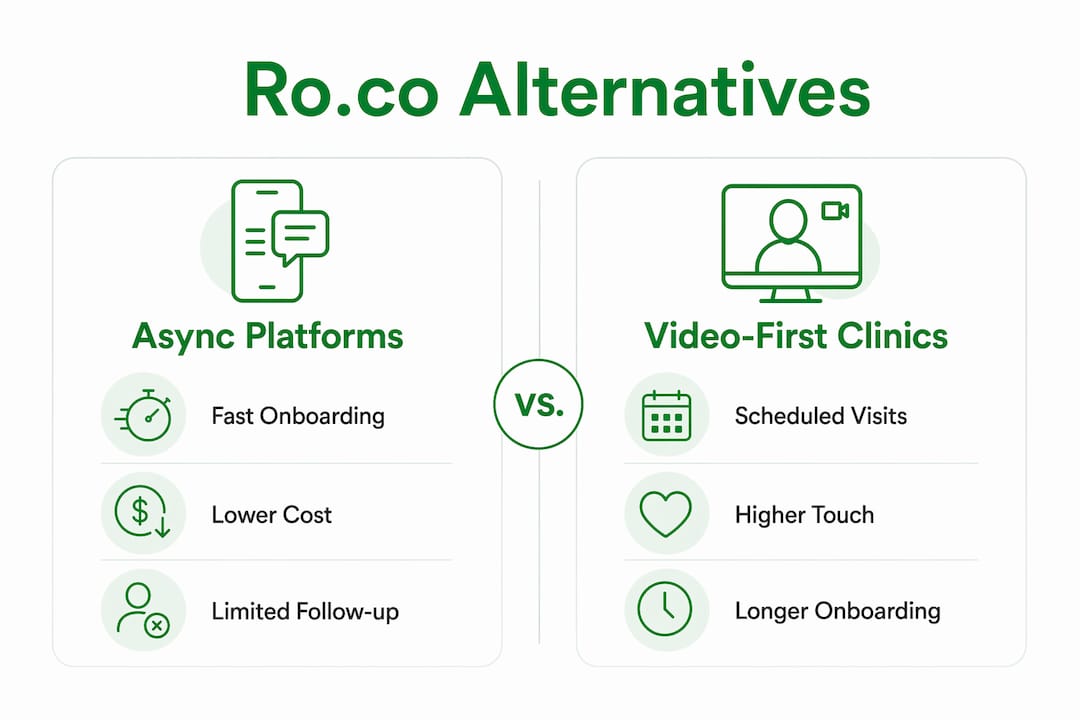
These services are built for speed. You fill out a detailed intake form, a clinician reviews it asynchronously, and you can have a prescription decision within 24–72 hours without ever scheduling a video call. The tradeoff is real: async models require you to self-report side effects and request dose changes rather than receiving scheduled clinician-initiated adjustments. If you’re comfortable managing your own check-ins and primarily want fast access to medication, this category works. If you need dose optimization support or have a complex history, the lack of synchronous touchpoints is a genuine gap.

These platforms require a scheduled video visit before prescribing, which slows onboarding to roughly 3–7 days but creates a stronger clinical foundation. Dose adjustments happen on a schedule, labs can be ordered if indicated, and the clinician relationship is ongoing rather than transactional. Brand-name injectables like Wegovy® and Mounjaro® are typically available, and prior authorization support is more common here than in async-only services.

Some platforms treat weight loss as one condition among many rather than a standalone program. That framing is actually useful if you’re managing hypertension, prediabetes, or another condition alongside obesity. The CB Insights database of telehealth alternatives shows a meaningful cluster of companies positioned around primary care and pharmacy partnerships rather than single-condition programs. Insurance acceptance tends to be stronger in this category, though the onboarding process can be more involved.
Compounded semaglutide and tirzepatide cost significantly less than brand-name equivalents, which is the main draw. The clinical model is usually async or hybrid, and the patient experience is leaner. The regulatory picture matters here: compounded GLP-1s are not FDA-approved drugs in the same sense as Wegovy® or Zepbound®, and availability varies by state. Ask specifically whether the compounding pharmacy is 503A or 503B accredited.
The most expensive category, but also the most structured. You get a clinician for prescribing and a dedicated coach for nutrition, behavior, and accountability. Weekly or biweekly sessions are standard. These programs suit patients who’ve tried medication alone without lasting results and want the behavioral layer built in. The personalized coaching and medication model that AM Rx offers draws from this philosophy without the boutique price tag.
Pro Tip: Before committing to any platform, ask whether your assigned clinician is the same person at every follow-up or whether you’re routed to whoever is available. Continuity of care matters more than most intake forms suggest.
Start with this: if clinical follow-up and dose optimization matter to you, choose a video-first or integrated care platform. If speed and low upfront cost are the priority and you’re comfortable self-managing between check-ins, an async platform may be enough.
Work through these in order before signing up for any service:
Most patients move through the same basic sequence regardless of platform. The timing varies by clinical model.
Total time from sign-up to medication in hand: as fast as 2–3 days (async + local pharmacy) to 2 weeks (video-first + mail-order).
For most platforms tested in 2026, expect a monthly membership fee (often around $149/month) plus medication:
These are representative ranges cited by Forbes Health for online GLP-1 programs; your actual costs can vary based on pharmacy, insurance, and medication choice.
Ranges sourced from Forbes Health’s 2026 testing of online GLP-1 programs. Actual costs depend on your pharmacy, insurance, and specific medication.
Pro Tip: Ask your platform whether dispensing and shipping fees are included in the quoted medication price or billed separately. That single question can reveal a $30–$80/month difference from the advertised number.
On insurance: most platform memberships are cash-pay. Medication coverage varies significantly by plan and drug. Check your pharmacy benefit directly, and ask the platform whether it provides prior authorization support.
The clinical model you choose isn’t just a convenience preference. It has a measurable effect on how your treatment goes.
GLP-1 medications like semaglutide and tirzepatide require dose titration over weeks to months. The FDA-approved prescribing guidance for semaglutide specifies a structured dose escalation schedule precisely because side effects (nausea, GI distress) are dose-dependent and manageable with proper titration. A clinician who reviews your progress at each dose step can slow the titration if you’re struggling, or accelerate it if you’re tolerating the medication well. An async model where you self-report and request changes puts that judgment entirely on you.
“Satisfaction for weight-loss outcomes correlates with continuous clinician contact and coaching availability — convenience wins for async-first platforms, but clinical follow-up quality drives long-term results.” — ExploreProviders comparative review
Research on obesity pharmacotherapy consistently shows that behavioral and clinical support alongside medication produces better long-term outcomes than medication alone. That’s not an argument against async platforms for every patient. It is an argument for being honest about what you’re trading when you choose speed over follow-up depth.
The NCBI clinical review of obesity management confirms that structured follow-up is a standard of care recommendation, not an optional add-on. Platforms that don’t build it in are cutting a corner that matters.
Here’s the short version, ranked by the most common patient priorities.
Best for high-touch clinical care: AM Rx. Video consultations with licensed providers, same-day appointments, transparent insurance handling, and a care model that includes ongoing follow-up. If you want a clinician relationship rather than a prescription portal, this is the most direct path. Start at the AM Rx weight-loss page to see program details and eligibility.
Best for price-first patients: Compounding-focused async platforms. Total monthly costs can run $100–$200 less than brand-injectable programs. The tradeoff is less clinical oversight and state-by-state availability of compounded medications. Go in with clear expectations about self-managing between check-ins.
Best for integrated care: Primary care telehealth platforms. If weight loss is one of several conditions you’re managing, a platform that handles primary care alongside GLP-1 prescribing keeps your care coordinated. Insurance acceptance is stronger in this category, which can offset the higher complexity of onboarding.
Pro Tip: Most platforms offer a free or low-cost initial consultation. Use it to ask the seven questions from the checklist above before you commit to a membership. The answers will tell you more than any marketing page.
User satisfaction across Ro-style telehealth services tends to split along the same axis as the clinical models themselves.
Async-first platforms consistently earn high marks for speed and convenience. Patients who complete intake on a Monday and have a prescription by Tuesday are generally satisfied, at least initially. Where satisfaction drops is at the follow-up stage: patients who experience side effects and can’t get a timely response, or who want a dose adjustment and wait days for a message reply, report frustration. The ExploreProviders comparison data reflects this pattern clearly: convenience drives early satisfaction, but clinical follow-up quality drives long-term retention.
Video-first and integrated care platforms show a different satisfaction curve. Onboarding takes longer, and some patients find the scheduling requirement a friction point. But patients who stay through the first 90 days tend to report higher satisfaction with outcomes, specifically with dose management and side-effect support. The AVIA Marketplace vendor data shows that organization-fit matters too: enterprise-scale platforms and boutique clinics serve different patient expectations, and mismatches between patient expectation and platform model are a common source of negative reviews.
AM Rx patients highlight the integrated care model and the accessibility of same-day appointments as standout features. The ability to address weight loss alongside other health concerns on one platform, without being bounced between providers, is a recurring theme in positive feedback.
One honest caveat: no telehealth platform has a perfect satisfaction record. GLP-1 medications work well for many patients and not at all for others, and some negative reviews reflect medication response rather than platform quality. Read reviews with that filter in mind.
The most important thing to know before choosing any Ro.co alternative: total monthly cost (membership + medication + dispensing) and clinical follow-up cadence are the two factors that determine whether the platform actually works for you.
| Point | Details |
|---|---|
| Calculate total cost | Add membership + medication + dispensing/shipping fees; never compare membership prices alone. |
| Follow-up cadence matters | Scheduled dose checks correlate with better side-effect management and long-term outcomes. |
| Medication type affects cost | Compounded GLP-1 options cost significantly less than brand injectables but carry state-by-state availability limits. |
| Ask seven questions at intake | Clinical model, total cost, dose-adjustment process, pharmacy, side-effect triage, insurance, and state licensure. |
| AM Rx for integrated care | AM Rx offers video-first consultations, same-day appointments, and transparent insurance handling for GLP-1 weight loss. |
The conventional wisdom in the Ro.co alternatives space is that async platforms are “good enough” for most patients because GLP-1 medications are well-understood and the intake process is standardized. I think that framing undersells the clinical complexity of dose titration.
Semaglutide and tirzepatide are not set-and-forget medications. The titration schedules exist because side effects are real, dose tolerance varies significantly between patients, and the difference between a patient who stays on medication and one who quits at week six often comes down to whether a clinician caught a manageable side effect early or let it become a reason to stop. Async models put that judgment in the patient’s hands. For some patients, that’s fine. For most, it’s a gap that shows up at the worst moment.
The platforms that build scheduled follow-up into the model, not as an upsell but as the default, are the ones worth paying slightly more for. AM Rx’s video-first approach, with same-day appointments and continuous clinician access, reflects that philosophy. The weight-loss FAQ on the AM Rx site is worth reading before you start any program, regardless of which platform you choose, because the questions it answers are the ones most patients don’t think to ask until they’re already three weeks in.
Price matters. But the cheapest program that doesn’t keep you on medication long enough to see results isn’t actually cheaper.
If the article above convinced you that follow-up cadence and pricing transparency are the two things worth paying attention to, AM Rx was built around exactly those priorities. Video consultations with licensed providers, same-day appointments, transparent insurance handling, and a care model that stays involved through dose titration rather than handing you a prescription and stepping back.

The AM Rx weight-loss program covers GLP-1 prescribing where clinically appropriate, prescription fulfillment through licensed pharmacies, and ongoing clinician access. Eligibility is determined at your first consultation. To get started, review the telehealth consent process and book your first appointment. Same-day availability means you don’t have to wait a week to find out if you qualify.
This article is general information, not medical advice. Confirm current eligibility requirements and medication availability with a licensed clinician or the platform directly before starting any weight-loss program.
For up-to-date pricing and program details, check the AM Rx weight-loss landing page directly, as platform pricing changes frequently.