Continuous mental health support online is defined as ongoing, coordinated virtual care that combines licensed therapy, psychiatric oversight, and daily symptom monitoring to help people manage stress, anxiety, and emotional challenges over time. This model differs fundamentally from episodic care, where a person sees a provider once and waits weeks for a follow-up. Continuous care models reduce hospitalizations by 25% for patients receiving ongoing virtual mental health support. That number reflects a system that catches problems early rather than waiting for a crisis. Getamrx applies this integrated model to deliver consistent, clinician-supervised care from home.
Starting virtual mental health care takes more preparation than most people expect. Getting the basics right before your first session prevents gaps in care later.
Technology and privacy
A stable internet connection and a private, quiet space are the two non-negotiable requirements. Video sessions require enough bandwidth to maintain a clear connection throughout a 45 to 60 minute appointment. A smartphone works, but a laptop or tablet gives you a larger screen and better audio, which reduces fatigue during longer sessions.

Insurance and cost transparency
Insurance verification is typically completed before the first appointment so you know your out-of-pocket costs upfront. Skipping this step is the most common reason people abandon care after one or two sessions. Ask your provider directly whether they accept your plan, what your copay will be, and whether psychiatric visits are billed separately from therapy.
Intake assessments
Most quality platforms begin with a structured intake process. AI-led intake assessments with licensed clinician review create a complete clinical picture before your first live session. This means your provider already understands your history, current symptoms, and goals when you meet, which makes the first session far more productive.
Licensing and location
Before you enroll, confirm that your provider holds a license in the state where you physically live. State licensure laws require clinicians to be licensed where the patient is located during each visit, not just where the provider practices. If you travel frequently, tell your care team in advance so they can arrange coverage or pause services legally.
Here is a quick checklist before your first session:
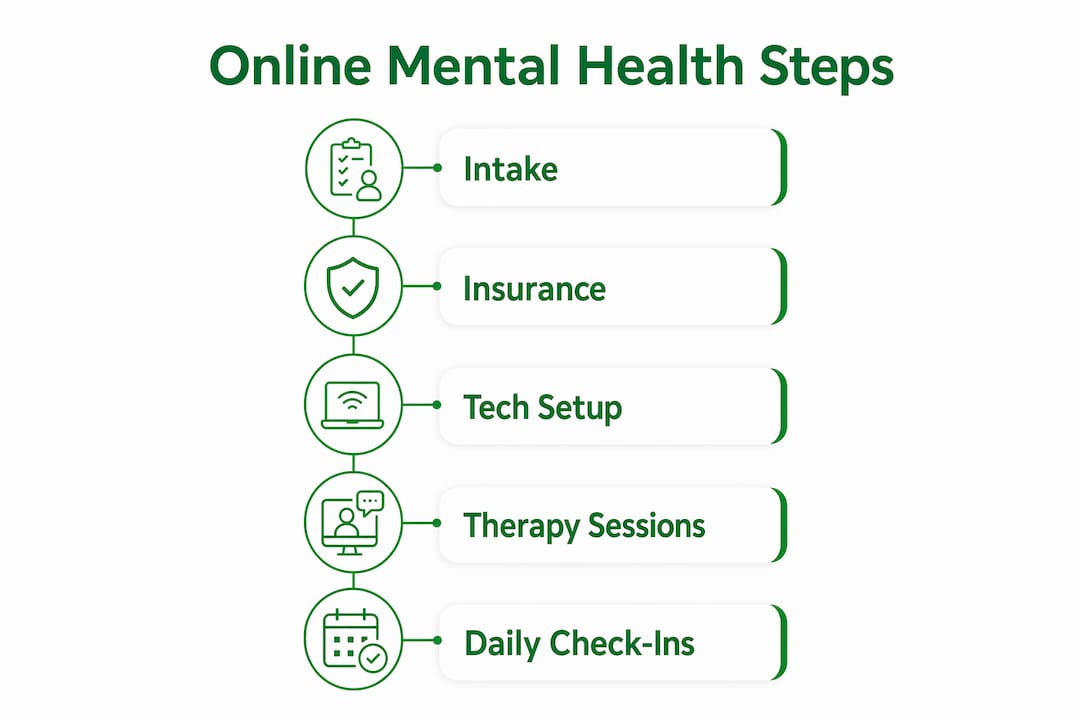
Continuous therapy is a deliberate, ongoing collaboration with a clinical team, not a series of one-time evaluations. Understanding the process step by step helps you stay engaged and get the most from each phase.
Complete a thorough intake. The process starts with a structured assessment, often AI-assisted and then reviewed by a licensed clinician. You answer questions about your mental health history, current symptoms, medications, sleep, and daily functioning. The clinician uses this to build your initial care plan.
Attend regular therapy sessions. Weekly or biweekly video sessions with a licensed therapist form the backbone of continuous care. Sessions use evidence-based methods such as Cognitive Behavioral Therapy (CBT) or Dialectical Behavior Therapy (DBT) to address specific patterns driving your anxiety, depression, or stress.
Track symptoms between sessions. Daily check-ins with licensed clinician oversight ensure you are not left unsupported between appointments. You log mood, sleep quality, energy, and any medication side effects through a secure app or patient portal. This data gives your clinician a real-time picture of how you are doing.
Receive clinician-reviewed care adjustments. Your psychiatrist or prescribing provider reviews your symptom data regularly. If your medication needs adjustment or your therapy plan needs to shift, those changes happen based on actual data rather than a single in-office impression.
Coordinate across your care team. In a well-run continuous care model, your therapist and psychiatrist communicate directly. Combining therapy, medication, and habit coaching produces sustained mental health improvements because each element reinforces the others.
Pro Tip: Log your mood and sleep every day, even on days when nothing feels notable. Patterns in “normal” days often reveal the most useful clinical information.
Improved outcomes come from active patient engagement between sessions, not just from showing up to appointments. The daily check-in habit is where most of the real progress happens.
Staying consistent with virtual mental health care is harder than starting it. Most people hit at least one of these obstacles within the first three months.
Missed appointments and motivation dips
Life gets busy, and video appointments are easier to cancel than in-person ones. Schedule sessions at a time when you are least likely to have conflicts, and treat them with the same commitment you would give a medical appointment. Many platforms send automated reminders, but you can also set your own calendar alerts 24 hours in advance.
Technology failures
A dropped connection mid-session is frustrating but fixable. Keep your provider’s phone number saved so you can switch to an audio call immediately. Most platforms have a backup protocol for technical failures, so ask about it during onboarding.
Traveling or relocating
This is the challenge most people do not anticipate. State licensure laws limit telehealth practice more than technology does. If you move to a new state, your current provider may not be licensed there. Notify your care team at least two weeks before any relocation or extended travel so they can either obtain the necessary license or refer you to a licensed provider in your new location.
Relying too heavily on AI tools
AI symptom trackers are useful for data collection, but they do not replace clinical judgment. AI must always operate under strict human clinician oversight to ensure safe and effective treatment decisions. If a platform offers AI-driven recommendations without a licensed clinician reviewing them, that is a red flag.
Continuous monitoring reduces the risk of unnoticed symptom worsening by tracking mood, side effects, and life events daily. Without that layer of oversight, small changes in your mental health can escalate before anyone notices.
Privacy concerns
Use only platforms that are HIPAA-compliant. Before your first session, confirm that your video software, messaging system, and data storage all meet federal privacy standards. A secure connection and encrypted messaging are the minimum acceptable baseline.
Not all virtual mental health programs deliver the same level of care. The differences come down to how much clinical involvement is built into the model.
| Feature category | Therapy-only programs | Combined therapy and psychiatry | AI-assisted with clinician oversight |
|---|---|---|---|
| Therapy sessions | Yes | Yes | Yes |
| Psychiatric care | No | Yes | Yes |
| Medication management | No | Yes | Yes |
| Daily symptom tracking | Rarely | Sometimes | Yes |
| Clinician review of data | No | Sometimes | Yes |
| Insurance integration | Varies | Usually | Usually |
| Habit coaching | Rarely | Sometimes | Yes |
Therapy-only programs work well for mild stress or situational anxiety. People managing depression, bipolar disorder, or anxiety disorders that require medication need a combined therapy and psychiatry model. The AI-assisted model with clinician oversight offers the most complete picture because it captures data between sessions and routes it to a licensed provider for review.
Virtual psychiatric care achieves clinical outcomes comparable to in-person treatment, including symptom management and follow-up quality. That finding matters because it removes the assumption that online care is a lesser option.
Payment models vary significantly. Some platforms charge a flat monthly subscription. Others bill per session and integrate directly with insurance. The most transparent programs provide a written cost estimate before you commit, including what happens if your insurance denies a claim.
Pro Tip: Before enrolling in any program, ask specifically: “Who reviews my daily check-in data, and how quickly?” If the answer is “our AI system,” keep looking.
The most effective programs treat technology as a data collection tool and keep licensed clinicians in charge of every care decision. That human-in-the-loop structure is what separates a clinical program from a wellness app.
Continuous mental health support online works because it combines daily symptom tracking, licensed clinical oversight, and coordinated therapy and psychiatry into one ongoing care model rather than isolated appointments.
| Point | Details |
|---|---|
| Continuous care reduces hospitalizations | Ongoing virtual care models report 25% fewer hospitalizations compared to episodic treatment. |
| Insurance verification comes first | Confirm your coverage and out-of-pocket costs before your first session to avoid unexpected gaps. |
| Daily check-ins drive outcomes | Logging mood, sleep, and side effects between sessions gives clinicians the data needed for timely adjustments. |
| State licensing affects continuity | Notify your provider before traveling or relocating to prevent interruptions in legally compliant care. |
| Clinician oversight is non-negotiable | AI tools support data collection, but a licensed clinician must review and approve all treatment decisions. |
People come to online mental health care expecting something like a doctor’s visit. They show up, talk for an hour, and wait to feel better. That model does not work for mental health, and the research backs that up clearly.
What actually produces change is the space between sessions. The mood log you fill out on a Tuesday night. The sleep data your psychiatrist reviews before your Thursday appointment. The message you send your care coordinator when something shifts unexpectedly. Patients often misunderstand continuous therapy as a single evaluation rather than an ongoing collaborative process, and that misunderstanding is the single biggest reason people drop out of care before they see results.
Technology has made it easier to stay engaged between sessions than ever before. Secure apps, encrypted messaging, and AI-assisted tracking tools remove the friction that used to make between-session contact impractical. But technology is only as good as the clinical team behind it. A symptom tracker without a licensed clinician reviewing the data is just a journal.
The stigma around seeking ongoing mental health support is real, but it is fading. People who commit to a continuous care model, not just a few sessions, report better outcomes, stronger coping skills, and fewer crises. That is not a coincidence. It is what happens when care is built around your actual life rather than a 45-minute window every few weeks.
— Bryan
Getamrx offers virtual mental health services that go beyond single-session therapy. The platform connects you with licensed therapists and psychiatric providers who coordinate your care directly, covering therapy, medication management, and ongoing clinical oversight in one place.

Getting started takes minutes. Getamrx walks you through insurance verification and telehealth consent before your first appointment so you know exactly what to expect. Same-day appointments are available, and your care team stays accessible between sessions. If you are ready to move from occasional check-ins to real, continuous care, Getamrx is built for exactly that.
Continuous mental health support online is ongoing virtual care that combines regular therapy sessions, psychiatric oversight, and daily symptom tracking under licensed clinician supervision. It differs from episodic care by maintaining active engagement between appointments.
Most continuous care programs include weekly therapy sessions and daily digital check-ins for mood and symptom tracking. The frequency of psychiatric reviews depends on your care plan and current stability.
Many insurance plans cover mental health counseling online, but coverage varies by plan and provider. Verifying your benefits before the first session is the standard practice on most reputable platforms.
Clinicians must be licensed in the state where you are physically located during each session. Notify your provider at least two weeks before traveling or relocating so they can arrange compliant coverage.
AI tools are safe for data collection and symptom tracking, but they are not safe as standalone treatment. Every AI-generated insight or recommendation must be reviewed by a licensed clinician before influencing your care plan.