The best online weight-loss programs in 2026 are medically supervised platforms that pair clinician oversight with lab monitoring, GLP‑1 medication access, and behavioral coaching. AM Rx is the recommended pick for adults who want an integrated telehealth experience: clinician-managed GLP‑1 prescriptions, lab integration, and insurance concierge support, all from home.
Here is the shortlist with one-line reasons:
GLP‑1 medications typically produce 10–20% body weight reduction in clinical outcomes, contingent on adherence and medical history. That range is meaningful, but it depends entirely on the quality of clinical supervision behind the prescription. Programs that skip baseline labs and skip titration visits are not delivering the same care, even if they hand you the same medication.
Pro Tip: Before signing up for any program, ask one direct question: “Will a licensed clinician review my labs before prescribing?” If the answer is vague or the program has no lab requirement, keep looking.
Forbes Health roundups and major editorial outlets consistently highlight medication access combined with coaching as the dominant comparison dimension in 2026. The table below maps the programs on the dimensions that actually affect your care and your wallet.
| Program | Medical oversight | GLP‑1 access | Labs / monitoring | Behavioral support | Insurance support | Price shape | Best for |
|---|---|---|---|---|---|---|---|
| AM Rx | MD/NP/PA via video | Yes, prescription evaluation | Lab integration included | Clinician-led coaching | Insurance concierge | Subscription + med costs | Integrated GLP‑1 care with insurance handling |
| Found | MD/NP via telehealth | Yes | Required at intake | App-based coaching | Limited | Subscription + med costs | Medication + app coaching |
| Noom Med | MD/NP for eligible patients | Yes, for eligible patients | Required for med track | Psychology-based curriculum | Limited | Subscription | Psychology-led with optional meds |
| Calibrate | MD-led program | Yes | Required | Structured coaching curriculum | Limited | Subscription (higher cost) | Intensive metabolic program |
| Teladoc Health | MD/NP/PA, broad network | Varies by clinician | Varies | Varies by provider | Varies | Per-visit or subscription | Wide-network telehealth access |
| WeightWatchers Clinic | MD/NP via telehealth | Yes (WW Clinic) | Required for med track | Points program + group coaching | Limited | Subscription tiers | Structured points + optional meds |
| Ro Body | MD/NP via telehealth | Yes | Required | App-based | Limited | Subscription + med costs | Convenient medication access |
| Mayo Clinic Diet | Physician-developed curriculum | GLP‑1 support track | Not required (lifestyle program) | RD-developed meal plans, group | None | Subscription | Lifestyle-first, clinic-developed |
| NDPP | CDC-recognized coaches | No | No | Structured group lifestyle program | Often covered by insurance | Low cost / free | Diabetes prevention, lifestyle |
| TOPS Club | None (peer-led) | No | No | Peer accountability groups | None | Low membership fee | Low-cost peer accountability |
| Noom Weight | None (app-only) | No | No | Psychology-based app coaching | None | Subscription | Habit formation, no medication |
| Cleveland Clinic Diet App | Health-system-developed | No | No | Nutrition-focused digital tools | None | Subscription | Clinical nutrition guidance |
| Jenny Craig | Coach-led (not MD) | No | No | One-on-one coaching + meal plans | None | Subscription + food costs | Pre-planned meals + coaching |
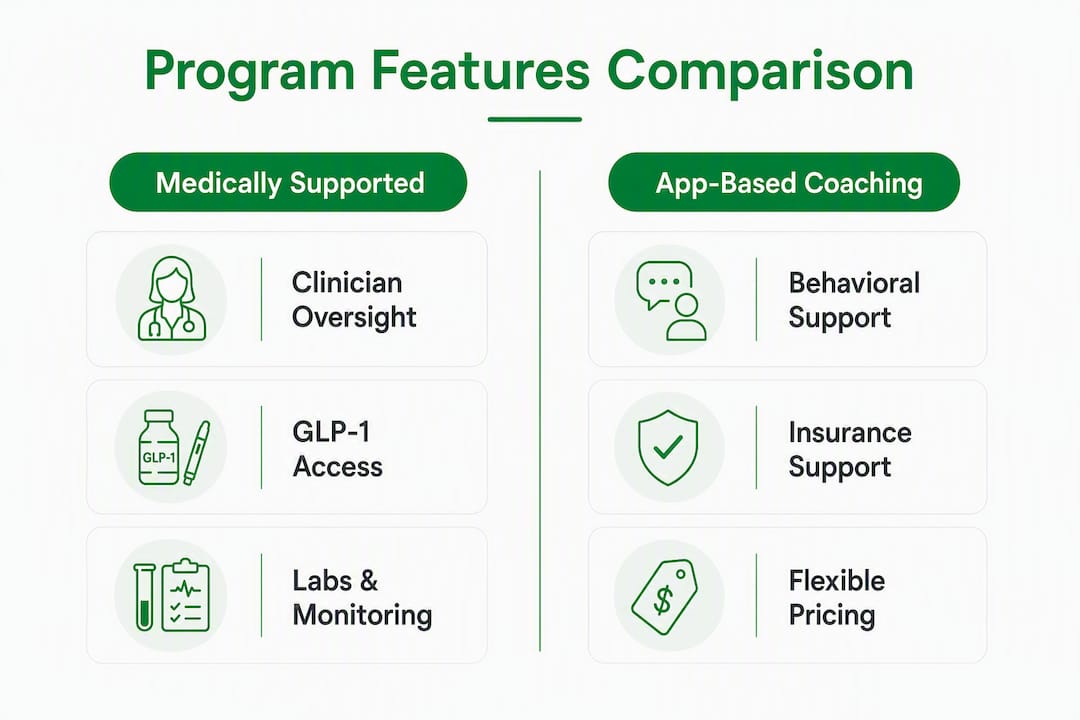
Trust signals worth noting: Programs at the top of this list require board-certified clinician oversight, baseline bloodwork before any prescription, and published clinical outcome ranges. High-touch models that combine medication access with nutrition coaching and lab monitoring consistently show better long-term adherence than automated, questionnaire-only services. AM Rx, Found, Noom Med, Calibrate, and Ro Body all require labs before prescribing; TOPS Club, Noom Weight, Cleveland Clinic Diet App, and Jenny Craig operate without medication or clinical oversight.
Understanding the standard clinical workflow helps you spot programs that cut corners. Here is what a legitimate medically supervised program looks like from intake to ongoing care.
The patient journey, step by step:
The difference between a legitimate program and a low-touch imitator often comes down to steps 3 and 6. High-quality medical programs require blood work and a thorough health history review rather than relying solely on automated questionnaires before prescribing. If a program skips the lab step or has no structured titration cadence, that is a clinical gap, not a convenience feature.
Pro Tip: When you first contact any program, ask for the specific lab panel they require before prescribing and the follow-up visit cadence during the first 90 days. A program that cannot answer both questions clearly is not delivering real medical supervision.

Every program in this guide was assessed against nine criteria. Safety and clinician oversight carried the highest weight; pricing transparency and trial availability carried the lowest.
Editorial disclosure: This article is published by AM Rx. AM Rx appears as the first entry in the comparison because it is the publisher’s own offering and because its integrated lab-driven workflow, insurance concierge, and clinician-managed GLP‑1 prescriptions align most closely with the criteria that scored highest in this evaluation. All other programs are assessed on their publicly available features and published clinical frameworks. No program was paid to appear here.
Pro Tip: When reading any weight-loss program comparison, check whether the publisher discloses a commercial relationship with any listed program. Transparency on this point is itself a trust signal.
AM Rx’s weight-loss program is built around clinician-managed GLP‑1 prescription evaluation, lab integration, and insurance concierge support. A licensed provider conducts a video consult, reviews your labs, and manages your prescription and titration. Insurance handling is part of the service, which matters because prior authorization for GLP‑1 medications is one of the most common friction points patients hit.
During the first 60–90 days, you can expect an intake consult, baseline labs, a prescription if clinically appropriate, and follow-up titration visits on a structured cadence. Same-day appointments are available. The program covers weight loss alongside other telehealth services (mental health, primary care, ED), so continuity of care is built in.

Best for: Adults who want a single platform for clinician-managed GLP‑1 prescriptions, lab oversight, and insurance support.
Found operates as a telehealth-first platform combining medication access with app-based behavioral coaching. Clinicians (MD/NP) conduct intake consults and require labs before prescribing. The app delivers coaching content between visits. Found’s strength is the medication-plus-coaching pairing in one subscription; its limitation is that the behavioral component is app-driven rather than one-on-one with a dietitian.
Best for: People who want medication access and structured app coaching without needing intensive one-on-one clinical coaching.
Noom Med layers clinical medication access on top of Noom’s well-established psychology-based curriculum. Eligible patients can access GLP‑1 prescriptions through a clinician, while the core program remains habit formation and cognitive behavioral techniques. Labs are required for the medication track. If you are drawn to Noom’s behavioral approach but want the option of medication support, Noom Med is the natural fit.
Calibrate positions itself as a metabolic-reset program, with a structured 12-month curriculum, clinician oversight, and required labs. The coaching is more intensive than most app-based competitors, and the program explicitly targets metabolic health rather than just the number on the scale. The tradeoff is cost: Calibrate sits at the higher end of the subscription price range.
Teladoc is a large telehealth network rather than a dedicated weight-loss program. Clinician quality and monitoring cadence vary by provider within the network. For patients who already use Teladoc for primary care and want to add weight-loss support, it is a convenient extension. For someone building a weight-loss plan from scratch, a dedicated program with a defined clinical protocol is a stronger starting point.
WeightWatchers runs two distinct tracks. The WW Points Program is the long-standing behavioral and nutrition model built around food tracking and group coaching, with decades of outcome data behind it. WeightWatchers Clinic is the newer telehealth-medication track, where an MD or NP can prescribe GLP‑1 medications with required labs. The two tracks can be combined. WW’s community infrastructure and behavioral evidence base are genuine strengths; the medication track is newer and less differentiated from competitors.
Ro Body offers telehealth medication access with app-based support and required labs before prescribing. The platform is clean and convenient, and home delivery is standard. Ro’s clinical depth is comparable to Found; the programs are similar enough that the choice often comes down to app preference and pricing.
The Mayo Clinic Diet is a physician and dietitian-developed program focused on long-term lifestyle sustainability. It offers specialty tracks for diabetes and heart disease, a GLP‑1 support track, personalized meal plans, and digital behavior tools. It does not prescribe medication directly. For adults who want a clinic-developed, evidence-based lifestyle program without a medication pathway, it is one of the strongest options available.
The CDC-recognized NDPP is a structured lifestyle-intervention program targeting adults at risk for type 2 diabetes. It is delivered by trained coaches in group settings (in-person or online), focuses on modest weight loss (5–7% of body weight) and physical activity, and is often covered by insurance or Medicare. No medication is involved. For people with prediabetes or metabolic risk, it is one of the most evidence-backed options in existence.
TOPS (Take Off Pounds Sensibly) is a nonprofit peer-support organization with weekly in-person and virtual meetings. There is no clinical oversight, no medication, and no prescribed meal plan. The value is accountability and community at a very low membership cost. TOPS is not a medical program, but for people who respond well to peer accountability and cannot afford subscription-based platforms, it fills a real gap.
Noom Weight is the non-medication version of the Noom platform: a psychology-based app curriculum focused on habit formation, food psychology, and behavior change. No clinician oversight, no medication. It works well for people who want structured coaching and are not candidates for or interested in medication.
The Cleveland Clinic Diet App delivers nutrition guidance and meal planning backed by the Cleveland Clinic’s clinical framework. It is a digital lifestyle tool, not a medical program. No prescriptions, no labs. Useful for people who want health-system credibility behind their nutrition plan.
Jenny Craig is a structured meal-plan service with one-on-one coaching and pre-packaged food. No medical oversight, no medication. The convenience of pre-planned meals is the main draw. Jenny Craig has gone through significant business changes in recent years, so confirm current availability and program structure before signing up.
Pro Tip: Programs without any clinical oversight (TOPS, Noom Weight, Cleveland Clinic Diet App, Jenny Craig) can be useful complements to a medically supervised program, but they should not be your primary plan if you are considering GLP‑1 medication.
The decision comes down to three variables: whether you want medication, how much clinical oversight you need, and what you can realistically afford.
Decision checklist:
Questions to ask during sign-up:
Red flags to walk away from:
Matching goals to programs:
GLP‑1 medications produce typical weight reductions of 10–20% of body weight in clinical outcomes, with results varying based on medical history, the specific medication, dose achieved, and adherence. That is a meaningful range: for a 200-pound adult, it translates to 20–40 pounds. Lifestyle-only programs without medication typically produce weight loss of around 5–10% of body weight, which is still clinically significant for metabolic health.
Common side effects of GLP‑1 medications:
What good monitoring looks like:
Contact your clinician promptly if you experience severe abdominal pain, persistent vomiting, signs of low blood sugar, or any symptom that feels out of proportion to what was described at intake. Go to an emergency room for chest pain, difficulty breathing, or severe allergic reactions.
Pro Tip: Before starting any GLP‑1 program, ask for a written care plan that specifies your titration schedule, the labs that will be run and when, and the protocol for side-effect management. If the program cannot provide this in writing, that is a clinical gap.
Pricing for medically supervised programs has three layers: the subscription or membership fee, the per-visit or consult fee, and the medication cost. These are often bundled differently, which makes direct comparison harder than it looks.
Common pricing shapes:
Approximate monthly cost ranges (program fees only, before medication):
| Program tier | Typical monthly program fee |
|---|---|
| Peer / lifestyle (TOPS, Noom Weight) | $0–$50 |
| App-based with coaching (Mayo Clinic Diet, Cleveland Clinic Diet App) | $20–$50 |
| Telehealth medication programs (AM Rx, Found, Ro Body, Noom Med) | $100–$150 |
| Intensive structured programs (Calibrate) | $150–$200+ |
Medication costs are the largest variable. GLP‑1 medications at list price can run several hundred dollars per month without insurance. With commercial insurance coverage, copays vary widely. CMS has announced plans to provide $50 monthly access to GLP‑1 medications for Medicare beneficiaries, which will significantly change the cost picture for eligible adults.
Ways to reduce out-of-pocket costs:
Medically supervised online weight-loss programs that require baseline labs, licensed clinician oversight, and a defined titration schedule consistently outperform automated, questionnaire-only platforms on both safety and long-term adherence.
| Point | Details |
|---|---|
| Labs before prescribing | Any program prescribing GLP‑1 medications without baseline bloodwork is skipping a critical safety step. |
| Clinician-managed titration | GLP‑1 dose titration visits every 2–4 weeks early in treatment improve adherence and manage side effects. |
| Expected outcomes | GLP‑1 medications typically produce 10–20% body weight reduction; lifestyle-only programs typically produce weight loss of around 5–10%. |
| Total cost calculation | Add program fees, per-visit costs, and medication costs together; per-visit models can escalate faster than subscriptions. |
| AM Rx | AM Rx combines clinician-managed GLP‑1 prescriptions, lab integration, and insurance concierge support in one telehealth platform. |
Pro Tip: Ask any program you are considering about its data privacy policy before sharing health information. Look for HIPAA compliance and clear language on whether your data is shared with third parties.
Most weight-loss content online treats medication as the whole story. It is not. The medication is a tool; the clinical infrastructure around it is what determines whether you use it safely and whether you keep the weight off.
What gets underestimated consistently is how much the titration phase matters. GLP‑1 medications work best when a clinician is actively adjusting the dose based on your tolerance and response, not when you are left to manage side effects on your own between automated check-ins. The programs that build titration visits into their standard cadence, require labs, and have a real clinician reviewing your case are delivering something categorically different from the ones that hand you a prescription after a five-minute questionnaire.
The insurance piece is also more important than most people realize. Prior authorization for GLP‑1 medications is a genuine barrier, and programs with concierge support handle it in ways that save patients weeks of frustration. That is not a minor convenience feature; for many patients, it is the difference between starting treatment and not.
Lifestyle-only programs have real value, particularly for people at metabolic risk who are not candidates for medication. The CDC’s chronic disease prevention framework and the NDPP are evidence-backed and often covered by insurance. They belong in this conversation. But for adults who are candidates for GLP‑1 therapy, a program that combines medication access with genuine clinical oversight is the stronger choice.
Skipping the waiting room does not mean skipping the clinical rigor. AM Rx delivers licensed clinician visits, GLP‑1 prescription evaluation, lab integration, and insurance concierge support through a single telehealth platform. You get a real provider reviewing your labs and managing your prescription, same-day appointments when you need them, and medication delivered to your door.

During your first 90 days, you complete an intake consult, get baseline labs reviewed by your clinician, receive a prescription if appropriate, and follow a structured titration schedule. Insurance handling is part of the service, so prior authorization does not fall entirely on you.
Disclosure: This article is published by AM Rx. AM Rx appears first in the comparison because it is the publisher’s own offering and because its clinical model aligns most closely with the evaluation criteria used in this guide.
Start your weight-loss consult with AM Rx or complete your telehealth consent to begin the intake process today.
The claims in this guide draw on the following primary and clinical sources:
A note on evidence: Clinical outcome data for individual telehealth programs varies in quality and availability. Where a program has not published peer-reviewed outcomes, profiles in this guide rely on publicly available program descriptions and clinical frameworks. Readers should ask programs directly for their outcome data before enrolling.
AM Rx is a strong option for adults seeking clinician-managed GLP‑1 prescriptions with lab integration and insurance concierge support. Found, Noom Med, Calibrate, and Ro Body are also legitimate medically supervised options that require labs before prescribing.
Programs with the strongest clinical evidence combine licensed clinician oversight, required baseline labs, GLP‑1 medication access, and behavioral coaching. GLP‑1 medications produce 10–20% body weight reduction in clinical outcomes; lifestyle-only programs typically produce weight loss of around 5–10%.
The Mayo Clinic Diet and the CDC-recognized National Diabetes Prevention Program are the strongest evidence-backed options for lifestyle-first weight management without medication, particularly for adults with metabolic risk or diabetes concerns.
Per-visit pricing models can look inexpensive upfront but escalate when you add frequent titration visits and full medication costs. Calculate the total expected monthly spend across program fees, visit fees, and medication before comparing programs on price alone.
This guide is general information for comparison purposes, not personalized medical advice. Confirm your eligibility for any medication and review your specific health history with a licensed clinician before starting a weight-loss program.