TL;DR
- Licensed telehealth platforms including AM Rx prescribe Zepbound (tirzepatide) when it's medically appropriate and will submit claims and prior authorizations to your plan. Many popular GLP-1 sites are cash-pay only, so confirm before you enter a card number.
- Whether your Zepbound is covered depends on your employer's plan design and your documented diagnosis, not on which clinic writes the prescription. No provider can override a plan exclusion.
- Prior authorization is the default for GLP-1s. Plan on a few business days to roughly two weeks for a decision.
- A denial isn't the end: appeal with added clinical notes, ask about a covered alternative, or price a flat-fee cash program against what your deductible would cost you anyway.
- Local pickup only beats delivery when your pharmacy actually has your dose on the shelf, which with GLP-1s has been a coin flip in a lot of markets.
Yes, you can get a Zepbound prescription online, and yes, a real subset of telehealth clinics will bill your insurance and fight a prior authorization for you instead of steering you straight to a monthly subscription. The trap is that "prescribes Zepbound" and "gets your plan to pay for Zepbound" are two very different promises. Almost every frustrated patient we talk to confused the two somewhere along the way.
Table of Contents
- Which online clinics prescribe Zepbound and bill insurance?
- How do you get Zepbound online with insurance covering it?
- What do people miss about insurance and Zepbound?
- Does insurance actually cover Zepbound for weight loss?
- What happens if your insurance won't cover Zepbound?
- Does picking up at CVS or Walgreens get you treatment faster?
- Your next step
- Frequently asked questions
Which online clinics prescribe Zepbound and bill insurance?
The ones that bill insurance are staffed by licensed physicians, nurse practitioners, or PAs who can document medical necessity in a chart note and submit claims through your pharmacy benefit. That's a smaller group than the number of sites advertising GLP-1s. AM Rx's weight loss program runs on that model. You complete an intake, a provider reviews your history and BMI, and if Zepbound or another GLP-1 fits, we submit through your insurance when you have coverage or quote you self-pay pricing when you don't.
Plenty of the brands you've seen advertised during a podcast ad break are subscription-only by design. That's fine if you've budgeted for it. It's a waste if your employer plan already covers Zepbound and all you needed was someone to code the claim correctly. Our breakdown of the best telehealth providers in the US sorts out which ones lean cash-pay versus insurance-friendly.

How do you get Zepbound online with insurance covering it?
The sequence is predictable. Nearly every delay we see traces back to a skipped step, not to the prescription itself.
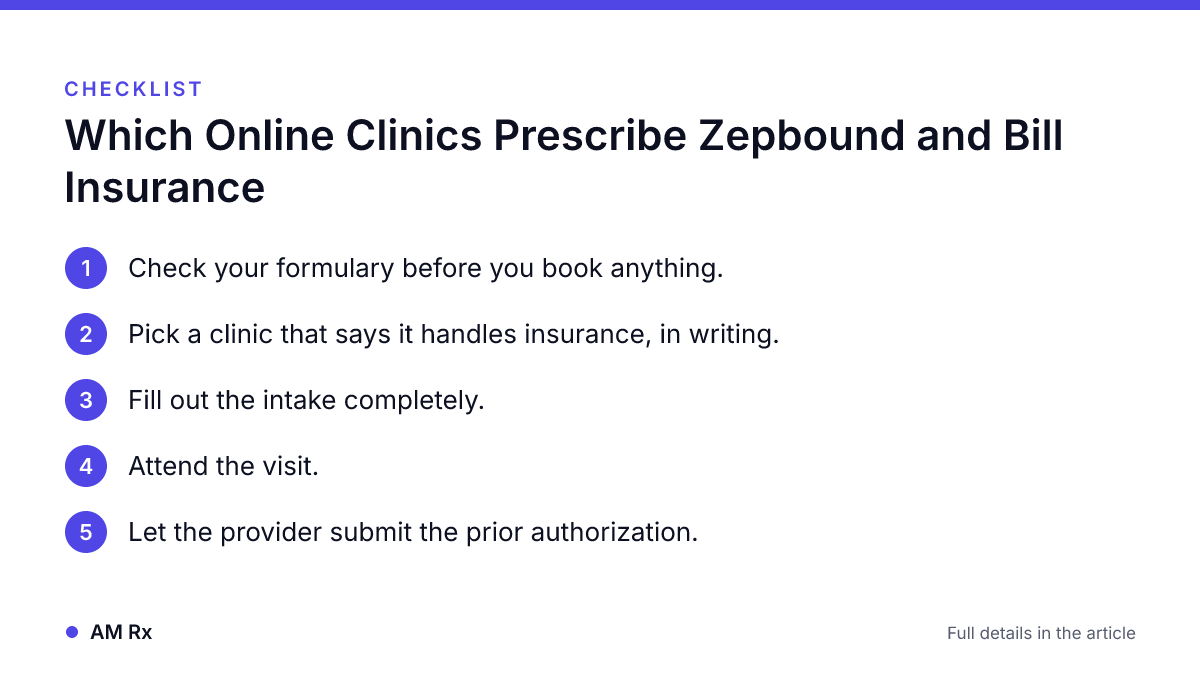
- Check your formulary before you book anything. Log into your insurance portal, or call the member services number on your card, and ask two questions: is Zepbound on the formulary, and does it require prior authorization or step therapy? A five-minute call saves weeks. A provider cannot change what your plan already decided to exclude.
- Pick a clinic that says it handles insurance, in writing. Look for explicit language about accepting insurance, submitting prior authorizations, or billing claims. AM Rx accepts both insurance and self-pay so patients aren't forced down one path.
- Fill out the intake completely. Your BMI, weight-related conditions like sleep apnea, prediabetes, or hypertension, and your history of prior weight-loss attempts all feed the medical-necessity documentation. Thin answers here are the most common reason a prior authorization comes back denied.
- Attend the visit. A provider confirms Zepbound is appropriate, sets your starting dose, and walks through side effects. It's usually under 20 minutes and often happens the same day you sign up.
- Let the provider submit the prior authorization. Your clinic sends clinical notes and diagnosis codes to the insurer. Then you wait, typically a few business days, sometimes closer to two weeks with slower plans.
- Decide where it gets filled. Local pickup or mail-order. If you've watched a CVS pharmacy line crawl forward one person in fifteen minutes, or driven over only to find the CVS pharmacy hours on the door don't match the ones online, you already understand why a lot of patients default to shipping.
- Stay in contact between refills. Zepbound titration is gradual, and nausea, constipation, and fatigue tend to show up in the first few weeks. Message your care team instead of booking a whole new appointment every time something feels off.
Pro tip: Download your plan's prior authorization criteria sheet before your visit and send it to the clinic with your intake. When our team can mirror the insurer's own language and attach the exact documentation it asks for, approvals come back faster. Vague submissions get kicked back for "additional information," and that round trip alone can cost you a week.
What do people miss about insurance and Zepbound?
Even patients who do everything right get caught by details that never make it into the marketing copy.
- "Covered" doesn't mean cheap. Formulary placement only makes the drug eligible. Your actual cost rides on your deductible, your copay tier, and whether you've hit your out-of-pocket maximum.
- Weight-loss exclusions are common and usually locked for the plan year. Some employers carve out anti-obesity medications entirely. Documentation doesn't matter in that case, and no clinic can override it.
- Quantity limits quietly shrink your supply. A plan can approve Zepbound and still cap pens per month below what your titration schedule calls for, which means a second conversation between your provider and the pharmacy.
- Compounded tirzepatide is a different product than Zepbound. It's not FDA-approved Zepbound and it generally isn't billed through insurance the same way. Ask directly which one you're being prescribed and get the answer in writing.
- Changing pharmacies after approval can reset the clock. Some prior authorizations are tied to a specific dispensing pharmacy. Lock your choice in before the PA goes in, not after.
Pro tip: If you get denied, request the actual denial letter rather than relying on what the phone rep tells you. The letter names the specific criterion you failed, and that single line tells your provider exactly what to add to the appeal. Nine times out of ten it's a missing comorbidity diagnosis or no documented history of prior weight-management attempts.
Does insurance actually cover Zepbound for weight loss?
Sometimes. It depends on your plan far more than on your doctor. In our experience, plans that cover GLP-1s for weight management look for a BMI of 30 or higher, or 27 or higher with a weight-related condition, plus some record that you've tried lifestyle changes. Even when you clear those, prior authorization is still usually required.
Here's how to run the math on your own plan. Three inputs: your plan's negotiated monthly price for Zepbound, your remaining deductible, and your coinsurance percentage.
Say the negotiated price is $700 a month, you have $1,200 of deductible left, and your coinsurance is 20%. These are round placeholder numbers, so swap in yours from the insurer portal.
- Month 1: you pay the full $700, which leaves $500 of deductible.
- Month 2: $500 finishes the deductible, then 20% of the remaining $200 is $40. You pay $540.
- Month 3 onward: $700 × 0.20 = $140 a month.
- First-year total: $700 + $540 + ($140 × 10) = $2,640.
Now compare that $2,640 against twelve months of a flat cash-pay program. If the cash number comes in lower, coverage isn't worth the prior-authorization wait and you should start treatment this week. If it comes in higher, the two-week approval wait is worth sitting through. That's the whole decision.
| Coverage path | What it involves | Typical wait to start | What drives your cost |
|---|---|---|---|
| Insurance covered, PA approved | Chart notes and diagnosis codes submitted to the plan | Few days to about two weeks | Deductible remaining and coinsurance rate |
| Denied, appeal in progress | Resubmission with the missing criterion documented | Add roughly two to four more weeks | Full negotiated price if you keep filling |
| Cash-pay program | No PA, prescription written at the visit | Same week | Flat program fee quoted before you commit |
| Compounded alternative | Different product, billed as compounded, not as Zepbound | Same week | Clinic pricing, typically under brand cash price |
What happens if your insurance won't cover Zepbound?
Three real options: appeal, switch to something your plan does cover, or pay cash.
Appeals win more often than people assume, and they win on specifics. Adding a sleep apnea diagnosis from a sleep study, a documented A1c in the prediabetic range, or a dated record of a supervised diet attempt turns a lot of denials into approvals on resubmission. If the first-level appeal fails, ask your provider about a peer-to-peer review, where your prescriber talks directly to the insurer's medical reviewer. It's a phone call most patients never know to request.
Also ask about manufacturer copay savings programs before you give up. Eligibility rules usually exclude anyone on government insurance like Medicare or Medicaid, so they don't help everyone, but they're worth a two-minute check.
If none of that lands and you want to start now, self-pay through a telehealth clinic like AM Rx bundles medication, visits, and coaching into one predictable number rather than a pharmacy price that moves between refills.
Does picking up at CVS or Walgreens get you treatment faster?
Usually not. Local pickup is only faster when the pharmacy has your specific dose in stock, and with GLP-1s that's been unreliable in a lot of markets for a while now. A Walgreens pharmacy short on the 5 mg pen can mean calling three stores before you find one, and we cover that scenario in our post on what to do when your Walgreens pharmacy is closed or out of stock.
Same story at CVS pharmacy counters, where queue times and inconsistent CVS pharmacy hours between nearby locations add friction that mail delivery doesn't have. Our cornerstone piece on CVS pharmacy waits versus getting your prescription online breaks down the full tradeoff.
One practical move: when a dose is backordered locally, ask your provider to send a new script to a mail pharmacy rather than waiting for the original to be released. Transferring a controlled-timeline prescription between pharmacies is slower than writing a fresh one.
If you want to weigh more than one platform, compare at least two on the same three questions: do they bill insurance, do they submit the prior authorization themselves, and is the cash price quoted as a flat monthly figure before you sign up.
Your next step
Open your insurance portal and check Zepbound's formulary status right now. That one answer decides whether your path runs through prior authorization or straight to self-pay, and it takes less time than reading this article did. Then start an intake with AM Rx and bring that answer with you. A provider can often review your case the same day, and our team handles both the insurance billing and the cash pricing depending on what you qualify for.
Frequently asked questions
Can I switch from a compounded GLP-1 to brand-name Zepbound later?
Yes. Most providers can transition you from compounded tirzepatide or semaglutide to brand-name Zepbound once it's available and covered. Your dose may need adjusting, since compounded concentrations don't always match the brand pen one-to-one. Coordinate it with your care team instead of restarting on your own.
Will my employer know I'm being prescribed Zepbound?
No. Prescription and visit information from telehealth is protected the same way it is at an in-person clinic. Your insurer processes the claim, not your HR department, and employers don't receive medication-level detail about individual employees.
How long does a Zepbound prior authorization stay valid once approved?
Most approvals run through the plan year and need resubmission annually. Some plans want a renewal sooner if your dose changes meaningfully. Check the expiration date printed on your approval letter and set a calendar reminder a month out so a refill doesn't stall.