TL;DR
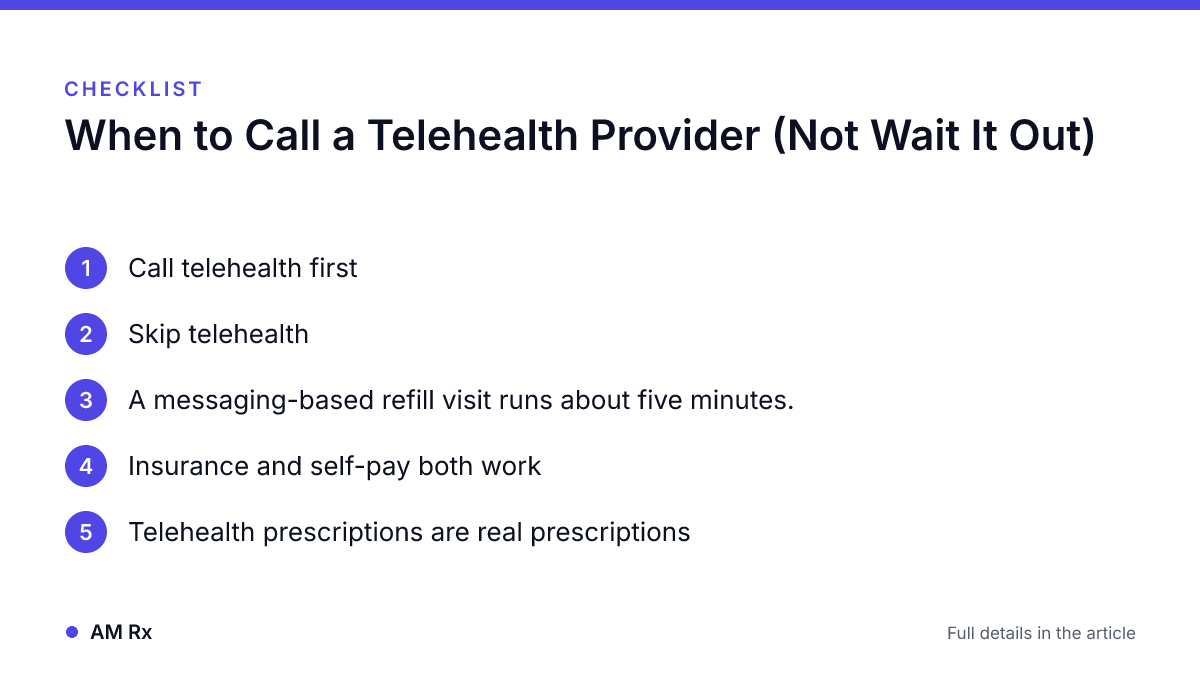
- Call telehealth first for ongoing prescriptions (birth control, ED meds, hair loss, GLP-1 refills), new but non-emergency symptoms (anxiety, acne, signs of low testosterone), and any refill where the pharmacy trip costs more time than the visit.
- Skip telehealth for chest pain, trouble breathing, stroke symptoms, severe allergic reactions, or any injury needing a hands-on exam, imaging, or stitches. Urgent care or the ER, not a video call.
- A messaging-based refill visit runs about five minutes. A same-day video visit, in our experience, rarely crosses 30 minutes. A same-day in-person appointment eats 45 to 90 minutes once you count drive time and the waiting room.
- Insurance and self-pay both work on most telehealth platforms, AM Rx included, so cost isn't a good reason to default to an office visit.
- Telehealth prescriptions are real prescriptions, sent electronically to your pharmacy or shipped to your door with a licensed provider's name on them.
Call a telehealth provider the moment your issue can be assessed through conversation, photos, or a questionnaire instead of hands-on exam. Refills. Ongoing conditions. Mental health check-ins. New symptoms that built up slowly rather than hitting you at once.
Go in person when something needs a physical exam, labs drawn on-site, or emergency intervention.
The extremes are easy. Everyone knows a broken arm needs a doctor's hands and a sniffle probably doesn't. The hard part is the enormous middle: the birth control refill you keep pushing to next week, the ED conversation you've been circling for six months, the three weeks of flat mood that haven't quite tipped into "something's wrong." That middle is where telehealth earns its keep.
Table of Contents
- When should you actually call a telehealth provider?
- Does telehealth only work for minor, non-urgent issues?
- Can you get a real prescription without seeing someone in person?
- Will telehealth cost more than walking into CVS or Walgreens?
- When should you skip telehealth and go in person or to the ER?
- How does an AM Rx visit actually work?
- Frequently asked questions
When should you actually call a telehealth provider?
Call telehealth any time your situation is about management rather than emergency. That covers far more health needs than most people assume: refilling a maintenance medication, starting treatment for a condition you already know you have, or getting a professional read on symptoms that have been building gradually.
Here's the shorthand we give patients:
- Your prescription ran out. It expired, you lost the bottle, or your pharmacy told you to "call your doctor" and your doctor's next opening is three weeks out.
- You already know the diagnosis. Acne, rosacea, hair thinning, anxiety, low libido. You need treatment or a dose adjustment, not a workup from scratch.
- You want to start a GLP-1 weight loss program and would rather answer a health questionnaire from your couch than sit in a waiting room for a 12-minute visit.
- The subject is private. ED, birth control, testosterone support. Skipping the in-person awkwardness usually means patients tell us the truth the first time, and honest answers produce better care.
- Your pharmacy is having a bad day. If you've shown up to find the counter 14 people deep or the pharmacist out sick, you already know a phone call won't fix it. A different channel will. Our piece on CVS pharmacy waits vs. getting your Rx online breaks down what that detour usually costs you.
Pro tip: If you can't tell whether your situation qualifies, the intake questionnaire does the triage for you. It takes about five minutes, and platforms like AM Rx will route you toward in-person care if your answers point that way.
Does telehealth only work for minor, non-urgent issues?
No, and that belief is a few years out of date. Virtual care now handles ongoing management of chronic and semi-chronic conditions: GLP-1 weight loss programs with coaching, enclomiphene for testosterone support, treatment for anxiety and depression, primary care check-ins. Not just sore throats and rashes.
The myth stuck because telehealth entered most people's lives in 2020 for exactly the minor-stuff use case. Pink eye. Quick refills during lockdown. That first impression outlasted the reality.
What's actually changed is the workflow around the visit. Skin conditions get assessed from photos, and a good provider will tell you how to take them: natural light, no filters, one close-up and one wider shot so they can see distribution, not just a single lesion. Labs don't disappear either. For testosterone support, you get an order for a morning draw at a local lab, and you discuss the results over message instead of burning another appointment slot to hear three numbers read aloud. GLP-1 titration is the clearest case of all. Dose changes, nausea management, and injection-site questions are conversations, and conversations don't require a parking space.
If your condition is one you'd normally manage with periodic check-ins and prescription adjustments rather than a procedure, there's a strong chance it belongs online now.
Can you get a real prescription without seeing someone in person?
Yes. This myth delays more care than any other on the list. A licensed provider who reviews your health history, asks the right questions, and determines a medication is medically appropriate can prescribe it whether you're across a desk or on a video call. The standard is the provider's clinical judgment, not the furniture in the room.
People assume otherwise because controlled substances do get more scrutiny online, and that part is legitimate. Certain medications require extra verification or an initial in-person component depending on the state. But most of what drives people to telehealth sits outside that category: birth control, ED treatment, hair loss medication, GLP-1s, acne and rosacea treatment.
When treatment is appropriate, AM Rx sends the prescription straight to your pharmacy or ships it to your door, and you keep messaging your care team between follow-ups instead of rebooking every time a dose needs tweaking.
Pro tip: If a platform can't explain why a specific medication needs an in-person visit, push back. An honest answer points to a named regulation or a state rule. A vague answer about liability usually means nobody there knows.
Will telehealth cost more than walking into CVS or Walgreens?
Usually not, and often it's cheaper once you price your own time. Telehealth platforms including AM Rx accept both insurance and self-pay, so the cost structure looks a lot like an office visit. You're paying for a provider's time and judgment either way.
The myth comes from comparing the wrong two things: a $4 generic at the pharmacy counter versus a telehealth subscription. That skips the part where you had to obtain the prescription in the first place. If your doctor's next opening is in three weeks, or your Walgreens pharmacy closed early and you're standing at locked doors with an empty bottle, the cheap option just cost you a missed dose or an urgent care copay.
So run the time math. The formula is simple: minutes spent, divided by 60, times what an hour of your time is worth.
Say your time is worth $25 an hour.
- In-person refill trip: 15 minutes of driving each way plus a 20-minute wait at the counter is 50 minutes. $25 × (50 ÷ 60) = $20.83.
- Online refill by message: 5 minutes for a first-time intake, closer to 2 for a returning patient messaging their care team. Call it 5 minutes. $25 × (5 ÷ 60) = $2.08.
That's $18.75 per refill, before gas, parking, or the afternoon you lose when the counter tells you insurance needs a prior authorization nobody can start until tomorrow. On a monthly prescription, $18.75 × 12 = $225 a year in time alone.
Rule of thumb: if your round-trip pharmacy errand runs over 30 minutes and you refill monthly, moving that prescription online pays for itself on time value well before you compare copays.
Here's how the three options stack up, based on what we see patients report:
| Factor | Same-day telehealth visit | Scheduled in-person visit | Urgent care / ER |
|---|---|---|---|
| Typical time commitment | 5 to 30 minutes, no travel | 45 to 90 minutes with drive and wait | 1 to 4 hours or more |
| Best for | Refills, ongoing conditions, non-urgent new symptoms | Physical exams, bloodwork, complex new diagnoses | Chest pain, severe injury, breathing trouble |
| Cost structure | Insurance or self-pay, often close to an office copay | Insurance copay or self-pay office rate | Highest of the three, ER especially |
| Prescription turnaround | Often same day, to your pharmacy or shipped | Same day to a few days | Same day, limited to the urgent problem |
| Follow-up access | Ongoing messaging with your care team | Requires booking a new appointment | Not built for ongoing care |
When should you skip telehealth and go in person or to the ER?
Go in person immediately for chest pain, trouble breathing, a sudden severe headache, signs of stroke, uncontrolled bleeding, or a severe allergic reaction. Those need hands, equipment, and imaging no camera can supply. Telehealth is built for conversation-based medicine. A good telehealth provider will say so plainly instead of trying to talk you through something that requires a physical exam.
A few more situations where in-person wins:
- New, severe, or rapidly worsening pain anywhere in the body that hasn't been evaluated before.
- Suspected fractures, deep cuts, or injuries that need imaging, stitches, or a splint.
- Fever with confusion or new disorientation, which can escalate quickly and needs bloodwork or IV treatment.
- Mental health crises involving thoughts of self-harm. Call 988 or go to an emergency room. This is not a scheduled follow-up message.
Pro tip: Use a two-question test. Can this be assessed by talking and looking at photos? Is it stable enough that waiting a few hours wouldn't change the outcome? Two yeses mean telehealth is a reasonable starting point. One no means go in.
How does an AM Rx visit actually work?
Figure five minutes to get started. Create an account, answer questions about your health history and your current concern, then choose a same-day or scheduled visit. If treatment is medically appropriate, the prescription goes to your door or your local pharmacy, and you keep messaging your care team for follow-ups instead of restarting the whole process.
Two things that make these visits go faster, learned the hard way: have your current medication names and doses in front of you, including supplements, and know which pharmacy you actually use. "The CVS near my house" is not an address, and chains cluster. Patients who can name the cross street get their prescription routed correctly the first time.
AM Rx covers the conditions people most often put off dealing with: GLP-1 weight loss programs with coaching, birth control prescriptions and refills, erectile dysfunction treatment, enclomiphene for testosterone support, hair loss treatment, skincare for acne, rosacea, and hyperpigmentation, primary care, and mental health care for anxiety and depression. If your concern falls outside that list, go find a platform that specializes in it. There's no prize for forcing every health concern through a single brand.
Frequently asked questions
Can I use telehealth and my regular doctor at the same time?
Yes. Most telehealth platforms will send records or visit summaries to your primary care provider on request, and nothing stops you from using both. Plenty of patients run ongoing prescriptions and specific concerns through telehealth while keeping an in-person doctor for annual physicals and anything requiring imaging.
Does my insurance cover telehealth the same way it covers in-person visits?
That depends on your plan, and plans vary more than people expect. Many insurers now reimburse telehealth visits at rates similar to office visits, but the only reliable answer comes from your own coverage. AM Rx accepts insurance and self-pay, so you can check during signup instead of guessing.
What happens if a telehealth provider says I need to be seen in person?
They tell you directly and point you to urgent care, an ER, or a specialist. That's the system working. A platform willing to turn away a visit it shouldn't handle is one practicing good medicine, not one failing at telehealth.
Next time you catch yourself skipping a refill because the pharmacy line looked brutal, or sitting on a symptom because booking an appointment felt like a project, put five minutes into the AM Rx intake instead. Worst case, they send you in person. Best case, your prescription is already moving before you'd have found parking.