TL;DR
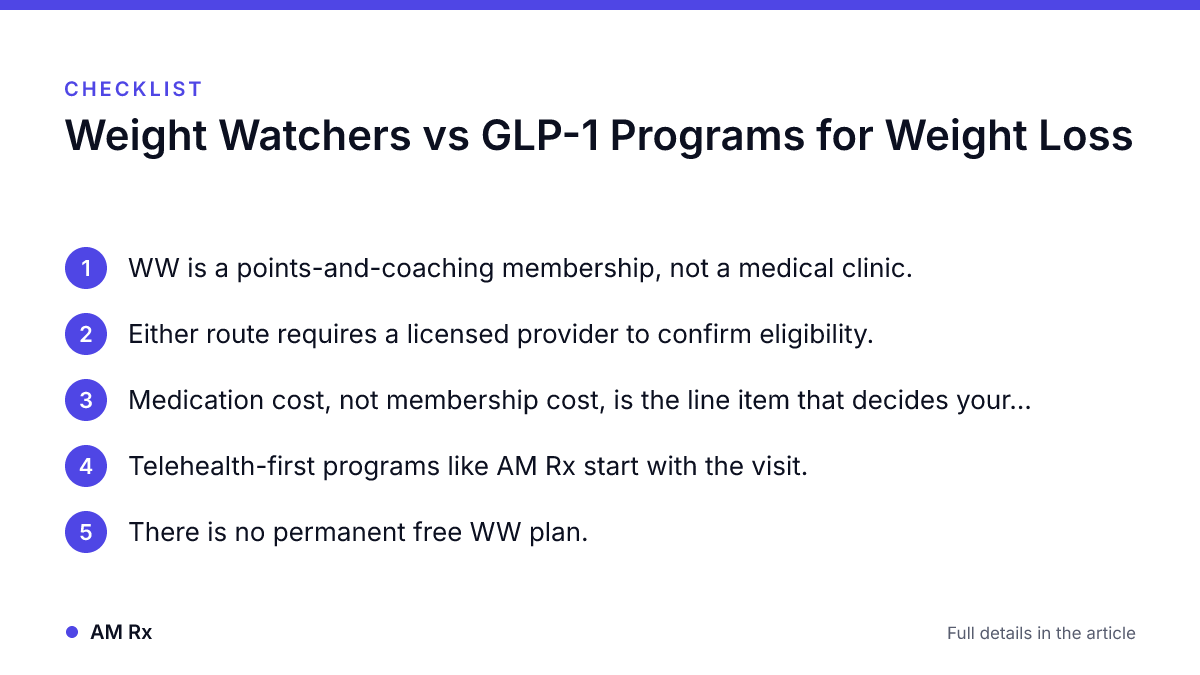
- WW is a points-and-coaching membership, not a medical clinic. The core product tracks food and behavior; prescriptions come through a separate clinical tier.
- Either route requires a licensed provider to confirm eligibility. The common threshold across weight-management programs is a BMI of 30 or higher, or 27 or higher with a weight-related condition like hypertension or type 2 diabetes.
- Medication cost, not membership cost, is the line item that decides your budget. Separate "access fee" from "medication price" in both quotes before you compare anything.
- Telehealth-first programs like AM Rx start with the visit. Same-day provider appointment, a prescription decision, and ongoing messaging with your care team, with no membership tier to climb first.
- There is no permanent free WW plan. Trial periods, employer wellness benefits, and some insurance-sponsored access exist, but you have to confirm current terms directly.
Weight Watchers built its name on points, meetings, and weekly weigh-ins long before "GLP-1" meant anything outside an endocrinology office. A GLP-1 program is built around three things instead: a licensed provider, a prescription, and a medication that changes how hungry you feel. Comparing them head to head is a little like comparing a gym membership to a cardiologist. One is structure. The other is treatment. Plenty of people end up using both.
Table of Contents
- What is the downside of Weight Watchers?
- How to get Weight Watchers for free?
- How does Weight Watchers' GLP-1 program actually work?
- How do Weight Watchers and telehealth GLP-1 programs compare on cost and process?
- What does a GLP-1 program actually cost per month?
- Is a GLP-1 program better than Weight Watchers' points system?
- What should you do if Weight Watchers hasn't worked for you?
- Frequently asked questions
What is the downside of Weight Watchers?
The core limitation is that WW is a behavior system, so it has a ceiling for anyone whose weight is driven by hormones, insulin resistance, or medication side effects rather than portion sizes. Points work beautifully as a portion-control framework for some people. They do nothing about an undertreated thyroid. U.S. News' WW diet review makes a similar point in gentler language: results track closely with how engaged the member stays, and the plan functions best as part of broader health management rather than the whole of it.
What we hear most often from patients who come to us after WW:
- Subscription stacking. Base membership, then the clinic tier if you want medication access. The second fee tends to surface after you're already invested in the first.
- No medical evaluation built in. A standard membership won't screen for PCOS, hypothyroidism, or the antidepressant that quietly added 15 pounds over two years.
- Slow response at higher BMIs. In our experience, patients starting in the mid-30s BMI range who have already done structured food tracking rarely get a different outcome by doing it more carefully.
- Accountability moved to a screen. Members who built their routine around live meetings often lose the part that was actually working once it becomes app-only tracking.
Pro tip: Three to six honest months of tracking with no movement on the scale is your signal to get a clinical eligibility check, not to start a fourth diet plan. "Honest" means you logged most days. If you quit logging in week three, that's a different problem and medication won't fix it either.
How to get Weight Watchers for free?
There's no ongoing free version, but three legitimate paths are worth ten minutes of checking. First, WW runs promotional trial periods throughout the year. Second, a lot of employer wellness plans cover a membership outright; search your benefits portal for "WW" or "weight management vendor" rather than scrolling the main benefits page, because wellness perks are usually buried under a separate vendor tab. Third, some health plans subsidize access as part of a chronic disease management or diabetes prevention track, which your insurer's member services line can confirm in one call.
Two practical notes. Weight-management program fees are sometimes FSA or HSA eligible with a letter of medical necessity from a provider, which is not the same as free but comes out of pre-tax dollars. And if you saw a low monthly price in an ad, treat it as a promotional rate that renews higher. Confirm the post-promo number through the WW sign-in portal before you hand over a card.
How does Weight Watchers' GLP-1 program actually work?
WeightWatchers added a clinical arm that connects members to providers who can prescribe GLP-1 medications such as semaglutide or tirzepatide. It's a separate intake with its own consultation and medical screening, not something that switches on inside your points membership. Expect criteria similar to any legitimate weight-loss provider: BMI of 30 or higher, or 27 or higher with a related condition such as type 2 diabetes, sleep apnea, or hypertension. That threshold isn't a WW invention; it's the standard clinical framework, and it applies to the company's clinical offering the same way it applies to us.
The real difference is workflow order. WW layers a clinical visit on top of an existing app-and-points ecosystem, so medication is the add-on. Our weight loss program is built the other way around: the medical visit is the product, and habit coaching rides along with it. If you've already decided medication is the next step, the second order of operations saves you a membership you didn't want.
How do Weight Watchers and telehealth GLP-1 programs compare on cost and process?
Here's the side-by-side most comparison articles skip:
| Factor | Weight Watchers | Telehealth GLP-1 program (e.g., AM Rx) |
|---|---|---|
| Core offering | Points tracking app, coaching, community | Licensed provider visit, prescription, follow-up messaging |
| Medication access | Separate clinic tier added to the base membership | Included in the visit from day one |
| Provider visit required for Rx | Yes, through the clinic tier | Yes, same-day or scheduled |
| Typical wait to speak with a provider | Depends on clinic availability | Often same day |
| Insurance billing | Varies by plan and clinic partner | Accepted alongside self-pay options |
| Support between visits | App tracking and community forums | Direct messaging with your care team |
| Best fit | First-timers who want structured habit tracking | People ready for medication who want a short path to it |
Pro tip: Ask any program, ours included, whether the quoted monthly price covers only the consultation or the medication too. That one question prevents most of the sticker shock in this category.
What does a GLP-1 program actually cost per month?
The formula is simple: monthly total = access fee + medication cost. Everything else is noise. Let's run it with illustrative placeholder numbers so you can swap in your own quotes.
Say a telehealth program charges a $49 monthly fee for provider access and coaching, and your self-pay medication runs $299 a month at your pharmacy and dose:
$49 + $299 = $348 per month, or $348 × 6 = $2,088 for six months.
Now the points-app route with a clinic tier added. Say $23 for the app, $49 for the clinic tier, same $299 medication:
$23 + $49 + $299 = $371 per month, or $2,226 for six months.
The difference is $138 across half a year. That's roughly one restaurant dinner a month, and it is not the number you should be making this decision on. Watch what happens when insurance enters the picture. Same program, but your plan covers the medication at a $25 copay:
$49 + $25 = $74 per month.
That single variable swings your cost by $297 a month, more than twenty times the membership gap. Rule of thumb: if medication is more than about 70% of your quoted total, stop comparing membership fees and start comparing which provider can actually get your prescription covered. For a deeper look at who bills insurance for which drug, our post on which online clinics prescribe Zepbound and bill insurance breaks it down.
Is a GLP-1 program better than Weight Watchers' points system?
Neither wins in the abstract. It depends entirely on what you've already tried.
If you've never tracked food, never weighed a portion, and don't know roughly what you eat in a day, a points system is a genuinely good on-ramp and cheaper per month than any medication program. Start there. If you've done months of disciplined tracking and the scale held still, or you meet clinical criteria on BMI and health history, a GLP-1 medication tends to do what tracking couldn't, because it works on appetite regulation biologically instead of asking you to out-discipline hunger.
A lot of our patients run both. Tracking gets easier on a GLP-1, not redundant, because the food noise quiets down enough that logging stops feeling like a daily argument with yourself.
A few terms you'll bump into while researching. Weight loss injections means the at-home injectable GLP-1s these programs prescribe. Weight loss medications is the broader bucket, including older appetite suppressants. Peptides for weight loss is the one to watch: GLP-1s are peptide hormones, so the term is technically accurate, but it's also the phrase of choice for sites selling unapproved research chemicals. If a site sells you a vial with no provider visit, that's your answer.
Comparing more than two options? Our comparison of the best telehealth providers in the US covers pricing, provider access, and insurance acceptance across platforms, and yourxhealth.com is another option worth putting on the list.
What should you do if Weight Watchers hasn't worked for you?
Get a real eligibility check before you buy another six months of tracking. Here's what makes that visit productive, and most people show up without it:
- Your weight history, not just today's number. Highest adult weight, current weight, and roughly when the gain happened. Timing points to causes.
- Your past attempts with durations. "WW for eight months, Noom for four, lost 11 pounds, regained it" tells a provider far more than "I've tried everything."
- Recent labs if you have them. A1c, thyroid panel, lipids from the last year. If you don't have them, say so.
- Your full medication list. Several common prescriptions drive weight gain, and that changes the plan.
- Your WW weigh-in export. This is the one people miss. Many insurers want documentation of a supervised weight-loss attempt before approving a GLP-1 prior authorization. Those logged weeks of tracking can become the paperwork that gets your medication covered, so don't delete the account.
AM Rx's intake takes about five minutes: create an account, answer the health questions, pick a same-day or scheduled visit with a licensed provider. If GLP-1 treatment is appropriate for you, the prescription goes to your door or your local pharmacy, and you keep messaging your care team between follow-ups. If the slow part of your current routine is the pharmacy counter rather than the program, our piece on CVS pharmacy waits versus getting your prescription online covers how much time that switch saves.
Frequently asked questions
Do I need a referral to get GLP-1 medication through telehealth instead of Weight Watchers?
No. The intake questionnaire and provider visit are your medical evaluation, so there's no referral from a primary care doctor required to start.
Can I use Weight Watchers and a GLP-1 medication from a different provider at the same time?
Yes, and many patients do: WW's app for food tracking, a separate telehealth provider for the prescription and medical supervision. Just make sure the provider managing your medication knows everything else you're taking, supplements included.
Does insurance cover GLP-1 medications the same way regardless of which provider prescribes them?
Coverage depends on your plan and the medication's approved indication, not on who writes the script. What does differ between providers is how well they handle prior authorizations and whether they bill insurance at all. Confirm both with your insurer and the provider's billing team before your first fill.
Ready to find out if you qualify? Start your intake on the AM Rx weight loss page and bring your weight history, med list, and WW logs. You can have a provider's answer the same day.