TL;DR
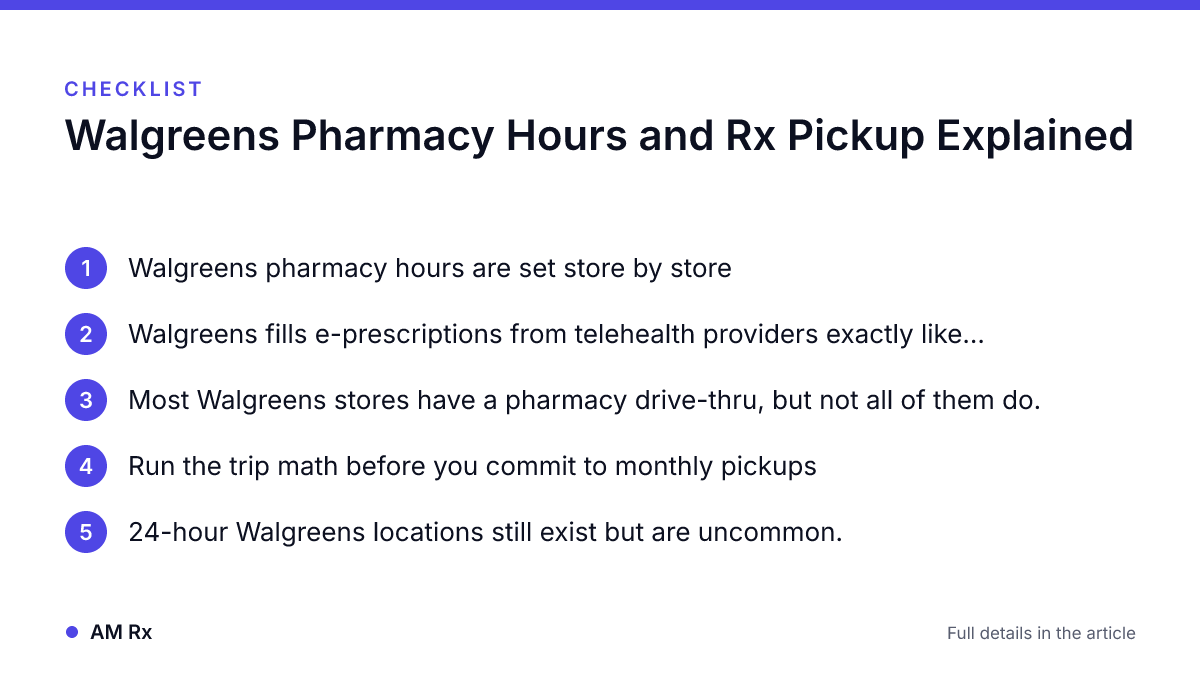
- Walgreens pharmacy hours are set store by store, not nationally. Most run somewhere in the 8 or 9 a.m. to 9 or 10 p.m. range on weekdays, with shorter Saturday hours and shorter still on Sunday.
- Walgreens fills e-prescriptions from telehealth providers exactly like ones from an in-person doctor. Same network, same workflow, no extra approval step, no reason a pharmacist should refuse it.
- Most Walgreens stores have a pharmacy drive-thru, but not all of them do. Where one exists, it usually moves faster than the inside counter during the 5 to 7 p.m. crush.
- Run the trip math before you commit to monthly pickups: 28 minutes per trip × 12 refills a year is 336 minutes, roughly 5.6 hours of driving and waiting.
- 24-hour Walgreens locations still exist but are uncommon. Confirm the specific store before you drive there at 1 a.m.
If you've ever pulled into a Walgreens lot at 9:15 p.m. and found the pharmacy gate pulled down while the rest of the store hummed along, you already know the answer. There is no single Walgreens pharmacy schedule. Weekday hours usually land between 8 or 9 a.m. and 9 or 10 p.m., weekends shrink, and the only number that matters is the one posted for your specific store.

Table of Contents
- What are Walgreens pharmacy hours, and why do they vary by location?
- Does Walgreens accept prescriptions sent electronically from online doctors?
- How do you fill a telehealth prescription at a physical Walgreens?
- Can you pick up prescriptions through the Walgreens drive-thru?
- What should you expect for wait times, and is skipping the pharmacy ever faster?
- Is Walgreens open 24 hours, and how do specialty pharmacy hours differ?
- What's the fastest way to handle prescriptions without the pharmacy run?
- Frequently asked questions
What are Walgreens pharmacy hours, and why do they vary by location?
Hours are set at the store level. A location on a busy downtown corridor may stay open until 10 p.m. while a suburban strip-mall store locks the pharmacy at 8, even though the front of the store is open later — the same kind of store-by-store inconsistency you'll find comparing Jewel-Osco pharmacy hours against online Rx care. Staffing is the biggest driver. One pharmacist short and the counter closes early, regardless of what the sign says.
That's true whether you're searching "Walgreens pharmacy hours Broadway" in Manhattan, "Walgreens Tuscaloosa" in Alabama, or hunting for the Walgreens Glen Ellyn pharmacy number before a trip.
A few things that save wasted drives:
- Use the store locator instead of a search snippet. Cached hours on Google and Maps lag behind real changes, and holiday weeks are the worst offenders.
- Call the pharmacy line directly for anything time-sensitive. It's listed separately from the main store number. That holds in smaller markets too, like the Pisgah Church Walgreens pharmacy hours plenty of Greensboro patients look up.
- Assume Sunday and major holidays are shortened even at stores that look open seven days a week on paper.
- Search "Walgreens near me" when you're traveling. Nearby stores can often see your prescription in the same system.
- Watch for the lunch close. Some single-pharmacist locations shut the counter for roughly 30 minutes midday, and that closure rarely shows up in online hours.
Pro tip: If your usual Walgreens has already closed and you need the medication tonight, call a nearby location that's still open and ask them to pull the transfer. Have your prescription number and the closed store's address ready. In most cases the receiving pharmacy handles it in a few minutes, and you're picking up the same evening instead of waiting until morning.
Does Walgreens accept prescriptions sent electronically from online doctors?
Yes. A prescription sent by a licensed telehealth provider arrives in the Walgreens queue the same way one from your family doctor or a local urgent care does. It travels over the same national e-prescribing network. The pharmacist sees a prescriber name, an NPI, and a drug, not a flag that says "internet."
The idea that online prescriptions get delayed or treated as suspect comes from people mixing up telehealth with mail-order and compounding pharmacies, which genuinely do run on different workflows. A standard e-script for birth control, a generic ED medication, or enclomiphene is just a standard e-script.
What actually decides whether the fill goes smoothly:
- Controlled substance status. Some medications carry extra identity verification requirements no matter who wrote them. That's a DEA rule, not a Walgreens policy.
- State licensing. Your provider has to be licensed in the state where you physically are during the visit, not where you usually live.
- Insurance formulary rules. Prior authorization on a brand-name drug or a GLP-1 can stall things for days, and it has nothing to do with where the prescription originated.
- Stock on hand. The most common holdup we hear about isn't the prescription at all. The store simply doesn't have the quantity, and nobody tells you until you show up.
If you got your prescription through AM Rx, it goes electronically to the Walgreens you pick, or we ship it to your door, whichever gets it in your hands sooner. We walk through the mechanics in our piece on getting birth control online without an office visit, and the same logic applies to our other treatment categories.
How do you fill a telehealth prescription at a physical Walgreens?
Exactly like any other prescription. Your provider transmits it, you pick the pickup store during your visit, and Walgreens processes it before you get there. No printed script to carry, no paperwork, no explaining that your doctor was on video.
- Choose your pharmacy during the visit. Most platforms, AM Rx included, let you search a specific Walgreens by street address in the intake flow. Pick the address, not the city, since two stores four miles apart have different hours.
- Wait for the "ready for pickup" text or app alert before you leave the house. This single habit prevents most wasted trips.
- Bring photo ID and your insurance card or your self-pay method, same as always.
- Use the drive-thru if the inside line is deep and the store has one.
- Set up auto-refill or move to delivery for anything you'll need every month, so you're not repeating this twelve times a year.
If your usual location is dark when you arrive, our guide on what to do when your Walgreens pharmacy is closed covers the transfer process step by step.
Can you pick up prescriptions through the Walgreens drive-thru?
Most Walgreens stores have a pharmacy drive-thru, and you can use it for drop-off and pickup, including e-prescriptions from a telehealth visit. Smaller urban locations and some strip-mall formats skip the lane entirely, so confirm before you build a plan around it.
Where it exists, the drive-thru tends to win during the evening rush, roughly 5 to 7 p.m., when the walk-in line backs up behind one person with an insurance problem and the car lane keeps cycling. Two things worth knowing from experience. First, the drive-thru often closes before the pharmacy counter does, sometimes an hour earlier, so a 9 p.m. close on the pharmacy may mean an 8 p.m. close on the window. Second, if your prescription needs a consultation (a first-time fill of something new usually does), the pharmacist still has to speak with you, and that conversation happens through a speaker with a car behind you. For a first fill, go inside. For a monthly refill of something you've taken for a year, take the lane.
The window also gives you a bit more privacy than an open counter, which matters to plenty of people picking up ED medication or birth control.
What should you expect for wait times, and is skipping the pharmacy ever faster?
Same-day fills are typical, but budget 15 to 30 minutes of counter time on top of your drive, longer if a new insurance claim has to be processed or the pharmacist needs to call your provider to clarify something. "Electronic" does not mean "automatic." A human pharmacist still verifies the prescription, screens for interactions, runs the claim, and bags it.
Here's the math worth running on your own numbers. Take your round-trip drive time, add your average counter wait, then multiply by the number of refills you pick up in a year.
Say your round trip is 16 minutes and your typical wait is 12 minutes. That's 28 minutes per trip. A monthly maintenance medication means 12 trips: 28 × 12 = 336 minutes, about 5.6 hours a year. That figure excludes the trip where the store is out of stock and you come back tomorrow, which in our experience happens at least once a year to most people on a recurring medication.
Now compare it to a 90-day supply shipped to you. Four deliveries, no drive, no line. The useful threshold: if your per-trip total clears 25 minutes and you refill monthly, you're spending more than a full workday a year on pickups, and it's time to ask about 90-day fills or delivery.
| Factor | Walgreens | CVS Pharmacy | Safeway Pharmacy | Online delivery (AM Rx) |
|---|---|---|---|---|
| Typical weekday hours | About 8 or 9 a.m. to 9 or 10 p.m. | About 8 a.m. to 9 or 10 p.m. | About 9 a.m. to 8 or 9 p.m. | Order any hour; provider messaging same day |
| Weekend hours | Usually shortened, Sunday shortest | Usually shortened, Sunday shortest | Usually shortened, Sunday shortest | Unchanged |
| Drive-thru | Most stores, not all | Most stores, not all | Fewer locations offer it | Not applicable |
| Typical in-store wait | 15 to 30 minutes | 15 to 30 minutes | 15 to 25 minutes | None; ships to your address |
| 24-hour locations | Uncommon, store-specific | Uncommon, store-specific | Very uncommon | Not applicable |
| Specialty medications | Routed to separate specialty locations | Routed to a separate specialty network | Limited handling | Coordinated by your care team |
For the same analysis run against a different chain, see our CVS pharmacy waits vs. getting your Rx online comparison.
Pro tip: On a GLP-1 program or anything with a titration schedule, ask your provider whether a 90-day fill is possible before you start. Missing a dose window can mean stepping back down a dose, and every extra pharmacy trip is another chance for a stock delay to cost you a week.
Is Walgreens open 24 hours, and how do specialty pharmacy hours differ?
A handful of Walgreens locations still run 24 hours, but they're the exception. Staffing models changed, and a lot of the all-night counters that people remember now close by 10 p.m. If you work nights or need a 2 a.m. refill, verify the specific address rather than trusting a memory of "the Walgreens on the corner is always open." Worth noting that in some 24-hour stores, the building stays open while the pharmacy itself does not, which is the exact trap that sends people on a pointless midnight drive.
Walgreens specialty pharmacy is a separate operation for complex, high-cost, or refrigerated medications: certain injectables, specialty dermatology treatments, some fertility and hormone therapies. Those locations typically keep business hours on weekdays only, because the medications require benefits investigation, prior authorization follow-up, and cold-chain shipping that nobody is doing at 9 p.m. on a Sunday. Specialty fills also tend to run on a schedule rather than on demand. You get a call to arrange a delivery date instead of dropping by.
Ask your provider up front whether your prescription routes through retail or specialty. The hours and the timelines are genuinely different, and finding out on day one saves a week.
What's the fastest way to handle prescriptions without the pharmacy run?
For routine, ongoing prescriptions, the fastest path is to stop driving anywhere. Have your provider ship directly to you, or route the script to whichever pharmacy is convenient this week rather than the store you selected years ago and never changed.
AM Rx patients take that route for GLP-1 weight loss programs, birth control refills, ED treatment, hair loss prescriptions, and enclomiphene for testosterone support. Same intake, a licensed provider reviewing your case, and a care team you can message between visits. If AM Rx isn't the right fit for a particular need, other telehealth brands like yourxhealth.com run comparable e-prescribing workflows that Walgreens, CVS, and Safeway all accept without friction. The goal is the same either way: stop letting the pharmacy counter set your schedule.
You can start an intake on the AM Rx homepage in about five minutes, look at specific programs like ED treatment or hair loss care, or read our FAQs for insurance and pricing questions first.
Frequently asked questions
Why are Walgreens pharmacy hours shorter than they used to be?
Pharmacist and technician staffing is the usual reason. When a location can't reliably cover a late shift, overnight and Sunday hours are the first to go, and in our experience those hours rarely come back once they're cut. If a store you relied on for 11 p.m. pickups now closes at 9, treat that as the new normal rather than a temporary change.
Can I call a specific Walgreens to check if my prescription is ready before I drive over?
Yes, and you should. Every Walgreens pharmacy has a direct line separate from the store's general number. Calling ahead, or checking the app, confirms two separate things: that the medication is in stock and that it's actually been filled. Those are not the same status, and assuming they are is how people end up waiting 20 minutes in a chair.
Does my insurance still apply if I fill a telehealth prescription at Walgreens instead of ordering by mail?
Yes. The pharmacy bills your plan based on the drug, the quantity, and your coverage, not on whether the visit happened in an exam room or on a screen. If you're unsure whether a specific program like GLP-1 treatment is covered, our breakdown of which clinics prescribe Zepbound and bill insurance is the next thing to read.
Before your next refill, time one trip door to door and multiply it by twelve. If that number bothers you, ask your provider about a 90-day supply or delivery on your next visit.