TL;DR
- The Mayo Clinic calorie calculator runs your age, sex, height, weight, and activity level through a standard metabolic formula. It gives you a starting estimate, not a personalized prescription.
- It can't see muscle mass, thyroid function, medications, or how your body adapts after weeks of eating less, which is why two people with identical stats often need very different numbers.
- The standard sustainable target is about 500 calories below your estimated maintenance, which lines up with roughly a pound of fat loss per week using the 3,500-calories-per-pound rule of thumb.
- Eating 600 calories a day isn't a shortcut. It's a medically supervised intervention, and a free web tool has no business signing off on it.
- If you've eaten at your calculated number honestly for a month and the scale hasn't moved, cutting another 200 calories is the wrong next move. Lab work is the right one.
Punch your stats into the Mayo Clinic calorie calculator and you'll get a clean, confident number. Maybe 1,850 calories a day to maintain, 1,350 to lose. It looks precise down to the digit. It isn't. That number is an average pulled from large groups of people, and if your metabolism doesn't sit on the average, following it to the letter can leave you stalled, hungry, or quietly under-eating for months.

Table of Contents
- How does the Mayo Clinic calorie calculator actually work?
- What formula is behind the number it gives you?
- How accurate is it, and where does it fall short?
- What if 600 calories a day sounds like the faster answer?
- When does it make sense to get real support instead of guessing?
- Frequently asked questions
How does the Mayo Clinic calorie calculator actually work?
It asks for your age, sex, height, current weight, and activity level. Then it estimates your basal metabolic rate, the calories you'd burn lying still all day keeping your heart beating and your lungs moving. It multiplies that BMR by an activity factor to get your total daily energy expenditure, which is the number you'd eat to stay exactly where you are. Mayo Clinic's tool, available free on their site, uses the same core logic you'll find behind most reputable calculators.
The activity dropdown is where most people quietly sabotage themselves. "Moderately active" sounds like a reasonable self-description if you walk the dog and hit the gym twice a week, but the multipliers were built around sustained daily movement, not three good sessions and four desk days. We see this constantly with patients: they select moderate, get a maintenance number 250 calories too high, eat at a deficit that isn't actually a deficit, and conclude their metabolism is broken. Pick the activity level one notch lower than your ego wants. You can always add food back.
There's no Mayo Clinic calorie calculator app and no official PDF. It's a browser form you fill out fresh each time, so screenshot the result or write it down if you want something to compare against in six weeks.
What formula is behind the number it gives you?
Calculators in this category, Mayo Clinic's included, lean on variations of the Mifflin-St Jeor equation. In plain terms, it weights body size and age heavily, because those drive most of your resting burn.
Here's the arithmetic worked out for a 40-year-old woman, 5'6", 165 pounds (about 75 kg), sedentary:
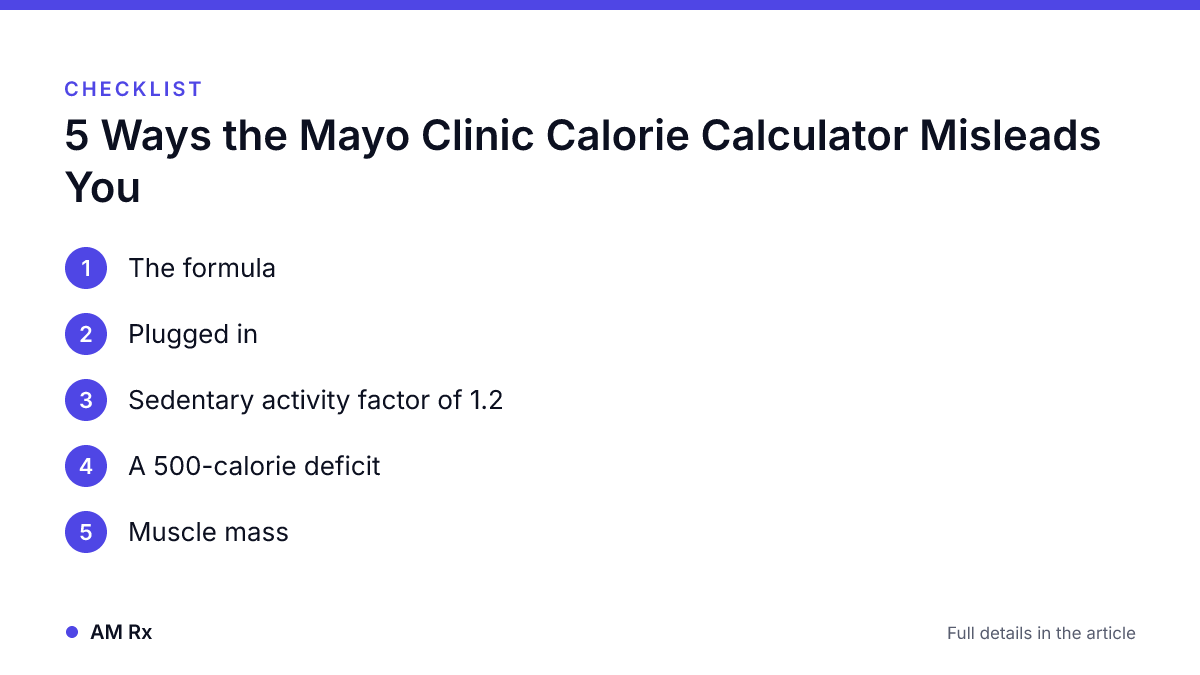
- The formula: 10 × weight (kg) + 6.25 × height (cm) − 5 × age − 161
- Plugged in: (10 × 75) + (6.25 × 167) − (5 × 40) − 161 = 750 + 1,043.75 − 200 − 161 = 1,432.75 calories
- Sedentary activity factor of 1.2: 1,432.75 × 1.2 ≈ 1,719 calories/day to maintain
- A 500-calorie deficit: 1,719 − 500 = 1,219 calories/day, which works out to about a pound of fat per week (500 × 7 = 3,500, the rough calorie equivalent of a pound)
Run your own numbers through those four lines and you'll know precisely where your target came from instead of trusting a black box. Men use the same equation with +5 at the end instead of −161, which is why a man and a woman of identical size get numbers about 166 calories apart.
Pro tip: If you're trying to gain, the math runs in reverse. Add 300 to 500 calories to maintenance rather than subtracting. Go bigger than that and you're mostly buying fat.
How accurate is it, and where does it fall short?
Solid at the population level, shaky at yours. The formula came from averaging across large groups, which makes it a good first guess and a bad final answer. What it can't see:
- Muscle mass: Two people at the same height, weight, and age can burn noticeably differently if one of them lifts. The calculator has no input for body composition.
- Medications and hormones: Thyroid conditions, PCOS, low testosterone, beta blockers, and some antidepressants all move your real number. None of them appear on the form.
- Metabolic adaptation: The longer you diet, the more your body trims around the edges to defend its weight. A one-time estimate can't track that drift.
- Activity honesty: The single biggest source of error, and the one you control. See the dropdown problem above.
- Life stage: Perimenopause, aging, and chronically bad sleep all shift your needs in ways a five-question quiz never catches.
| Method | What it considers | Best for | Main limitation |
|---|---|---|---|
| Mayo Clinic calorie calculator | Age, sex, height, weight, activity level | A fast first estimate before you change anything | Blind to muscle mass, hormones, medications |
| Generic calorie deficit calculator | Same inputs, looser math | Casual planning and rough targets | Even less personalization, wider error |
| Food tracking app | Logged meals against an estimated burn | Day-to-day accountability and portion reality checks | Only as good as your logging honesty |
| Medically supervised program | Labs, medical history, medication response, ongoing adjustment | Anyone plateaued or managing a health condition | Requires a provider relationship and intake visit |
What if 600 calories a day sounds like the faster answer?
It isn't, and no calculator should hand you that number casually. If you've searched something like "if I eat 600 calories a day how much weight will I lose calculator," here's the honest version: the scale drops fast for about ten days, most of it water and lean tissue, and then it stops. Intakes that low belong under medical supervision because of the real risks of nutrient deficiencies, gallstones, and muscle loss. Mayo Clinic covers the sane starting point in their own guidance on getting ready to lose weight.
The practical tell that your deficit is too aggressive: you're cold all the time, your workouts feel heavy, and you're thinking about food during meetings. Add 150 calories back and give it ten days before judging.
When does it make sense to get real support instead of guessing?
When you've eaten at your calculated number for four to six weeks, logged honestly including the weekends, and the scale hasn't moved. That's not a willpower problem. That's missing data.
What a real workup adds that the calculator can't: a thyroid panel, fasting insulin and A1C, a look at every medication you're on (a few common ones make weight loss genuinely harder), and an actual conversation about what your appetite is doing between meals. For a lot of people the blocker isn't arithmetic at all, it's that hunger signaling overrides the plan by 4 p.m. every single day. That's where GLP-1 therapy changes the equation, because it works on appetite and satiety rather than asking you to out-discipline your biology.
AM Rx's weight loss program pairs GLP-1 medication with coaching and provider check-ins, so your target gets revised as your body adapts instead of staying frozen at a number you calculated once in March.
Comparing telehealth options before you commit? Our breakdown of the best telehealth providers in the US is a reasonable starting point, and FitRx is worth a look if you want something coaching-heavy with automatic refills built in.
Frequently asked questions
Is the Mayo Clinic calorie calculator free to use?
Yes. It's free on Mayo Clinic's website with no account and no app download. Answer the questions, get an instant estimate.
Why did two different calorie calculators give me different numbers?
Different formulas and different activity multipliers. A swing of a hundred calories or so between tools is completely normal and doesn't make either one wrong. Treat the spread as your realistic starting zone and stop hunting for the one true figure.
Do I need a prescription to start a weight loss program after using a calculator?
Not for diet and exercise changes. If you're considering GLP-1 medication, a licensed provider has to review your health history and decide whether it's appropriate, which you can handle in a same-day virtual visit rather than waiting weeks for an in-person slot.
Take your calculated number, eat at it for four weeks, weigh yourself at the same time of day three mornings a week, and average those weekly. If the four-week trend is flat, book the lab work. And if you do end up with a prescription, you don't have to stand in line for it: here's how CVS pharmacy wait times compare against getting your prescription delivered online.